Space

Astronomers Detect a Radio 'Heartbeat' Billions of Light-Years from Earth (mit.edu) 39

Astronomers at MIT and universities across Canada and the United States have detected a strange and persistent radio signal from a far-off galaxy that appears to be flashing with surprising regularity. From a report:The signal is classified as a fast radio burst, or FRB -- an intensely strong burst of radio waves of unknown astrophysical origin, that typically lasts for a few milliseconds at most. However, this new signal persists for up to three seconds, about 1,000 times longer than the average FRB. Within this window, the team detected bursts of radio waves that repeat every 0.2 seconds in a clear periodic pattern, similar to a beating heart. The researchers have labeled the signal FRB 20191221A, and it is currently the longest-lasting FRB, with the clearest periodic pattern, detected to date.

The source of the signal lies in a distant galaxy, several billion light-years from Earth. Exactly what that source might be remains a mystery, though astronomers suspect the signal could emanate from either a radio pulsar or a magnetar, both of which are types of neutron stars -- extremely dense, rapidly spinning collapsed cores of giant stars. There are not many things in the universe that emit strictly periodic signals," says Daniele Michilli, a postdoc in MIT's Kavli Institute for Astrophysics and Space Research. âoeExamples that we know of in our own galaxy are radio pulsars and magnetars, which

United States

Efforts to Acquire Pegasus Spyware's Company Backed by US Spies, Says Stingray Maker (msn.com) 23

The New York Times describes Pegasus as "a 'zero-click' hacking tool that can remotely extract everything from a target's mobile phone [and] turn the mobile phone into a tracking and recording device." But they also report that the tool's "notorious" maker, NSO Group, was visited "numerous times" in recent months by a executives from American military contractor L3Harris — makes of the cellphone-tracking Stingray tool — who'd wanted to negotiate a purchase of the company.

Their first problem? The U.S. government had blacklisted NSO Group in November, saying Pegasus had been used to compromise phones of political leaders, human rights activists and journalists. But five people familiar with the negotiations said that the L3Harris team had brought with them a surprising message that made a deal seem possible. American intelligence officials, they said, quietly supported its plans to purchase NSO, whose technology over the years has been of intense interest to many intelligence and law enforcement agencies around the world, including the F.B.I. and the C.I.A.

The talks continued in secret until last month, when word of NSO's possible sale leaked and sent all the parties scrambling. White House officials said they were outraged to learn about the negotiations, and that any attempt by American defense firms to purchase a blacklisted company would be met by serious resistance.... Left in place are questions in Washington, other allied capitals and Jerusalem about whether parts of the U.S. government — with or without the knowledge of the White House — had seized an opportunity to try to bring control of NSO's powerful spyware under U.S. authority, despite the administration's very public stance against the Israeli firm....

[NSO Group] had seen a deal with the American defense contractor as a potential lifeline after being blacklisted by the Commerce Department, which has crippled its business. American firms are not allowed to do business with companies on the blacklist, under penalty of sanctions. As a result, NSO cannot buy any American technology to sustain its operations — whether it be Dell servers or Amazon cloud storage — and the Israeli firm has been hoping that being sold to a company in the United States could lead to the sanctions being lifted....

L3 Harris's representatives told the Israelis that U.S. intelligence agencies supported the acquisition as long as certain conditions were met, according to five people familiar with the discussions. One of the conditions, those people said, was that NSO's arsenal of "zero days" — the vulnerabilities in computer source code that allow Pegasus to hack into mobile phones — could be sold to all of the United States' partners in the so-called Five Eyes intelligence sharing relationship. The other partners are Britain, Canada, Australia and New Zealand.

"Several people familiar with the talks said there have been attempts to resuscitate the negotiations..."
Security

Most Government Websites Serve Tracking Cookies Without Consent, Report Finds (hothardware.com) 27

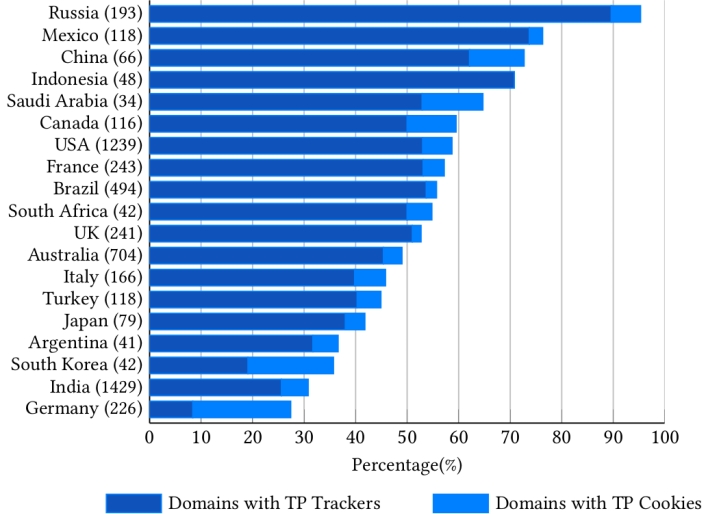
A new study published by the IMDEA Networks Institute shows just how common it is for government websites to install third-party cookies in visitors' web browsers. HotHardware reports: The study makes a distinction between third-party (TP) cookies and third-party tracking (TPT) cookies, because not all third-party cookies are "set by domains that are known to be tracking users for data collection purposes." The chart [here] shows the percentage of government websites for each country that install at least one third-party cookie, as well as the percentage of said cookies that are associated with domains that are known to be tracking users. Russia tops out the list with over 90% of its government websites installing third-party cookies in visitors' web browsers. Meanwhile, nearly 60% of US government websites install at least one third-party cookie. Germany sits at the bottom of the list with a little under 30% of government websites serving up third-party cookies.

Most of the third-party cookies installed by government websites are known tracking cookies, except in the case of Germany, where under 10% of third-party cookies are associated with domains that are known to track users. The researchers also found that, depending on the country, 20% to 60% of the third party cookies installed by government websites remain in visitors' browsers without expiring for a year or more. That's a long time for a tracker installed without your knowledge or consent to remain active. Beyond specifically tracking cookies, the researchers measured the number of trackers of any kind present on government websites. The Russian gov.ru has the most trackers out of any government website analyzed by the researchers, numbering 31 trackers in total. However, Brazil and Canada aren't far behind, with 25 trackers present on both investexportbrasil.gov.br and nac-cna.ca. The US government website with the most trackers is hhs.gov, which has 13.

The researchers point out that both third-party tracking cookies are automatically installed in visitors' web browsers without their consent. However, the researchers guess that web developers and administrators likely include third-party content without intending to add trackers to their websites. A great many websites now rely on third-party resources and include social content that come with trackers built-in.

Canada

A Major Rogers Outage Has Cut Off 25 Percent of Canada's Internet Traffic (theverge.com) 89

Canadian telecom Rogers is suffering a major outage affecting landline phones, cellular connections, and internet connectivity throughout Canada that started early this morning. DownDetector listed thousands of reports for the issue as people started to get up around 5AM ET and couldn't get online. From a report: Rogers first addressed the outage in a tweet from its official support account just before 9AM ET, and then went silent for a couple of hours. In a statement given to The Verge and tweeted at around 11:30AM ET, Rogers said, "We are currently experiencing an outage across our wireline and wireless networks and our technical teams are working hard to restore services as quickly as possible. On behalf of all of us at Rogers, we sincerely apologize to our customers, and we will continue to keep you updated as we have more information to share, including when we expect service to be back up. Thank you for your patience as we work to resolve this issue."
United States

Countries Form New NATO-Like 'Mineral Security' Alliance to Ensure EV Supplies (yahoo.com) 53

"A metallic NATO is starting to take shape," writes the senior metals columnist at Reuters, "though no-one is calling it that just yet." The Minerals Security Partnership is in theory open to all countries that are committed to "responsible critical mineral supply chains to support economic prosperity and climate objectives". But the coalition assembled by the United States is one of like-minded countries such as Australia, Canada, the United Kingdom, France and Germany with an Asian axis in the form of Japan and South Korea. [Also the European Commission, as well as Finland and Sweden.]

It is defined as much as anything by who is not on the invite list — China and Russia.

China's dominance of key enabling minerals such as lithium and rare earths is the single biggest reason why Western countries are looking to build their own supply chains. Russia, a major producer of nickel, aluminium and platinum group metals, is now also a highly problematic trading partner as its war in Ukraine that the Kremlin calls a "special military operation" grinds on. A previously highly globalised minerals supply network looks set to split into politically polarised spheres of influence, a tectonic realignment with far-reaching implications. The United States and Europe have realised that they can't build out purely domestic supply chains quickly enough to meet demand from the electric vehicle transition....

The process was already well underway before the U.S. State Department announced the formation of the Minerals Security Partnership on June 14. U.S. and Canadian officials have been working closely as Canada fleshes out a promised C$3.8 billion ($3.02 billion) package to boost production of lithium, copper and other strategic minerals. European Commission Vice-President Maros Sefcovic has just been in Norway to seal "a strategic partnership" on battery technologies and critical raw materials.

The article points out America's Department of Defense is already investing $120 million in a new plant for heavy rare earths separation — and has chosen an Australian company as its partner.

Shortly thereafter the Defense Department noted an online disinformation campaign against its new partner (according to U.S.-based cybersecurity firm Mandiant), disinformation which Reuters describes as "a pro-China propaganda campaign" using fake social media accounts to try to stir up opposition.
United Kingdom

UK Seeks Science Collaboration Further Afield After EU Freeze (bloomberg.com) 81

The UK is rattling off a series of international science agreements with a message to the European Union: if you don't want our money, we'll do deals elsewhere. From a report: Prime Minister Boris Johnson signed a memorandum of understanding with his New Zealand counterpart, Jacinda Ardern, on Friday, aimed at easing UK access to the Pacific nation's quantum and agricultural technology. The UK has already negotiated similar agreements with Israel, Switzerland and Canada -- as well as EU member Sweden, and is hoping to seal more with Japan, Singapore, South Korea and certain US states. The drive comes as the government seeks to diversify the country's scientific collaboration after the UK was frozen out of the EU's $96 billion Horizon research program because of tensions stemming from Britain's plan to override the part of the Brexit deal governing Northern Ireland. The majority of the UK's international science budget -- around $18 billion -- is usually spent helping to fund Horizon.
Earth

New Study Solves Long-Standing Mystery of What May Have Triggered Ice Age 101

nickwinlund77 shares a report from Phys.Org: A new study led by University of Arizona researchers may have solved two mysteries that have long puzzled paleo-climate experts: Where did the ice sheets that rang in the last ice age more than 100,000 years ago come from, and how could they grow so quickly? Understanding what drives Earth's glacial -- interglacial cycles -- the periodic advance and retreat of ice sheets in the Northern Hemisphere -- is no easy feat, and researchers have devoted substantial effort to explaining the expansion and shrinking of large ice masses over thousands of years. The new study, published in the journal Nature Geoscience, proposes an explanation for the rapid expansion of the ice sheets that covered much of the Northern Hemisphere during the most recent ice age, and the findings could also apply to other glacial periods throughout Earth's history.

About 100,000 years ago, when mammoths roamed the Earth, the Northern Hemisphere climate plummeted into a deep freeze that allowed massive ice sheets to form. Over a period of about 10,000 years, local mountain glaciers grew and formed large ice sheets covering much of today's Canada, Siberia and northern Europe. While it has been widely accepted that periodic "wobbling" in the Earth's orbit around the sun triggered cooling in the Northern Hemisphere summer that caused the onset of widespread glaciation, scientists have struggled to explain the extensive ice sheets covering much of Scandinavia and northern Europe, where temperatures are much more mild. [...] "Using both climate model simulations and marine sediment analysis, we show that ice forming in northern Canada can obstruct ocean gateways and divert water transport from the Arctic into the North Atlantic," [said Lofverstrom, an assistant professor of geosciences and head of the UArizona Earth System Dynamics Lab], "and that in turn leads to a weakened ocean circulation and cold conditions off the coast of Scandinavia, which is sufficient to start growing ice in that region."

"These findings are supported by marine sediment records from the North Atlantic, which show evidence of glaciers in northern Canada several thousand years before the European side," said Diane Thompson, assistant professor in the UArizona Department of Geosciences. "The sediment records also show compelling evidence of a weakened deep ocean circulation before the glaciers form in Scandinavia, similar to our modeling results." Together, the experiments suggest that the formation of marine ice in northern Canada may be a necessary precursor to glaciation in Scandinavia, the authors write. [...] "It is possible that the mechanisms we identified here apply to every glacial period, not just the most recent one," [Lofverstrom] said. "It may even help explain more short-lived cold periods such as the Younger Dryas cold reversal (12,900 to 11,700 years ago) that punctuated the general warming at the end of the last ice age."
Government

Russia's Cyberattacks Thwarted by Ukraine, Microsoft, Google, and Western Intelligence (nytimes.com) 37

Russia's invasion of Ukraine is "the first full-scale battle in which traditional and cyberweapons have been used side by side," reports the New York Times. But the biggest surprise is that "many of the attacks were thwarted, or there was enough redundancy built into the Ukrainian networks that the efforts did little damage... more than two-thirds of them failed, echoing its poor performance on the physical battlefield."

Microsoft president Brad Smith says the ultimate result is Russia's attempted cyberatacks get underreported, according to the Times: [A study published by Microsoft Wednesday] indicated that Ukraine was well prepared to fend off cyberattacks, after having endured them for many years. That was at least in part because of a well-established system of warnings from private-sector companies, including Microsoft and Google, and preparations that included moving much of Ukraine's most important systems to the cloud, onto servers outside Ukraine....

In many instances, Russia coordinated its use of cyberweapons with conventional attacks, including taking down the computer network of a nuclear power plant before moving in its troops to take it over, Mr. Smith said. Microsoft officials declined to identify which plant Mr. Smith was referring to. While much of Russia's cyberactivity has focused on Ukraine, Microsoft has detected 128 network intrusions in 42 countries. Of the 29 percent of Russian attacks that have successfully penetrated a network, Microsoft concluded, only a quarter of those resulted in data being stolen. Outside Ukraine, Russia has concentrated its attacks on the United States, Poland and two aspiring members of NATO, Sweden and Finland...

But Microsoft, other technology companies and government officials have said that Russia has paired those infiltration attempts with a broad effort to deliver propaganda around the world. Microsoft tracked the growth in consumption of Russian propaganda in the United States in the first weeks of the year. It peaked at 82 percent right before the Feb. 24 invasion of Ukraine, with 60 million to 80 million monthly page views. That figure, Microsoft said, rivaled page views on the biggest traditional media sites in the United States. One example Mr. Smith cited was that of Russian propaganda inside Russia pushing its citizens to get vaccinated, while its English-language messaging spread anti-vaccine content. Microsoft also tracked the rise in Russian propaganda in Canada in the weeks before a trucker convoy protesting vaccine mandates tried to shut down Ottawa, and that in New Zealand before protests there against public health measures meant to fight the pandemic.

Russians successfully "sabotaged a satellite communications network called Viasat in the opening days of the war," notes the Washington Post, "with the damage spilling over into other European countries. But Ukraine, working with private tech companies, Western intelligence and its own expert software engineers, has quickly fixed most of the damage..."

"The close partnerships that have emerged between U.S. technology companies and Western cybersecurity agencies is one of the unheralded stories of the war...." "Cyber responses must rely on greater public and private collaboration," argues Brad Smith, Microsoft's president, in a new study... published Wednesday on Microsoft's "lessons learned" from cyber conflict in Ukraine. A White House cyber official explains the new cooperative approach this way: "Where companies see destructive attacks, that has driven partnerships with the intelligence community and other government agencies to see how best we can share information to protect infrastructure around the world." The tech world's sympathies lie with the underdog, Ukraine. That applies to giant firms such as Microsoft and Google....

Ukraine's cybersecurity defense benefited from an early start. U.S. Cyber Command experts went to Ukraine months before the war started, according to its commander, Gen. Paul Nakasone. Microsoft and Google became involved even earlier. Microsoft began monitoring Russian phishing attacks against Ukrainian military networks in early 2021, and through the rest of last year observed increasingly aggressive hacks by six different attackers linked to Russia's three intelligence services, the GRU, SVR and FSB, according to a Microsoft report released in April. Microsoft has spent a total of $239 million on financial and technical assistance to Ukraine, a company official said....

Google, a part of Alphabet, has also helped Ukraine fend off threats. Back in 2014, prompted by Russia's use of DDOS ("distributed denial-of-service") malware in its seizure of Crimea and eastern Ukraine, Google began what it called "Project Shield." Software protected news sites, human rights groups and election sites against crippling DDOS floods of junk internet messages. Today, Project Shield is used by 200 sites in Ukraine and 2,300 others in 140 countries around the world, according to Jared Cohen, the chief executive of Google's Jigsaw unit.

Twitter

Twitter Testing Notes, a Long-Form Content Feature (searchengineland.com) 25

An anonymous reader quotes a report from Search Engine Land: Twitter is testing a new feature that would eliminate the constraints of its 280-character tweet limit and allow users to publish long-form tweets. Twitter confirmed the test via a tweet.

When this will become available to all Twitter users? It's unclear. Twitter noted: "We're excited for the moment when everyone can use Notes, but for now, our focus is on building it right. A large part of that is engaging with writers and building community." For now, Twitter plans to test it over the next two months with a small group of writers from Canada, Ghana, the UK and the U.S.

In Twitter Notes, it looks like you will be able to add:
- Formatting: Bold, italic and strikethrough text; insert ordered/unordered lists; add links.
- Media: You can add one GIF, one video, or up to four images.
- Tweets: You can either embed tweets by pasting URLs or from bookmarked tweets.

Notes also has a "Focus mode," that makes the article composer full-screen.

Canada

Canada To Compel YouTube, TikTok and Streamers To Boost Domestic Content (wsj.com) 141

Canada approved legislation that targets what video- and audio-sharing platforms like YouTube and TikTok can broadcast to a Canadian audience, as the country follows in Europe's footsteps in imposing a heftier regulatory burden on the digital sector. From a report: This marks the second attempt in as many years by Canada's Liberal government to compel digital platforms, including streaming companies like Netflix, to prominently feature Canadian artists on their services when users with a Canadian internet-protocol address log in. As contemplated under the new measures, users who search for music, television programming, films or do-it-yourself video shorts would get results incorporating a certain quota of Canadian-made content.

YouTube, a unit of Alphabet, TikTok, and the big streaming companies, among them Netflix, as well as legal experts and some Canadian artists, have either opposed Canada's move or warned of unintended consequences -- such as hurting the people the new policy is intended to help. Countries like Canada are increasingly turning to regulatory changes to protect domestic interests in light of the big inroads the world's biggest digital companies have made in transforming how households watch programs, listen to music, conduct day-to-day business and consume news.

News

Monkeypox Outbreak Poses 'Real Risk' To Public Health, WHO Official Says (nytimes.com) 202

The World Health Organization's top official in Europe on Wednesday called for urgent action by the authorities and civic groups to control fast-rising cases of monkeypox that he said posed a real risk to public health. From a report: Europe has emerged as the epicenter of an outbreak of monkeypox, with more than 1,500 cases identified in 25 European countries, which account for 85 percent of global cases, the official, Dr. Hans Kluge, the W.H.O.'s director of its European region, said at a news conference. The W.H.O. will convene its emergency committee in Geneva next week, Dr. Kluge added, to determine if the outbreak constitutes a public health emergency of international concern, a formal declaration that calls for a coordinated response between countries.

"The magnitude of this outbreak poses a real risk," Dr. Kluge said. "The longer the virus circulates, the more it will extend its reach, and the stronger the disease's foothold will get in nonendemic countries." Monkeypox is a viral infection endemic in West Africa, but it has now spread to 39 countries, including 32 that have no previous experience of it, the W.H.O. director, Dr. Tedros Adhanom Ghebreyesus, told reporters on Tuesday. Countries outside Africa and Europe that have identified cases of monkeypox include Australia, Brazil, Canada, Israel and the United States.

Businesses

Adobe Plans To Make Photoshop on the Web Free To Everyone (theverge.com) 119

Adobe has started testing a free-to-use version of Photoshop on the web and plans to open the service up to everyone as a way to introduce more users to the app. From a report: The company is now testing the free version in Canada, where users are able to access Photoshop on the web through a free Adobe account. Adobe describes the service as "freemium" and eventually plans to gate off some features that will be exclusive to paying subscribers. Enough tools will be freely available to perform what Adobe considers to be Photoshop's core functions. "We want to make [Photoshop] more accessible and easier for more people to try it out and experience the product," says Maria Yap, Adobe's VP of digital imaging.
AI

IBM's AI-Powered Robotic 'Mayflower' Ship Finally Reaches Its Destination - Sort of (apnews.com) 28

The Associated Press reports on "a crewless robotic boat that had tried to retrace the 1620 sea voyage of the Mayflower" from the U.K. to Massachusetts' Plymouth Rock. And after five weeks it finally did reach North America.

Halifax, Canada.

"The technology that makes up the autonomous system worked perfectly, flawlessly," an IBM computing executive involved in the project told the Associated Press. But "Mechanically, we did run into problems."

It's especially disappointing because they'd tried the same voyage last year. (Slashdot had noted that "Unlike the real Mayflower, this robotic 21st-century doppelganger 'had to turn back Friday to fix a mechanical problem,' reports the Associated Press...")

So what happened this year? A new article from the Associated Press reports: It set off again from England nearly a year later on April 27, bound for Virginia — but a generator problem diverted it to Portugal's Azores islands, where a team member flew in to perform emergency repairs. More troubles on the open sea came in late May when the U.S.-bound boat developed a problem with the charging circuit for the generator's starter batteries.

AI software is getting better at helping self-driving machines understand their surroundings and pilot themselves, but most robots can't heal themselves when the hardware goes awry.

Nonprofit marine research organization ProMare, which worked with IBM to build the ship, switched to a back-up navigation computer on May 30 and charted a course to Halifax — which was closer than any U.S. destination.

And unlike the real Mayflower, "the boat's webcam on Sunday morning showed it being towed by a larger boat as the Halifax skyline neared — a safety requirement under international maritime rules, IBM said."
Printer

New Type of 3D Printing Uses Sound Waves To Build Up Objects (newatlas.com) 23

A team of scientists at Canada's Concordia University are using sound waves to print intricate three-dimensional objects. The technology is known as direct sound printing (DSP). New Atlas reports: In the current version of the technique, a transducer is used to send focused pulses of ultrasound through the sides of a chamber, into liquid polydimethylsiloxane (PDMS) resin contained within. Doing so produces ultrasonic fields, which cause rapidly oscillating microscopic bubbles to temporarily form at specific points in the resin. As those bubbles oscillate, the temperature inside them rises to about 15,000 degrees Kelvin (14,727C or 26,540F) and the pressure within them climbs to over 1,000 bar (14,504 psi). Although this sudden increase in temperature and pressure only lasts for picoseconds (trillionths of a second), it causes the resin to solidify at the exact location of the bubble. Therefore, by incrementally moving the transducer along a predetermined path, it's possible to build up an intricate three-dimensional object -- one tiny pixel at a time. Along with its ability to produce very small, detailed items, DSP also allows structures to be non-invasively printed inside other structures that have opaque surfaces. [...] Besides the PDMS resin, the scientists have also successfully used DSP to print objects made of ceramic material. They now plan on experimenting with polymer-metal composites, followed by pure metal. The research has been published in the journal Nature Communications.
Canada

Tim Hortons App Violated Laws In Collection of 'Vast Amounts' of Location Data (www.cbc.ca) 117

An anonymous reader quotes a report from CBC News: The federal privacy commissioner's investigation into the Tim Hortons mobile app found that the app unnecessarily collected extensive amounts of data without obtaining adequate consent from users. The commissioner's report, which was published Wednesday morning, states that Tim Hortons collected granular location data for the purpose of targeted advertising and the promotion of its products but that the company never used the data for those purposes. "The consequences associated with the App's collection of that data, the vast majority of which was collected when the App was not in use, represented a loss of Users' privacy that was not proportional to the potential benefits Tim Hortons may have hoped to gain from improved targeted promotion of its coffee and associated products," the report read.

The joint investigation was launched about two years ago by the Office of the Privacy Commissioner of Canada in conjunction with similar authorities in British Columbia, Quebec and Alberta. It came after reporting from the Financial Post found that the Tim Hortons app tracked users' geolocation while users were not using the app. According to a presentation to investors shared in May, the restaurant chain's app has four million active users.

Tim Hortons was using a third-party service provider, Radar, to collect geolocation data of users. In August 2020, Tim Hortons stopped collecting location data. However, the investigation found that there was a lack of contractual protections for users' personal information while being processed by Radar. The report describes the language in the contractual clauses to be "vague and permissive," which could have allowed Radar to use the personal information collected in aggregated or de-identified form for its own business. [...] The report states that Tim Hortons also agreed to delete all granular location data and to have third-party service providers do so as well, as per recommendations from the privacy authorities. The company also agreed to establish a privacy management program for its app and all future apps to ensure they are compliant with federal and provincial privacy legislation. Given these remedies, the report found that while the Tim Hortons app was not compliant with privacy laws, the company has since taken measures to resolve the issues.
"We've strengthened our internal team that's dedicated to enhancing best practices when it comes to privacy and we're continuing to focus on ensuring that guests can make informed decisions about their data when using our app," a statement from Tim Hortons released on Wednesday said.
Canada

Internet Drama in Canada (nytimes.com) 88

We all need great internet service, but it doesn't happen by accident. From a report: Let's talk about internet policy! In Canada! Wheee! I'm serious that there are useful lessons from a saga over home internet service in Canada. What has been a promising, albeit imperfect, system that increased choices and improved internet service for Canadians is poised to fall apart. Barring a last-minute government intervention today or Friday, many smaller internet providers in Canada are likely to significantly increase their prices and lose customers or shut down. The dream of more competition leading to better internet service for Canadians is on life support. What's happening in Canada reveals why we need smart internet policy to be paired with strong government oversight to have better and more affordable internet for all -- and it shows what happens when we lose that.

The U.S. has botched it for years, and that's one reason America's internet service stinks. Canada may be a real-world experiment in what happens when muddled government regulation undermines internet policy that has mostly been effective. Bear with me for a lesson in Canada's home internet service. The bottom line is that Canadians have something that is relatively novel to Americans: Many people have options to pick a home internet provider that they don't hate. That's because in Canada -- similar to many countries including Britain, Australia and Japan -- the companies that own internet pipelines are required to rent access to businesses that then sell internet service to homes. Regulators keep a close watch to make sure those rental costs and terms are fair.

Power

Researchers Unveil Paper On New Battery That Could Last 100 Years (electrek.co) 50

An anonymous reader quotes a report from Electrek: Tesla's advanced battery research group in Canada in partnership with Dalhousie University has released a new paper on a new nickel-based battery that could last 100 years while still favorably comparing to LFP cells on charging and energy density. [...] The paper describes a nickel-based battery chemistry meant to compete with LFP battery cells on longevity while retaining the properties that people like in nickel-based batteries, like higher energy density, which enables longer range with fewer batteries for electric vehicles.

The group wrote in the paper's abstract: "Single crystal Li[Ni0.5Mn0.3Co0.2]O2//graphite (NMC532) pouch cells with only sufficient graphite for operation to 3.80 V (rather than [greater than or equal to] 4.2 V) were cycled with charging to either 3.65 V or 3.80 V to facilitate comparison with LiFePO4//graphite (LFP) pouch cells on the grounds of similar maximum charging potential and similar negative electrode utilization. The NMC532 cells, when constructed with only sufficient graphite to be charged to 3.80 V, have an energy density that exceeds that of the LFP cells and a cycle-life that greatly exceeds that of the LFP cells at 40C, 55C and 70C. Excellent lifetime at high temperature is demonstrated with electrolytes that contain lithium bis(fluorosulfonyl)imide (LiFSI) salt, well beyond those provided by conventional LiPF6 electrolytes." The cells showed an impressive capacity retention over a high number of cycles.

The research group even noted that the new cell described in the paper could last a 100 years if the temperature is controlled at 25C: "Ultra-high precision coulometry and electrochemical impedance spectroscopy are used to complement cycling results and investigate the reasons for the improved performance of the NMC cells. NMC cells, particularly those balanced and charged to 3.8 V, show better coulombic efficiency, less capacity fade and higher energy density compared to LFP cells and are projected to yield lifetimes approaching a century at 25C." One of the keys appears to be using an electrolyte with LiFSI lithium salts, and the paper notes that the benefits could also apply to other nickel-based chemistries, including those with no or low cobalt.
The paper has been published in the Journal of the Electrochemical Society.
Canada

Canada Bans Huawei Equipment From 5G Networks, Orders Removal By 2024 (theverge.com) 31

Canada has banned the use of Huawei and fellow Chinese tech giant ZTE's equipment in its 5G networks, its government has announced. From a report: In a statement, it cited national security concerns for the move, saying that the suppliers could be forced to comply with "extrajudicial directions from foreign governments" in ways that could "conflict with Canadian laws or would be detrimental to Canadian interests." Telcos will be prevented from procuring new 4G or 5G equipment from the companies by September this year, and must remove all ZTE- and Huawei-branded 5G equipment from their networks by June 28th, 2024. Equipment must also be removed from 4G networks by the end of 2027. "The Government is committed to maximizing the social and economic benefits of 5G and access to telecommunications services writ large, but not at the expense of security," the Canadian government wrote in its statement.
Canada

Canada Set To Ban Chinese Tech Giant Huawei From 5G Network 70

Canada is planning to ban Huawei from working on Canada's fifth-generation networks. CBC.ca reports: The move puts Canada in line with key intelligence allies like the United States which have expressed concerns about the national security implications of giving the Chinese tech giant access to key infrastructure. [...] Critics have warned that Huawei's participation in Canada's 5G networks could give the company an inside look at how, when and where Canadians use internet-connected devices -- and that the Chinese government could force the company to hand over that personal information. China's National Intelligence Law says Chinese organizations and citizens must support, assist and co-operate with state intelligence work. [...] Huawei insists it is a fiercely independent company that does not engage in espionage for anyone, including Beijing.

Huawei already supplies some Canadian telecommunications firms with 4G equipment. As Global News has reported, telecommunication companies spent hundreds of millions of dollars on Huawei equipment while the federal government's review of 5G was ongoing -- although that number has waned over the years. It's not clear whether Ottawa's decision to bar Huawei from 5G will require those companies to rip out existing Huawei equipment, or whether compensation would be provided.
United States

Vast Swath of US At Risk of Summer Blackouts, Regulator Warns (newsnationnow.com) 195

An anonymous reader quotes a report from NewsNation: Blackouts could plague a number of states in the U.S. this summer, regulators warn, as a combination of drought, heat, potential cyber attacks, geopolitical conflicts and supply chain problems could disrupt the power supply, according to a grim new report (PDF) from the North American Electric Reliability Corporation (NERC). The regulatory body found that large swathes of the U.S. and parts of Canada are at an elevated or high risk of energy shortfalls during the summer's hottest months.

The Midwest is at especially high risk due to the retirement of older plants, which has caused a 2.3% decrease in capacity from last summer, as well as increased demand, according to NERC. In the Southwest, plummeting river levels may cripple hydropower production, the group warned, and in Texas drought-related heat events could cause extreme energy demand. A NERC map shows all states in the western half of the continental U.S., including North Dakota, South Dakota, Nebraska, Kansas, Oklahoma and Texas are at least under elevated risk of energy shortfalls, with parts of the northeastern-most states under high risk. Many states under the Midcontinent Independent System Operator (MISO), such as Arkansas, Louisiana, Michigan, Wisconsin, Iowa, Minnesota, Iowa, Illinois and Indiana are either entirely or partly at high risk.
"Industry prepares its equipment and operators for challenging summer conditions. Persistent, extreme drought and its accompanying weather patterns, however, are out-of-the-ordinary and tend to create extra stresses on electricity supply and demand," said Mark Olson, NERC's manager of Reliability Assessments. "Grid operators in affected areas will need all available tools to keep the system in balance this summer."

Slashdot Top Deals