Piracy

Major Private Torrent Sites Have a Security Disaster to Fix Right Now 30

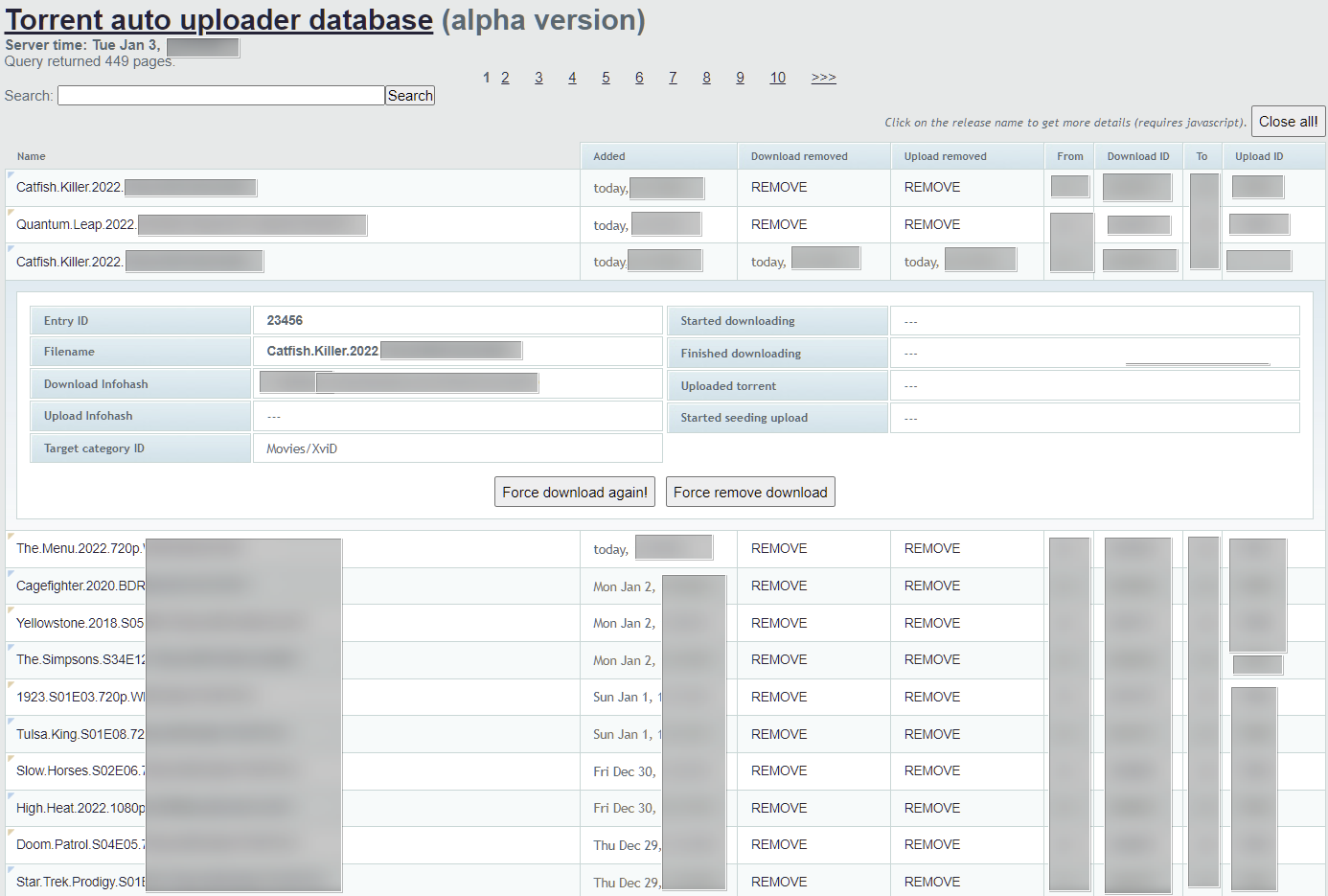
At least three major torrent sites are currently exposing intimate details of their operations to anyone with a web browser. TorrentFreak understands that the sites use a piece of software that grabs brand-new content from other sites before automatically uploading it to their own. A security researcher tried to raise the alarm but nobody will listen. From the report: To get their hands on the latest releases as quickly as possible, [private torrent sites, or private trackers as they're commonly known] often rely on outside sources that have access to so-called 0-Day content, i.e, content released today. The three affected sites seem to have little difficulty obtaining some of their content within minutes. At least in part, that's achieved via automation. When outside suppliers of content are other torrent sites, a piece of software called Torrent Auto Uploader steps in. It can automatically download torrents, descriptions, and associated NFO files from one site and upload them to another, complete with a new .torrent file containing the tracker's announce URL. The management page [here] has been heavily redacted because the content has the potential to identify at least one of the sites. It's a web interface, one that has no password protection and is readily accessible by anyone with a web browser. The same problem affects at least three different servers operated by the three sites in question.

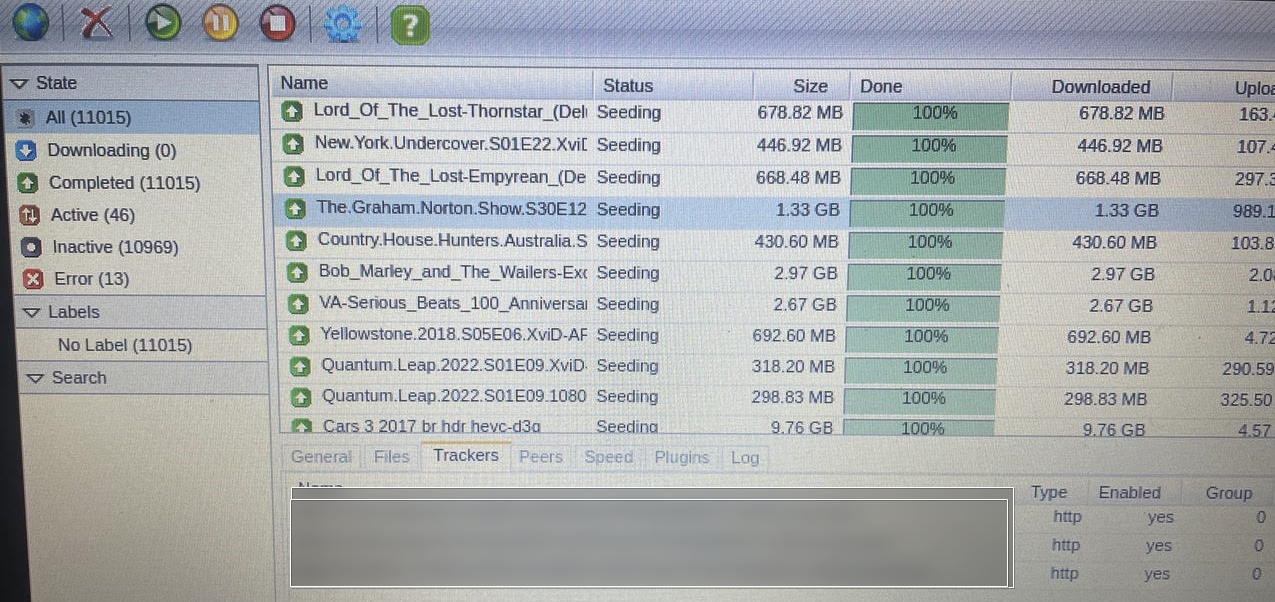
Torrent Auto Uploader relies on torrent clients to transfer content. The three sites in question all use rTorrent clients with a ruTorrent Web UI. We know this because the researcher sent over a whole bunch of screenshots and supporting information which confirms access to the torrent clients as well as the Torrent Auto Uploader software. The image [here] shows redactions on the tracker tab for good reason. In a regular setup, torrent users can see the names of the trackers coordinating their downloads. This setup is no different except that these URLs reference three different trackers supplying the content to one of the three compromised sites.

Rather than publish a sequence of completely redacted screenshots, we'll try to explain what they contain. One begins with a GET request to another tracker, which responds with a torrent file. It's then uploaded to the requesting site which updates its SQL database accordingly. From there the script starts checking for any new entries on a specific RSS feed which is hidden away on another site that has nothing to do with torrents. The feed is protected with a passkey but that's only useful when nobody knows what it is. The same security hole also grants direct access to one of the sites tracker 'bots' through the panel that controls it. Then there's access to 'Staff Tools' on the same page which connect to other pages allowing username changes, uploader application reviews, and a list of misbehaving users that need to be monitored. That's on top of user profiles, the number of torrents they have active, and everything else one could imagine. Another screenshot featuring a torrent related to a 2022 movie reveals the URL of yet another third-party supplier tracker. Some basic queries on that URL lead to even more torrent sites. And from there, more, and more, and more -- revealing torrent passkeys for every single one on the way.
Software

Southwest Meltdown Shows Airlines Need Tighter Software Integration (wsj.com) 59

The Southwest Airlines meltdown that stranded thousands of passengers during one of the busiest travel weeks of the year exposed a major industry shortcoming: crew-scheduling technology that was largely built for a bygone era and is due for a major overhaul. From a report: Southwest relies on crew-assignment software called SkySolver, an off-the-shelf application that it has customized and updated, but is nearing the end of its life, according to the airline. The program was developed decades ago and is now owned by General Electric. During the winter storm, amid a huge volume of changes to crew schedules to work through, SkySolver couldn't handle the task of matching crew members and which flights they should work, executives of the Dallas-based carrier said.

Southwest's software wasn't designed to solve problems of that scale, Chief Operating Officer Andrew Watterson said Thursday, forcing the airline to revert to manual scheduling. Unlike some large rivals with hub-and-spoke networks, Southwest planes hopscotch from city to city, which may have been another complicating factor. Many carriers still rely on homegrown solutions, which largely were built on legacy mainframe computers, analysts say. Analysts and industry insiders say the airline industry is overdue for a massive technology overhaul that would take advantage of highly scalable cloud technologies and fully connect disparate sources of real-time data to better coordinate crews with aircraft. The airline sector has been among the slowest to adopt cloud-based and analytics technologies that could help solve complicated transportation network problems, those analysts say.

Windows

'Debloating Windows 10 With One Command and No Scripts' (gabrielsieben.tech) 101

An anonymous reader writes: Recently, I had to set up a Windows 10 computer for one specific application in a semi-embedded use case. Anything else that Windows does or comes with is unnecessary for this. While there are plenty of internet scripts and apps for de-bloating Windows, I have found the easiest (and little known) way to debloat Windows without running any internet scripts is as follows:

1. Open Powershell.
2. Type Get-AppxPackage | Remove-AppxPackage.
3. Ignore any error messages about packages that can't be removed, it's fine.

Will this work for everyone? No, of course not, but it's a great one-line, easily memorable tool for cleaning up a PC quickly for an industrial use case without any security risks.

IT

Seeking Exotic Remote Work Locations? More Than 40 Places Now Offer 'Digital Nomad' Visas (theconversation.com) 40

"Imagine starting your work day with a fresh coconut juice perched by your laptop as you gaze over the ocean or a tropical rainforest...." writes the Conversation.

"More than 40 nations or territories now offer "digital nomad" visas to attract those able to be employed in one country while living, and spending their income, in another." Fancy the beach? A bunch of exotic islands are on the list. Prefer tropical forests? Try Brazil or Costa Rica. Looking for history? There's Spain or Greece. Love Wim Hof-style ice-bathing? Iceland beckons.

Think of a "digital nomad" visa as a cross between a tourist and temporary migrant visa — a working-on-holiday visa. Instead of the visa giving you the right to work in the country, it's allowing you to stay so long as you're gainfully employed and bringing money into the local economy. How long you can stay varies, from 90 days in Aruba in the Caribbean to up to two years in the Cayman Islands. Most are for 12 months, with an option to renew. Some places, such as Latvia, restrict visas to employers registered in an OECD country. But generally the key requirement is that you can show you have no need to find local work and can meet minimum income requirements.

Generally, the visa conditions simplify taxation issues: you continue to pay your income tax in the country of your employer. But this varies. For example, in Greece (which offers a two-year renewable visa) you are exempt from paying local income tax only for the first six months.

A key driver of the digital nomad trend is the ability to maintain a career while ticking off other personal goals, particularly travel and the ability to experience a different way of life. Moving somewhere with a cheaper cost of living could be another motivation.

The article warns that "Living a long way away from family and friends and support networks is likely to be more challenging, no matter how idyllic your location.

"If you like predictable structure and routine, the uncertainty and inevitable inconveniences that arise may mean it isn't for you."
Transportation

The Shameful Open Secret Behind Southwest's Failure? Software Shortcomings (nytimes.com) 159

Computer programmer Zeynep Tufekci now writes about the impact of technology on society. In an opinion piece for the New York Times, Tufekci writes on "the shameful open secret" that earlier this week led Southwest airlines to suddenly cancel 5,400 flights in less than 48 hours. "The recent meltdown was avoidable, but it would have cost them."

Long-time Slashdot reader theodp writes that the piece "takes a crack at explaining 'technical debt' to the masses." Tufekci writes: Computers become increasingly capable and powerful by the year and new hardware is often the most visible cue for technological progress. However, even with the shiniest hardware, the software that plays a critical role inside many systems is too often antiquated, and in some cases decades old. This failing appears to be a key factor in why Southwest Airlines couldn't return to business as usual the way other airlines did after last week's major winter storm. More than 15,000 of its flights were canceled starting on Dec. 22, including more than 2,300 canceled this past Thursday — almost a week after the storm had passed.

It's been an open secret within Southwest for some time, and a shameful one, that the company desperately needed to modernize its scheduling systems. Software shortcomings had contributed to previous, smaller-scale meltdowns, and Southwest unions had repeatedly warned about it. Without more government regulation and oversight, and greater accountability, we may see more fiascos like this one, which most likely stranded hundreds of thousands of Southwest passengers — perhaps more than a million — over Christmas week.

And not just for a single company, as the problem is widespread across many industries.

"The reason we made it through Y2K intact is that we didn't ignore the problem," the piece argues. But in comparison, it points out, Southwest had already experienced another cancellation crisis in October of 2021 (while the president of the pilots' union "pointed out that the antiquated crew-scheduling technology was leading to cascading disruptions.") "In March, in its open letter to the company, the union even placed updating the creaking scheduling technology above its demands for increased pay."

Speaking about this week's outage, a Southwest spokesman concedes that "We had available crews and aircraft, but our technology struggled to align our resources due to the magnitude and scale of the disruptions."

But Tufekci concludes that "Ultimately, the problem is that we haven't built a regulatory environment where companies have incentives to address technical debt, rather than passing the burden on to customers, employees or the next management.... For airlines, it might mean holding them responsible for the problems their miserly approach causes to the flying public."
Microsoft

Microsoft's $200 Surface Earbuds Have Seemingly Been Abandoned (windowscentral.com) 32

Windows Central reports: The Surface Earbuds are a weird product in Microsoft's line of Surface devices. Now over two years old, and still available to buy at a close to launch price of $160, the Surface Earbuds might be the worst "Surface" branded device you can buy brand new right now. They launched at a time when the wireless earbuds space was heating up and offered less than the competition while charging more. Are they the best in audio quality? Definitely not. Are they the best designed? Most would argue that they aren't. Are they the most comfortable? That depends, but I know a lot of people claim they don't properly fit in their ears. Do they support wireless charging? Nope. Is the case premium? Mine scratches easily and the lid feels flimsy. Nothing about the product screams $160 premium earbuds.

[...] My sources have said that Microsoft was working on a successor to the Surface Earbuds, codenamed Ella, that was supposed to launch before the end of this year. We're now at the end of the year and that never happened. I hope they've simply been delayed and not canceled, though I wouldn't be surprised if they have. Microsoft's abandonment of the first Surface Earbuds should be a huge red flag for any potential buyers of a second-generation pair. Why should anyone buy them if Microsoft is going to abandon them the second they hit the market? This product segment is competitive, and there are many other brands that will commit to supporting their own wireless earbuds for longer.

Security

FBI Investigating 3Commas Data Breach (coindesk.com) 25

The FBI is investigating the 3Commas data breach, CoinDesk is reporting. From the report: The investigation comes after weeks of criticism from users of the Estonia-based crypto trading service, who say its CEO repeatedly brushed off warning signs that the platform had leaked user data. This week, 100,000 Binance and KuCoin API keys linked to 3Commas were leaked by an anonymous person. On Thursday, two 3Commas users told CoinDesk that they were contacted by agents from the FBI's Cincinnati Field Office in connection to the leak.

Over the last several months, dozens of 3Commas users found that the service had, without their consent, traded away funds on crypto exchanges they'd linked to it. Initially, 3Commas said that these users were most likely phished and insisted that the platform was safe. The API database leaker insinuated that the 3Commas keys had been sold by someone from within the company, but 3Commas CEO Yuriy Sorokin said in a statement on Thursday that "3Commas stresses that it has found no evidence during the internal investigation that any employee of 3Commas was somehow involved in attacks against the API data."

Spam

Google Voice Will Now Warn You About Potential Spam Calls (theverge.com) 28

Google has announced that it's adding a red "suspected spam caller" warning to Google Voice calls if it doesn't think they're legitimate. From a report: In a post on Thursday, the company says it's identifying spam "using the same advanced artificial intelligence" system as it does with its traditional phone app for Android. If the spam label appears, you'll also have the option of confirming that a call was spam -- in which case any future calls will be sent straight to your voicemail -- or clarifying that it wasn't, which will get rid of the label for future calls.

Google Voice has had the ability to automatically filter calls identified as spam to voicemail for years, and has also allowed you to screen calls before actually picking them up, but those options may not have been great if you're the type of person who gets a lot of important calls from unknown numbers. Google does say that you'll have to turn off the Filter Spam feature by going to Settings > Security > Filter spam if you want the automatic spam labeling.

The Courts

Insurance Policy Does Not Cover Ransomware Attack on Software, Ohio Supreme Court Says (jurist.org) 51

The Ohio Supreme Court has unanimously overruled a judgment of the Ohio Second District Court of Appeals and moved that there must be "direct" physical loss or physical damage in the company's computer software for insurance policy coverage. From a report: In the three-year court proceedings between the greater Dayton medical billing software maker EMOI and its insurance service provider Lansing, Michigan-based Owners Insurance Company, the latter asserted that the insurance contract unambiguously stated only "direct physical loss" or "direct physical damage" to media would be covered under the insurance policy.

The court in its final ruling gave the rationale that a computer might have physical electronic components that are "tangible" in nature but the information stored there has no "physical presence"; thus a ransomware attack on the company software has no coverage under the company's insurance policy. The judgment against EMOI concludes that a software developer can't use its property insurance to cover losses. A district judge had dismissed EMOI's case against Owners, which the developer brought forth just months after the attack. But the appellate court in November 2021 had ruled in favor of EMOI stating that the claimant could sue the insurance company for allegedly treating its claim in bad faith by failing to properly examine "the various types of damage that can occur to media such as software."

Security

NetGear Warns Users To Patch Recently Fixed Wi-Fi Router Bug (bleepingcomputer.com) 7

Netgear has fixed a high-severity vulnerability affecting multiple WiFi router models and advised customers to update their devices to the latest available firmware as soon as possible. BleepingComputer reports: The flaw impacts multiple Wireless AC Nighthawk, Wireless AX Nighthawk (WiFi 6), and Wireless AC router models. Although Netgear did not disclose any information about the component affected by this bug or its impact, it did say that it is a pre-authentication buffer overflow vulnerability. The impact of a successful buffer overflow exploitation can range from crashes following denial of service to arbitrary code execution, if code execution is achieved during the attack. Attackers can exploit this flaw in low-complexity attacks without requiring permissions or user interaction. In a security advisory published on Wednesday, Netgear said it "strongly recommends that you download the latest firmware as soon as possible." A list of vulnerable routers and the patched firmware versions can be found here.
IT

HandBrake 1.6.0 Debuts AV1 Transcoding Support for the Masses (tomshardware.com) 28

HandBrake, the popular free and open source video transcoder, has been updated to version 1.6.0. This major point upgrade is notable for facilitating AV1 video encoding for the first time in a general release. Moreover, those with Intel Quick Sync Video (QSV) enabled processors, and those with Intel Arc GPUs will be able to encode AV1 video with hardware acceleration. From a report: HandBrake 1.6.0 can encode AV1 videos on any of its supported systems. In the current release its SVT-AV1 encoder offers the widest support, encoding on your processor through software. However, those with Intel QSV supporting CPUs or discrete Arc graphics can use the QSV-AV1 encoder for hardware accelerated processing. QSV isn't supported if your CPU is an 'F' suffixed model (i.e. it doesn't have an iGPU), or it is older than the Skylake generation. If you are lucky enough to have multiple QSV accelerators in your system, support for Intel Deep Link Hyper Encode should accelerate processing further. While AMD and Nvidia have AV1 encoders available for their latest GPUs, they currently aren't integrated with HandBrake. AV1 video is set to become the dominant codec across app-based streaming services and the wider internet, offering attractions such as; an open and royalty-free architecture, improved compression enabling efficient 8K video streaming, and support for the newest HDR standards.
United States

Department of Homeland Security Can't Even Secure Its Buildings Against People It Fired (theintercept.com) 49

For the fourth time since 2007, an internal audit shows the Department of Homeland Security isn't deactivating access cards in the hands of ex-employees, leaving its secure facilities vulnerable to intruders. From a report: A new report by Homeland Security's Office of Inspector General shows that the department is systemically failing to revoke tens of thousands of "personal identity verification" cards that allow staff to enter sensitive, secure facilities and access internal data networks, despite being warned about the problem for 15 years. The issue is made worse, the report continues, by the fact that Homeland Security's internal record-keeping is so shoddy that it was impossible to determine how many ex-staffers have working access cards they aren't supposed to.

Like many modern office workers, Homeland Security hands out office-unlocking keycards to its employees to make sure strangers can't wander in off the street. And, like most workplaces, the department is supposed to follow a standard policy: When an employee is no longer an employee, for whatever reason, their card is to be promptly deactivated. Unlike most employers, though, Homeland Security is a component of the U.S. Intelligence Community, meaning these credit card-sized badges have a "grave potential for misuse if lost, stolen, or compromised," according to the inspector general report. Unfortunately for the department -- and potentially the homeland -- the OIG's latest audit found that's exactly what's happening, and on a vast scale.

Security

EarSpy: Spying On Phone Calls Via Ear Speaker Vibrations Captured By Accelerometer (securityweek.com) 27

An anonymous reader quotes a report from SecurityWeek: As smartphone manufacturers are improving the ear speakers in their devices, it can become easier for malicious actors to leverage a particular side-channel for eavesdropping on a targeted user's conversations, according to a team of researchers from several universities in the United States. The attack method, named EarSpy, is described in a paper published just before Christmas by researchers from Texas A&M University, Temple University, New Jersey Institute of Technology, Rutgers University, and the University of Dayton. EarSpy relies on the phone's ear speaker -- the speaker at the top of the device that is used when the phone is held to the ear -- and the device's built-in accelerometer for capturing the tiny vibrations generated by the speaker.

The researchers discovered that attacks such as EarSpy are becoming increasingly feasible due to the improvements made by smartphone manufacturers to ear speakers. They conducted tests on the OnePlus 7T and the OnePlus 9 smartphones -- both running Android -- and found that significantly more data can be captured by the accelerometer from the ear speaker due to the stereo speakers present in these newer models compared to the older model OnePlus phones, which did not have stereo speakers. The experiments conducted by the academic researchers analyzed the reverberation effect of ear speakers on the accelerometer by extracting time-frequency domain features and spectrograms. The analysis focused on gender recognition, speaker recognition, and speech recognition.

In the gender recognition test, whose goal is to determine whether the target is male or female, the EarSpy attack had a 98% accuracy. The accuracy was nearly as high, at 92%, for detecting the speaker's identity. When it comes to actual speech, the accuracy was up to 56% for capturing digits spoken in a phone call. "[This] accuracy still exhibits five times greater accuracy than a random guess, which implies that vibration due to the ear speaker induced a reasonable amount of distinguishable impact on accelerometer data," the researchers said.

Security

The LastPass Disclosure of Leaked Password Vaults Is Being Torn Apart By Security Experts (theverge.com) 78

Last week, LastPass announced that attackers stole customer vault data after breaching its cloud storage earlier this year using information stolen during an August 2022 incident. "While the company insists that your login information is still secure, some cybersecurity experts are heavily criticizing its post, saying that it could make people feel more secure than they actually are and pointing out that this is just the latest in a series of incidents that make it hard to trust the password manager," reports The Verge. Here's an excerpt from the report: LastPass' December 22nd statement was "full of omissions, half-truths and outright lies," reads a blog post from Wladimir Palant, a security researcher known for helping originally develop AdBlock Pro, among other things. Some of his criticisms deal with how the company has framed the incident and how transparent it's being; he accuses the company of trying to portray the August incident where LastPass says "some source code and technical information were stolen" as a separate breach when he says that in reality the company "failed to contain" the breach. He also highlights LastPass' admission that the leaked data included "the IP addresses from which customers were accessing the LastPass service," saying that could let the threat actor "create a complete movement profile" of customers if LastPass was logging every IP address you used with its service.

Another security researcher, Jeremi Gosney, wrote a long post on Mastodon explaining his recommendation to move to another password manager. "LastPass's claim of 'zero knowledge' is a bald-faced lie," he says, alleging that the company has "about as much knowledge as a password manager can possibly get away with." LastPass claims its "zero knowledge" architecture keeps users safe because the company never has access to your master password, which is the thing that hackers would need to unlock the stolen vaults. While Gosney doesn't dispute that particular point, he does say that the phrase is misleading. "I think most people envision their vault as a sort of encrypted database where the entire file is protected, but no -- with LastPass, your vault is a plaintext file and only a few select fields are encrypted."

Palant also notes that the encryption only does you any good if the hackers can't crack your master password, which is LastPass' main defense in its post: if you use its defaults for password length and strengthening and haven't reused it on another site, "it would take millions of years to guess your master password using generally-available password-cracking technology" wrote Karim Toubba, the company's CEO. "This prepares the ground for blaming the customers," writes Palant, saying that "LastPass should be aware that passwords will be decrypted for at least some of their customers. And they have a convenient explanation already: these customers clearly didn't follow their best practices." However, he also points out that LastPass hasn't necessarily enforced those standards. Despite the fact that it made 12-character passwords the default in 2018, Palant says, "I can log in with my eight-character password without any warnings or prompts to change it."

Programming

Code-Generating AI Can Introduce Security Vulnerabilities, Study Finds (techcrunch.com) 37

An anonymous reader quotes a report from TechCrunch: A recent study finds that software engineers who use code-generating AI systems are more likely to cause security vulnerabilities in the apps they develop. The paper, co-authored by a team of researchers affiliated with Stanford, highlights the potential pitfalls of code-generating systems as vendors like GitHub start marketing them in earnest. The Stanford study looked specifically at Codex, the AI code-generating system developed by San Francisco-based research lab OpenAI. (Codex powers Copilot.) The researchers recruited 47 developers -- ranging from undergraduate students to industry professionals with decades of programming experience -- to use Codex to complete security-related problems across programming languages including Python, JavaScript and C.

Codex was trained on billions of lines of public code to suggest additional lines of code and functions given the context of existing code. The system surfaces a programming approach or solution in response to a description of what a developer wants to accomplish (e.g. "Say hello world"), drawing on both its knowledge base and the current context. According to the researchers, the study participants who had access to Codex were more likely to write incorrect and "insecure" (in the cybersecurity sense) solutions to programming problems compared to a control group. Even more concerningly, they were more likely to say that their insecure answers were secure compared to the people in the control.

Megha Srivastava, a postgraduate student at Stanford and the second co-author on the study, stressed that the findings aren't a complete condemnation of Codex and other code-generating systems. The study participants didn't have security expertise that might've enabled them to better spot code vulnerabilities, for one. That aside, Srivastava believes that code-generating systems are reliably helpful for tasks that aren't high risk, like exploratory research code, and could with fine-tuning improve in their coding suggestions. "Companies that develop their own [systems], perhaps further trained on their in-house source code, may be better off as the model may be encouraged to generate outputs more in-line with their coding and security practices," Srivastava said.
The co-authors suggest vendors use a mechanism to "refine" users' prompts to be more secure -- "akin to a supervisor looking over and revising rough drafts of code," reports TechCrunch. "They also suggest that developers of cryptography libraries ensure their default settings are secure, as code-generating systems tend to stick to default values that aren't always free of exploits."
Government

No More TikTok On House of Representatives' Smartphones 78

TikTok will no longer be allowed on any device managed by the US House of Representatives. Ars Technica reports: On Tuesday, the House's Chief Administrative Office announced the ban of the popular video-sharing app, a move that comes just a week after legislation that would bar TikTok from all federal devices was introduced. Congresspersons and their staffers will not be able to download the app on managed devices, the CAO's Office of Cybersecurity said in an email seen by Reuters. The mobile app is a "high risk to users due to a number of security risks," the email said. "If you have the TikTok app on your House mobile device, you will be contacted to remove it," the email continued.

Potential federal bans aside, TikTok is already at least partially banned from government-owned devices in 19 states. And the federal omnibus spending bill passed last week will put the kibosh on TikTok when it comes to all federally managed smartphones and devices.
United States

Hackers Stole Data From Multiple Electric Utilities in Recent Ransomware Attack 16

Hackers stole data belonging to multiple electric utilities in an October ransomware attack on a US government contractor that handles critical infrastructure projects across the country, according to a memo describing the hack obtained by CNN. From the report: Federal officials have closely monitored the incident for any potential broader impact on the US power sector while private investigators have combed the dark web for the stolen data, according to the memo sent this month to power company executives by the North American grid regulator's cyberthreat sharing center. The previously unreported incident is a window into how ransomware attacks on critical US companies are handled behind the scenes as lawyers and federal investigators quietly spring into action to determine the extent of the damage.

The ransomware attack hit Chicago-based Sargent & Lundy, an engineering firm that has designed more than 900 power stations and thousands of miles of power systems and that holds sensitive data on those projects. The firm also handles nuclear security issues, working with the departments of Defense, Energy and other agencies "to strengthen nuclear deterrence" and keep weapons of mass destruction out of terrorists' hands, according to its website. Two people familiar with the investigation of the Sargent & Lundy hack told CNN that the incident was contained and remediated, and didn't appear to have a broader impact on other power-sector firms. There is no sign that data stolen from Sargent & Lundy, which includes "model files" and "transmission data" the firm uses for utility projects, is on the dark web, according to the memo from the Electricity Information Sharing and Analysis Center.
Security

Cyber Attacks Set To Become 'Uninsurable,' Says Zurich Chief 96

The chief executive of one of Europe's biggest insurance companies has warned that cyber attacks, rather than natural catastrophes, will become "uninsurable" as the disruption from hacks continues to grow. From a report: Insurance executives have been increasingly vocal in recent years about systemic risks, such as pandemics and climate change, that test the sector's ability to provide coverage. For the second year in a row, natural catastrophe-related claims are expected to top $100 billion. But Mario Greco, chief executive at insurer Zurich, told the Financial Times that cyber was the risk to watch. "What will become uninsurable is going to be cyber," he said. "What if someone takes control of vital parts of our infrastructure, the consequences of that?"

Recent attacks that have disrupted hospitals, shut down pipelines and targeted government departments have all fed concern about this expanding risk among industry executives. Focusing on the privacy risk to individuals was missing the bigger picture, Greco added: "First off, there must be a perception that this is not just data ... this is about civilisation. These people can severely disrupt our lives." Spiralling cyber losses in recent years have prompted emergency measures by the sector's underwriters to limit their exposure. As well as pushing up prices, some insurers have responded by tweaking policies so clients retain more losses.
Microsoft

The Worst-Selling Microsoft Software Product of All Time: OS/2 for the Mach 20 (microsoft.com) 127

Raymond Chen, writing for Microsoft DevBlogs: In the mid-1980's, Microsoft produced an expansion card for the IBM PC and PC XT, known as the Mach 10. In addition to occupying an expansion slot, it also replaced your CPU: You unplugged your old and busted 4.77 MHz 8088 CPU and plugged into the now-empty socket a special adapter that led via a ribbon cable back to the Mach 10 card. On the Mach 10 card was the new hotness: A 9.54 MHz 8086 CPU. This gave you a 2x performance upgrade for a lot less money than an IBM PC AT. The Mach 10 also came with a mouse port, so you could add a mouse without having to burn an additional expansion slot. Sidebar: The product name was stylized as MACH [PDF] in some product literature. The Mach 10 was a flop.

Undaunted, Microsoft partnered with a company called Portable Computer Support Group to produce the Mach 20, released in 1987. You probably remember the Portable Computer Support Group for their disk cache software called Lightning. The Mach 20 took the same basic idea as the Mach 10, but to the next level: As before, you unplugged your old 4.77 MHz 8088 CPU and replaced it with an adapter that led via ribbon cable to the Mach 20 card, which you plugged into an expansion slot. This time, the Mach 20 had an 8 MHz 80286 CPU, so you were really cooking with gas now. And, like the Mach 10, it had a mouse port built in. According to a review in Info World, it retailed for $495. The Mach 20 itself had room for expansion: it had an empty socket for an 80287 floating point coprocessor. One daughterboard was the Mach 20 Memory Plus Expanded Memory Option, which gave you an astonishing 3.5 megabytes of RAM, and it was high-speed RAM since it wasn't bottlenecked by the ISA bus on the main motherboard. The other daughterboard was the Mach 20 Disk Plus, which lets you connect 5 1/4 or 3 1/2 floppy drives.

A key detail is that all these expansions connected directly to the main Mach 20 board, so that they didn't consume a precious expansion slot. The IBM PC came with five expansion slots, and they were in high demand. You needed one for the hard drive controller, one for the floppy drive controller, one for the video card, one for the printer parallel port, one for the mouse. Oh no, you ran out of slots, and you haven't even gotten to installing a network card or expansion RAM yet! You could try to do some consolidation by buying so-called multifunction cards, but still, the expansion card crunch was real. But why go to all this trouble to upgrade your IBM PC to something roughly equivalent to an IBM PC AT? Why not just buy an IBM PC AT in the first place? Who would be interested in this niche upgrade product?

United States

Washington State Power-Station Attacks Are Latest Assault on Grid (bloomberg.com) 116

Four power substations in Washington State were attacked on Christmas Day, disrupting service to thousands of residents, just weeks after gunfire at electricity facilities in North Carolina prompted an investigation by the FBI. From a report: Law enforcement agencies are now investigating at least eight attacks on power stations in four states in the past month that have underscored the vulnerability of the nation's power grid. It remains unknown if they were connected. In the most recent incidents outside of Tacoma, Washington, thousands were left without power after vandals forced their way into four substations and damaged equipment, in one case leading to a fire, according to the Pierce County Sheriff's Department. In all, 14,000 people were left without power from that attacks on substations owned by Tacoma Public Utilities and Puget Sound Energy, according to the sheriff's office, which said most power has since been restored.

Slashdot Top Deals