Microsoft

'Microsoft' Scam Callers Arrested After Years of Terrorising the Technically Challenged (gizmodo.co.uk) 185

An anonymous reader shares a report: Those shameless scammers that cold-call people pretending to be from Microsoft and demanding money after walking users through supposed problems with their computers? They're going down, it seems, with four people arrested in the UK for enabling the rip-off. City of London Police and Microsoft, the real Microsoft, have been working together for two years to trace the operators of the scheme, with the four people -- two from Woking and two from South Shields -- arrested on suspicion of fraud. Although the calls were found to originate from India, the investigators found that the scam was allegedly being run out of the UK, with the poor overseas callers working from scripts and, presumably, not really aware they're doing anything hugely wrong.
Microsoft

Windows 10 Will Soon Protect Files and Folders From Ransomware (theverge.com) 219

Microsoft is making some interesting security-related changes to Windows 10 with the next Fall Creators Update, expected to debut in September. From a report: Windows 10 testers can now access a preview of the changes that include a new controlled folder access feature. It's designed to only allow specific apps to access and read / write to a folder. If enabled, the default list prevents apps from accessing the desktop, pictures, movies, and documents folders. "Controlled folder access monitors the changes that apps make to files in certain protected folders," explains Dona Sarkar, head of Microsoft's Windows Insiders program. "If an app attempts to make a change to these files, and the app is blacklisted by the feature, you'll get a notification about the attempt."
Government

US Senators Seek Military Ban on Kaspersky Lab Products Amid FBI Probe (reuters.com) 96

An anonymous reader shares a report: U.S. senators sought on Wednesday to ban Moscow-based cyber security firm Kaspersky Lab's products from use by the military because of fears the company is vulnerable to "Russian government influence," a day after the FBI interviewed several of its U.S. employees as part of a probe into its operations. Federal Bureau of Investigation agents visited the homes of Kaspersky employees late on Tuesday in multiple U.S. cities, although no search warrants were served, according to two sources, who spoke on condition of anonymity because they were not authorized to discuss the FBI probe. Kaspersky Lab confirmed in a statement on Wednesday that FBI agents have had "brief interactions" with some of its U.S. employees, discussions that the company described as "due diligence" chats. The interviews were followed on Wednesday by the release of a defense spending policy bill passed by the Senate Armed Services Committee, which would prohibit the U.S. Defense Department from using Kaspersky software platforms because the company "might be vulnerable to Russian government influence," according to a summary of the legislation.
Privacy

Let's Encrypt Hits New Milestone: Over 100,000,000 Certificates Issued (letsencrypt.org) 164

Josh Aas, the executive director of Internet Security Research Group (ISRG) writing for Let's Encrypt: Let's Encrypt, a free, automated, and open certificate authority has reached a milestone: we've now issued more than 100,000,000 certificates. This number reflects at least a few things: First, it illustrates the strong demand for our services. We'd like to thank all of the sysadmins, web developers, and everyone else managing servers for prioritizing protecting your visitors with HTTPS. Second, it illustrates our ability to scale. I'm incredibly proud of the work our engineering teams have done to make this volume of issuance possible. I'm also very grateful to our operational partners, including IdenTrust, Akamai, and Sumo Logic. Third, it illustrates the power of automated certificate management. If getting and managing certificates from Let's Encrypt always required manual steps there is simply no way we'd be able to serve as many sites as we do. The total number of certificates we've issued is an interesting number, but it doesn't reflect much about tangible progress towards our primary goal: a 100% HTTPS Web.
Security

Hacks Raise Fear Over NSA's Hold on Cyberweapons (nytimes.com) 103

Nicole Perlroth, and David Sanger, writing for The New York Times: Twice in the past month, National Security Agency cyberweapons stolen from its arsenal have been turned against two very different partners of the United States -- Britain and Ukraine. The N.S.A. has kept quiet, not acknowledging its role in developing the weapons (alternative source). White House officials have deflected many questions, and responded to others by arguing that the focus should be on the attackers themselves, not the manufacturer of their weapons. But the silence is wearing thin for victims of the assaults, as a series of escalating attacks using N.S.A. cyberweapons have hit hospitals, a nuclear site and American businesses. Now there is growing concern that United States intelligence agencies have rushed to create digital weapons that they cannot keep safe from adversaries or disable once they fall into the wrong hands. On Wednesday, the calls for the agency to address its role in the latest attacks grew louder, as victims and technology companies cried foul. Representative Ted Lieu, a California Democrat and a former Air Force officer who serves on the House Judiciary and Foreign Affairs Committees, urged the N.S.A. to help stop the attacks and to stop hoarding knowledge of the computer vulnerabilities upon which these weapons rely.
Security

WikiLeaks Dump Reveals CIA Malware For Tracking Windows Devices Via WiFi Networks (bleepingcomputer.com) 85

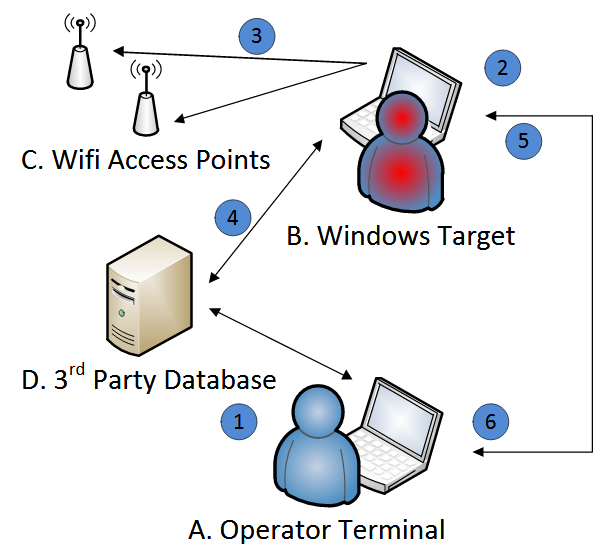
WikiLeaks has published the documentation manual for an alleged CIA tool that can track users of Wi-Fi-capable Windows devices based on the Extended Service Set (ESS) data of nearby Wi-Fi networks. According to the tool's 42-page manual, the tool's name is ELSA. Bleeping Computer has an image embedded in its report that explains how the tool works. There are six steps that summarize the ELSA operation. Bleeping Computer reports: Step 1: CIA operative configures ELSA implant (malware) based on a target's environment. This is done using a tool called the "PATCHER wizard," which generates the ELSA payload, a simple DLL file.
Step 2: CIA operative deploys ELSA implant on target's Wi-Fi-enabled Windows machine. Because ELSA is an implant (malware), the CIA operator will likely have to use other CIA hacking tools and exploits to place the malware on a victim's PC.
Step 3: The implant begins collecting Wi-Fi access point information based on the schedule set by the operator. Data collection can happen even if the user is disconnected from a Wi-Fi network.
Step 4: When the target user connects to the Internet, ELSA will take the collected Wi-Fi data and query a third-party database for geolocation information.
Step 5: The CIA operative connects to the target's computer and fetches the ELSA log. This is done via the tools that allowed the operator to place ELSA on his system, or through other tools.
Step 6: The operator decrypts the log and performs further analysis on their target. Optionally, he can use the collected WiFi data to query alternate EES geo-location databases, if he feels they provide a better accuracy.

Security

London Metropolitan Police's 18,000 Windows XP PCs Is a Disaster Waiting To Happen (mspoweruser.com) 232

According to MSPoweruser, the London Metropolitan Police are still using around 18,000 PCs powered by Windows XP, an operating system Microsoft stopped supporting in 2014. What's more is that the police force is upgrading its PCs from Windows XP to Windows 8.1, instead of Windows 10. Only 8 PCs at the police force are reportedly powered by the "most secure version of Windows right now." From the report: From the looks of things, the London Metropolitan Police will continue to upgrade their systems to Windows 8.1 at the moment. Windows 8.1 is still being supported by Microsoft, although the mainstream support for the OS is set to end on the 9 January 2018. Microsoft will offer extended support for the OS until 2023, which means Windows 8.1 is still a much more secure alternative for the Metropolitan Police than Windows XP. Windows 10 still would have been the best option in terms of security, however. Microsoft is releasing security updates for the OS every month, and the new advanced security features like Windows Defender Advanced Threat Protection makes PCs running Windows a whole lot more secure. The spokesman of the 0Conservative London Assembly said in a statement: "The Met is working towards upgrading its software, but in its current state it's like a fish swimming in a pool of sharks. It is vital the Met is given the resources to step up its upgrade timeline before we see another cyber-attack with nationwide security implications."
Government

US Imposes Stricter Security Screenings At Foreign Airports, But Won't Expand Laptop Ban Yet (theverge.com) 64

An anonymous reader quotes a report from The Verge: The United States will require foreign airports to implement stricter security practices and screenings for any passengers headed to the U.S. John Kelly, the U.S. secretary of Homeland Security, announced today that the new measures were being put in place. Though he didn't go into specifics, Kelly said the new requirements would include further screenings of electronics, more thorough vetting of passengers, and measures meant to stop "insider attacks." The U.S. is also encouraging the use of more bomb-detecting dogs, "advanced checkpoint screening technology," and the addition of "preclearance" locations, which station U.S. customs officers overseas, allowing them to screen passengers before boarding instead of after they land. One thing Kelly didn't announce was an expansion of the tablet and laptop ban, which is currently in effect on flights from 10 airports in the Middle East and North Africa. If airports don't comply with the new screening rules, Kelly said, they may be subject to additional electronics bans. But for the time being, it sounds like the ban will be kept to those 10 locations. According to Reuters, airlines have 21 days to comply with the new rules for explosives screenings and four months to comply with everything else.
Security

The Petya Ransomware Is Starting To Look Like a Cyberattack in Disguise (theverge.com) 182

Further research and investigation into Petya ransomware -- which has affected computers in over 60 countries -- suggest three interesting things: 1. Ukraine was the epicentre of the attack. According to Kaspersky, 60 percent of all machines infected were located within Ukraine. 2. The attackers behind the attack have made little money -- around $10,000. Which leads to speculation that perhaps money wasn't a motive at all. 3. Petya was either "incredibly buggy, or irreversibly destructive on purpose." An anonymous reader shares a report: Because the virus has proven unusually destructive in Ukraine, a number of researchers have come to suspect more sinister motives at work. Peeling apart the program's decryption failure in a post today, Comae's Matthieu Suiche concluded a nation state attack was the only plausible explanation. "Pretending to be a ransomware while being in fact a nation state attack," Suiche wrote, "is in our opinion a very subtle way from the attacker to control the narrative of the attack." Another prominent infosec figure put it more bluntly: "There's no fucking way this was criminals." There's already mounting evidence that Petya's focus on Ukraine was deliberate. The Petya virus is very good at moving within networks, but initial attacks were limited to just a few specific infections, all of which seem to have been targeted at Ukraine. The highest-profile one was a Ukrainian accounting program called MeDoc, which sent out a suspicious software update Tuesday morning that many researchers blame for the initial Petya infections. Attackers also planted malware on the homepage of a prominent Ukraine-based news outlet, according to one researcher at Kaspersky. Ars Technica has more.
Businesses

A New Kind of Tech Job Emphasizes Skills, Not a College Degree (nytimes.com) 218

Steve Lohr, writing for the New York Times: A few years ago, Sean Bridges lived with his mother, Linda, in Wiley Ford, W.Va. Their only income was her monthly Social Security disability check. He applied for work at Walmart and Burger King, but they were not hiring. Yet while Mr. Bridges had no work history, he had certain skills. He had built and sold some stripped-down personal computers, and he had studied information technology at a community college. When Mr. Bridges heard IBM was hiring at a nearby operations center in 2013, he applied and demonstrated those skills. Now Mr. Bridges, 25, is a computer security analyst, making $45,000 a year. In a struggling Appalachian economy, that is enough to provide him with his own apartment, a car, spending money -- and career ambitions. "I got one big break," he said. "That's what I needed." Mr. Bridges represents a new but promising category in the American labor market: people working in so-called new-collar or middle-skill jobs. As the United States struggles with how to match good jobs to the two-thirds of adults who do not have a four-year college degree, his experience shows how a worker's skills can be emphasized over traditional hiring filters like college degrees, work history and personal references. [...] On Wednesday, the approach received a strong corporate endorsement from Microsoft, which announced a grant of more than $25 million to help Skillful, a program to foster skills-oriented hiring, training and education. The initiative, led by the Markle Foundation, began last year in Colorado, and Microsoft's grant will be used to expand it there and move it into other states. "We need new approaches, or we're going to leave more and more people behind in our economy," said Brad Smith, president of Microsoft.
Government

FBI Interviews Employees of Russia-Linked Cyber Security Firm Kaspersky Lab (nbcnews.com) 43

FBI agents on Tuesday paid visits to at least a dozen employees of Kaspersky Lab, a Russia-based cyber-security company, asking questions about that company's operations as part of a counter-intelligence inquiry, multiple sources familiar with the matter told NBC News. From a report: In a classic FBI investigative tactic, agents visited the homes of the employees at the end of the work day at multiple locations on both the east and west coasts, the sources said. There is no indication at this time that the inquiry is part of Special Counsel Robert Mueller's investigation into Russian election meddling and possible collusion. Kaspersky has long been of interest to the U.S. government. Its cyber-security software is widely used in the United States, and its billionaire owner, Eugene Kaspersky, has close ties to some Russian intelligence figures, according to U.S. officials.
Facebook

The Guardian Backtracks On WhatsApp 'Backdoor' Report (theguardian.com) 48

Five months after The Guardian published an investigative report, in which it found a "backdoor" in the Facebook-owned service, the publication is finally making amendments. The January report immediately stirred controversy among security experts, who began questioning The Guardian's piece. Weeks later, Zeynep Tufekci, a researcher and op-ed writer for the New York Times, published an open letter with over 70 major security researchers working at major universities and companies like Google condemning the story, and asking the publication to retract it.. Paul Chadwick, The Guardian's reader's editor, said "The Guardian was wrong to report last January that the popular messaging service WhatsApp had a security flaw so serious that it was a huge threat to freedom of speech." From his article: In a detailed review I found that misinterpretations, mistakes and misunderstandings happened at several stages of the reporting and editing process. Cumulatively they produced an article that overstated its case. The Guardian ought to have responded more effectively to the strong criticism the article generated from well-credentialled experts in the arcane field of developing and adapting end-to-end encryption for a large-scale messaging service. The original article -- now amended and associated with the conclusions of this review -- led to follow-up coverage, some of which sustained the wrong impression given at the outset. The most serious inaccuracy was a claim that WhatsApp had a "backdoor", an intentional, secret way for third parties to read supposedly private messages. This claim was withdrawn within eight hours of initial publication online, but withdrawn incompletely. The story retained material predicated on the existence of a backdoor, including strongly expressed concerns about threats to freedom, betrayal of trust and benefits for governments which surveil. In effect, having dialled back the cause for alarm, the Guardian failed to dial back expressions of alarm.

Security

Microsoft's Telemetry Shows Petya Infections in 65 Countries Around the World (microsoft.com) 86

From a blog post by Microsoft: On June 27, 2017 reports of a ransomware infection began spreading across Europe. We saw the first infections in Ukraine, where more than 12,500 machines encountered the threat. We then observed infections in another 64 countries, including Belgium, Brazil, Germany, Russia, and the United States. The new ransomware has worm capabilities, which allows it to move laterally across infected networks. Based on our investigation, this new ransomware shares similar codes and is a new variant of Ransom:Win32/Petya. This new strain of ransomware, however, is more sophisticated. [...] Initial infection appears to involve a software supply-chain threat involving the Ukrainian company M.E.Doc, which develops tax accounting software, MEDoc. Although this vector was speculated at length by news media and security researchers -- including Ukraine's own Cyber Police -- there was only circumstantial evidence for this vector. Microsoft now has evidence that a few active infections of the ransomware initially started from the legitimate MEDoc updater process. A New York Times reports how rest of the world is dealing with Petya. From the article: A fuller picture of the impact will probably emerge in the coming days. But companies and government offices worldwide appeared less affected than the WannaCry attack, notably in places like China, which was hard hit in May. Reports from Asia suggested that many of the companies hit were the local arms of European and American companies struck on Tuesday. In Mumbai, India, a port terminal operated by A.P. Moller-Maersk, the Danish shipping giant, was shut after it disclosed that it had been hit by the malware. In a statement, Indian port authorities said they were taking steps to relieve congestion, such as finding places to park stranded cargo. The attack shut the terminal down on Tuesday afternoon. On the Australian island of Tasmania, computers in a Cadbury chocolate factory owned by Mondelez International, the American food company, displayed the ransomware message, according to the local news media.
Security

Contractors Lose Jobs After Hacking CIA's In-House Vending Machines (techrepublic.com) 190

An anonymous reader quotes a report from TechRepublic: Today's vending machines are likely to be bolted to the floor or each other and are much more sophisticated -- possibly containing machine intelligence, and belonging to the Internet of Things (IoT). Hacking this kind of vending machine obviously requires a more refined approach. The type security professionals working for the U.S. Central Intelligence Agency (CIA) might conjure up, according to journalists Jason Leopold and David Mack, who first broke the story A Bunch Of CIA Contractors Got Fired For Stealing Snacks From Vending Machines. In their BuzzFeed post, the two writers state, "Several CIA contractors were kicked out of the Agency for stealing more than $3,000 in snacks from vending machines according to official documents... ." This October 2013 declassified Office of Inspector General (OIG) report is one of the documents referred to by Leopold and Mack. The reporters write that getting the records required initiating a Freedom Of Information Act lawsuit two years ago, adding that the redacted files were only recently released. The OIG report states Agency employees use an electronic payment system, developed by FreedomPay, to purchase food, beverages, and goods from the vending machines. The payment system relies on the Agency Internet Network to communicate between vending machines and the FreedomPay controlling server. The OIG report adds the party hacking the electronic payment system discovered that severing communications to the FreedomPay server by disconnecting the vending machine's network cable allows purchases to be made using unfunded FreedomPay cards.
United Kingdom

Britain's Newest Warship Runs Windows XP, Raising Cyber Attack Fears (telegraph.co.uk) 302

Chrisq shares a report from The Telegraph: Fears have been raised that Britain's largest ever warship could be vulnerable to cyber attacks after it emerged it appears to be running the outdated Microsoft Windows XP. A defense source told The telegraph that some of the on-board hardware and software "would have been good in 2004" when the carrier was designed, "but now seems rather antiquated." However, he added that HMS Queen Elizabeth is due to be given a computer refit within a decade. And senior officers said they will have cyber specialists on board to defend the carrier from such attacks.
Security

Petya Ransomware Outbreak Originated In Ukraine Via Tainted Accounting Software (bleepingcomputer.com) 23

An anonymous reader quotes a report from Bleeping Computer: Today's massive ransomware outbreak was caused by a malicious software update for M.E.Doc, a popular accounting software used by Ukrainian companies. According to several researchers, such as Cisco Talos, ESET, MalwareHunter, Kaspersky Lab, and others, an unknown attacker was able to compromise the software update mechanism for M.E.Doc's servers, and deliver a malicious update to customers. When the update reached M.E.Doc's customers, the tainted software packaged delivered the Petya ransomware -- also referenced online as NotPetya, or Petna. The Ukrainian software vendor appears to have inadvertently confirmed that something was wrong when, this morning, issued a security advisory. Hours later, as the ransomware outbreak spread all over Ukraine and other countries across the globe causing huge damages, M.E.Doc denied on Facebook its servers ever served any malware. According to security researcher MalwareHunter, this is not the first time M.E.Doc has carried a malicious software update that delivered ransomware. Back in May, the company's software update mechanism also helped spread the XData ransomware.
Microsoft

Microsoft Bringing EMET Back As a Built-In Part of Windows 10 (arstechnica.com) 49

An anonymous reader quotes a report from Ars Technica: The Windows 10 Fall Creators Update will include EMET-like capabilities managed through a new feature called Windows Defender Exploit Guard. Microsoft's EMET, the Enhanced Mitigation Experience Toolkit, was a useful tool for hardening Windows systems. It used a range of techniques -- some built in to Windows, some part of EMET itself -- to make exploitable security flaws harder to reliably exploit. The idea being that, even if coding bugs should occur, turning those bugs into actual security issues should be made as difficult as possible. With Windows 10, however, EMET's development was essentially cancelled. But as more mitigation capabilities have been put into Windows, the need for a system for managing and controlling them has not gone away. Some of the mitigations introduce application compatibility issues -- a few even require applications to be deliberately written with the mitigation in mind -- which means that Windows does not simply turn on every mitigation for every application. It's here that Exploit Guard comes in.
Security

Hacker Behind Massive Ransomware Outbreak Can't Get Emails From Victims Who Paid (vice.com) 182

Joseph Cox, reporting for Motherboard: On Tuesday, a new, worldwide ransomware outbreak took off, infecting targets in Ukraine, France, Spain, and elsewhere. The hackers hit everything from international law firms to media companies. The ransom note demands victims send bitcoin to a predefined address and contact the hacker via email to allegedly have their files decrypted. But the email company the hacker happened to use, Posteo, says it has decided to block the attacker's account, leaving victims with no obvious way to unlock their files. [...] The hacker tells victims to send $300 worth of bitcoin. But to determine who exactly has paid, the hacker also instructs people to email their bitcoin wallet ID, and their "personal installation key." This is a 60 character code made up of letters and digits generated by the malware, which is presumably unique to each infection of the ransomware. That process is not possible now, though. "Midway through today (CEST) we became aware that ransomware blackmailers are currently using a Posteo address as a means of contact," Posteo, the German email provider the hacker had an account with, wrote in a blog post. "Our anti-abuse team checked this immediately -- and blocked the account straight away.
Security

Heritage Valley Health System Target Of Cyber Attack (cbslocal.com) 24

The Heritage Valley Health System says it has been hit with a cyber attack. From a report: A spokeswoman confirmed the attack Tuesday morning. "Heritage Valley Health System has been affected by a cyber security incident. The incident is widespread and is affecting the entire health system including satellite and community locations. We have implemented downtime procedures and made operational adjustments to ensure safe patient care continues un-impeded." Heritage Valley is a $480 million network that provides care for residents of Allegheny, Beaver, Butler and Lawrence counties, in Pennsylvania; parts of eastern Ohio; and the panhandle of West Virginia. Also read: Ukrainian Banks, Electricity Firm Hit by Fresh Cyber Attack; Reports Claim the Ransomware Is Quickly Spreading Across the World.

Slashdot Top Deals