Security

Attacks On WordPress Sites Intensify As Hackers Deface Over 1.5 Million Pages (bleepingcomputer.com) 119

An anonymous reader writes: "Attacks on WordPress sites using a vulnerability in the REST API, patched in WordPress version 4.7.2, have intensified over the past two days, as attackers have now defaced over 1.5 million pages, spread across 39,000 unique domains," reports BleepingComputer. "Initial attacks using the WordPress REST API flaw were reported on Monday by web security firm Sucuri, who said four groups of attackers defaced over 67,000 pages. The number grew to over 100,000 pages the next day, but according to a report from fellow web security firm WordFence, these numbers have skyrocketed today to over 1.5 million pages, as there are now 20 hacking groups involved in a defacement turf war." Making matters worse, over the weekend Google's Search Console service, formerly known as Google Webmaster, was sending out security alerts to people it shouldn't. Google attempted to send security alerts to all WordPress 4.7.0 and 4.7.1 website owners (vulnerable to the REST API flaw), but some emails reached WordPress 4.7.2 owners. Some of which misinterpreted the email and panicked, fearing their site might lose search engine ranking.
Encryption

Republicans Are Reportedly Using a Self-Destructing Message App To Avoid Leaks (theverge.com) 326

An anonymous reader quotes a report from The Verge: Trump administration members and other Republicans are using the encrypted, self-destructing messaging app Confide to keep conversations private in the wake of hacks and leaks, according to Jonathan Swan and David McCabe at Axios. Axios writes that "numerous senior GOP operatives and several members of the Trump administration" have downloaded Confide, which automatically wipes messages after they're read. One operative told Axios that the app "provides some cover" for people in the party. He ties it to last year's hack of the Democratic National Committee, which led to huge and damaging information dumps of DNC emails leading up to the 2016 election. But besides outright hacks, the source also said he liked the fact that Confide makes it difficult to screenshot messages, because only a few words are shown at a time. That suggests that it's useful not just for reducing paper trails, but for stopping insiders from preserving individual messages -- especially given the steady flow of leaks that have come out since Trump took office. As Axios notes, official White House business is subject to preservation rules, although we don't know much about who's allegedly using Confide and what they're doing with it, so it's not clear whether this might run afoul of those laws. It's also difficult to say how much this is a specifically Republican phenomenon, and how much is a general move toward encryption.
Communications

RSA: Ban On Booth Babes Has Been No Big Deal (networkworld.com) 233

netbuzz quotes a report from Network World: In March 2015, RSA Conference organizers made news by contractually insisting that vendors pitch their security wares without the help of "booth babes," a first such ban for the technology industry. Next week's event will be third under the new rules. With the use of "booth babes" long a source of contention -- and some would say embarrassment -- implementation of the ban has gone smoothly, according to RSA. "Overall I would say this has been received well by our exhibitors," says Sandra Toms, vice president and curator of the conference. "Several have thanked us for having a policy." If you compare the policy's contract language in 2015 with the language now used by Toms, you'll notice how much it has evolved and how it has been accepted by various stake-holders. Here's an excerpt from the "short Q&A" between Paul McNamara, news editor for Network World, and Toms: Has there been any need to enforce the code or have all exhibitors complied? "Enforce" always makes it sound like armed guards have come into play and dragged someone off the show floor. We share these guidelines with our exhibitors and we're clear that this is a policy that is expected to be acknowledged and complied with. We take our attendee experience seriously and expect our exhibitors to do the same. If we receive a complaint about a particular exhibitor, we will send someone over to the booth and examine the situation. If the attire matches our dress code, then they can proceed and we can explain to the attendee why that form of dress is allowed. If they are clearly in violation, we will ask them to change. This policy is equally applied to both men and women -- from Sumo wrestlers to scantily clad models.
Privacy

Arby's Probes Possible Data Breach Affecting 355,000 Credit Cards (krebsonsecurity.com) 49

Brian Krebs is reporting that Arby's "recently remediated a breach involving malicious software installed on payment card systems at hundreds of its restaurant locations nationwide." The breach is said to only affect some corporate stores and not franchised restaurant locations. While there is no exact number of those affected, it's possible that more than 355,000 credit and debit cards issued by PCSU members banks may have been compromised. Krebs On Security reports: The first clues about a possible breach at the sandwich chain came in a non-public alert issued by PSCU, a service organization that serves more than 800 credit unions. The alert sent to PSCU member banks advised that PSCU had just received very long lists of compromised card numbers from both Visa and MasterCard. The alerts stated that a breach at an unnamed retailer compromised more than 355,000 credit and debit cards issued by PCSU member banks. Arby's declined to say how long the malware was thought to have stolen credit and debit card data from infected corporate payment systems. But the PSCU notice said the breach is estimated to have occurred between Oct. 25, 2016 and January 19, 2017. Such a large alert from the card associations is generally a sign of a sizable nationwide breach, as this is likely just the first of many alerts Visa and MasterCard will send to card-issuing banks regarding accounts that were compromised in the intrusion. If history is any lesson, some financial institutions will respond by re-issuing thousands of customer cards, while other (likely larger) institutions will focus on managing fraud losses on the compromised cards.
Government

NSA Contractor Indicted Over Mammoth Theft of Classified Data (reuters.com) 156

Dustin Volz, reporting for Reuters: A former National Security Agency contractor was indicted on Wednesday by a federal grand jury on charges he willfully retained national defense information, in what U.S. officials have said may have been the largest heist of classified government information in history. The indictment alleges that Harold Thomas Martin, 52, spent up to 20 years stealing highly sensitive government material from the U.S. intelligence community related to national defense, collecting a trove of secrets he hoarded at his home in Glen Burnie, Maryland. The government has not said what, if anything, Martin did with the stolen data. Martin faces 20 criminal counts, each punishable by up to 10 years in prison, the Justice Department said. "For as long as two decades, Harold Martin flagrantly abused the trust placed in him by the government," said U.S. Attorney Rod Rosenstein.
Facebook

Facebook Is Closing 200 of Its 500 VR Demo Stations At Best Buy Stores Across US (businessinsider.com) 128

According to Business Insider, "Facebook is closing around 200 of its 500 Oculus Rift virtual-reality demo stations at Best Buy locations across the U.S." The reason has to do with "store performance," as multiple Best Buy pop-ups told Business Insider that "it was common for them to go days without giving a single demonstration." From their report: Oculus spokeswoman Andrea Schubert confirmed the closings and said they were due to "seasonal changes." "We're making some seasonal changes and prioritizing demos at hundreds of Best Buy locations in larger markets," she said. "You can still request Rift demos at hundreds of Best Buy stores in the U.S. and Canada." "We still believe the best way to learn about VR is through a live demo," she continued. "We're going to find opportunities to do regular events and pop ups in retail locations and local communities throughout the year." Best Buy spokeswoman Carly Charlson said stores that no longer offer demos will continue to sell the Oculus Rift headset and accompanying touch controllers, which cost $600 and $200 respectively. Multiple "Oculus Ambassador" workers BI spoke with said that, at most, they would sell a few Oculus headsets per week during the holiday season, and that foot traffic to their pop-ups decreased drastically after Christmas. "There'd be some days where I wouldn't give a demo at all because people didn't want to," said one worker at a Best Buy in Texas who asked to remain anonymous. Another worker from California said that Oculus software bugs would often render his demo headsets unusable.
Botnet

Programmer Develops Phone Bot To Target Windows Support Scammers (onthewire.io) 97

Trailrunner7 quotes a report from On the Wire: The man who developed a bot that frustrates and annoys robocallers is planning to take on the infamous Windows support scam callers head-on. Roger Anderson last year debuted his Jolly Roger bot, a system that intercepts robocalls and puts the caller into a never-ending loop of pre-recorded phrases designed to waste their time. Anderson built the system as a way to protect his own landlines from annoying telemarketers and it worked so well that he later expanded it into a service for both consumers and businesses. Users can send telemarketing calls to the Jolly Roger bot and listen in while it chats inanely with the caller. Now, Anderson is targeting the huge business that is the Windows fake support scam. This one takes a variety of forms, often with a pre-recorded message informing the victim that technicians have detected that his computer has a virus and that he will be connected to a Windows support specialist to help fix it. The callers have no affiliation with Microsoft and no way of detecting any malware on a target's machine. It's just a scare tactic to intimidate victims into paying a fee to remove the nonexistent malware, and sometimes the scammers get victims to install other unwanted apps on their PCs, as well. Anderson plans to turn the tables on these scammers and unleash his bots on their call centers. "I'm getting ready for a major initiative to shut down Windows Support. It's like wack-a-mole, but I'm getting close to going nuclear on them. As fast as you can report fake 'you have a virus call this number now' messages to me, I will be able to hit them with thousands of calls from bots," Andrew said in a post Tuesday.
Privacy

72% of 'Anonymous' Browsing History Can Be Attached To the Real User (thestack.com) 67

An anonymous reader quotes a report from The Stack: Researchers at Stanford and Princeton have succeeded in identifying 70% of web users by comparing their web-browsing history to publicly available information on social networks. The study "De-anonymizing Web Browsing Data with Social Networks" [PDF] found that it was possible to reattach identities to 374 sets of apparently anonymous browsing histories simply by following the connections between links shared on Twitter feeds and the likelihood that a user would favor personal recommendations over abstract web browsing. The test subjects were provided with a Chrome extension that extracted their browsing history; the researchers then used Twitter's proprietary URL-shortening protocol to identify t.co links. 81% of the top 15 results of each enquiry run through the de-anonymization program contained the correct re-identified user -- and 72% of the results identified the user in first place. Ultimately the trail only leads as far as a Twitter user ID, and if a user is pseudonymous, further action would need to be taken to affirm their real identity. Using https connections and VPN services can limit exposure to such re-identification attempts, though the first method does not mask the base URL of the site being connected to, and the second does not prevent the tracking cookies and other tracking methods which can provide a continuous browsing history. Additionally UTM codes in URLs offer the possibility of re-identification even where encryption is present. Further reading available via The Atlantic.
Transportation

Iris Scans and Fingerprints Could Be Your Ticket On British Rail (silicon.co.uk) 75

Mickeycaskill quotes a report from Silicon.co.uk: Rail passengers could use fingerprints or iris scans to pay for tickets and pass through gates, under plans announced by the UK rail industry. In its current form, the mobile technology is intended to allow passengers to travel without tickets, instead using Bluetooth and geolocation technology to track a passenger's movements and automatically charge their travel account at the end of the day for journeys taken. The Rail Delivery Group (RDG), which represents train operators and Network Rail, said further development could see passengers identified using biometric technology in a way similar to the facial-recognition schemes used at some UK airports to speed up border checks. The RDG said more than 200 research, design and technology projects have been identified to increase the railways' capacity and improve customer service. Other projects include new seat designs that could improve train capacity by up to 30 percent and folding seats that could boost space during peak times, including tables that could fold into seats.
IOS

Dozens of Popular iOS Apps Vulnerable To Intercept of TLS-Protected Data (arstechnica.com) 53

Researchers at Sudo Security Group Inc. discovered seventy-six popular applications in Apple's iOS App Store that had implemented encrypted communications with their back-end services in such a way that user information could be intercepted by a man-in-the-middle attack. According to Ars Technica, the applications could be fooled by a forged certificate sent back by a proxy, allowing their Transport Layer Security to be unencrypted and examined as it is passed over the internet. From their report: The discovery was initially the result of bulk analysis done by Sudo's verify.ly, a service that performs bulk static analysis of application binaries from Apple's App Store. Will Strafach, president of Sudo, verified the applications discovered by the system were vulnerable in the lab, using a network proxy configured with its own Secure Socket Layer certificate. In the post about his findings being published today, Strafach wrote: "During the testing process, I was able to confirm 76 popular iOS applications allow a silent man-in-the-middle attack to be performed on connections which should be protected by TLS (HTTPS), allowing interception and/or manipulation of data in motion. According to Apptopia estimates, there has been a combined total of more than 18,000,000 (Eighteen Million) downloads of app versions which are confirmed to be affected by this vulnerability."

The data exposed by the vulnerability in each of the applications varied in sensitivity. For just less than half -- 33 of the applications -- the risk was relatively low, as most of the data was "partially sensitive analytics data," Strafach said. These apps included a number of third-party "uploader" apps for Snapchat (which exposed Snapchat usernames and passwords) and the Vice News app, among others. In 24 cases, the exposed data included login credentials or session tokens that would allow an attacker to hijack the account associated with the application, though those accounts were not tied to highly sensitive data. However, the remaining 19 applications left sensitive data exposed to attack. In these cases, Strafach "confirmed ability to intercept financial or medical service login credentials and/or session authentication tokens for logged in users."

DRM

DRM Company Denuvo Forgets To Secure Its Server, Leaks Two Years Of Emails (torrentfreak.com) 77

Denuvo "left several private directories on its website open to the public," TorrentFreak wrote Sunday, calling it "an embarrassing blunder" for the digital rights management company. "Members of the cracking community are downloading and scrutinizing the contents," the site reports, with one of the finds being an 11-megabyte text file which apparently contains every message sent through Denuvo's web site since 2014. An anonymous reader writes: There's a message from Google's security team, one from Capcom Japan, and "dozens of emails from angry pirates, each looking to vent their anger," according to TorrentFreak. Ars Technica reports that there's also a 2015 message from Microsoft about "an upcoming initiative," as well as messages several game studios, and even one from the producers of Mavis Beacon Teaches Typing. "Combing the log file brings up countless spam messages, along with complaints, confused 'why won't this game work' queries from apparent pirates, and even threats (an example: 'for what you did to arkham knight I will find you and I will kill you and all of your loved ones, this I promise you CEO of this SHIT drm')."

"Since Denuvo's contact page does not contain a link to a private e-mail address -- only a contact form and a phone number to the company's Austrian headquarters -- the form appears to also have been used by many game developers and publishers." And in addition, "much of Denuvo's web database content appears to be entirely unsecured, with root directories for 'fileadmin' and 'logs' sitting in the open right now."

In addition, there's also a slideshow -- which has since been uploaded to Imgur -- bragging that "With over 300 man years of development experience among us, we clearly know what we're doing."
Education

Ask Slashdot: Why Do You Care About Tech Conferences? 197

An anonymous user is "just starting a programming career," and has several questions for Slashdot's readers: What exactly is the role of tech conferences? I always assumed they were mostly for exhibitors to pitch me things, but then what's in it for me? Am I just going there to network, or am I learning new cutting-edge techniques and getting enlightened by awesome training sessions? Or is it just a fun way to get a free trip to Las Vegas?

And then what's in it for my employer, who's paying to send me there? If my boss has to approve the cost of attending a conference, what's going to make him say yes? I mean, do employers really get enough value from that extra conference-only information to justify sending off their employees for several days of non-productivity? (Don't they know all that networking could lead me to job offers from other companies?)

It's always been a little intimidating the way people talk about conferences, like everyone already knows all about them, and drop the conference's name into the conversations like you should already know what it is. I always assumed people just attended only conferences for their current programming language or platform -- but is there more to it than that? What exactly is the big deal?

I'm struggling to even find the right metaphor for this -- is it a live interactive infomercial or a grand gathering of geeky good will? So leave your best answers in the comments. Why do you care about tech conferences?
Security

14,000 Domains Dropped Dyn's DNS Service After Mirai Attack (securityledger.com) 27

chicksdaddy New data suggests that some 14,500 web domains stopped using Dyn's Managed DNS service in the immediate aftermath of an October DDoS attack by the Mirai botnet. That's around 8% of the web domains using Dyn Managed DNS... "The data show that Dyn lost a pretty big chunk of their customer base because they were affected by (Mirai)," said Dan Dahlberg, a research scientist at BitSight Technologies in Cambridge, Massachusetts... BitSight, which provides security rating services for companies, analyzed a set of 178,000 domains that were hosted on Dyn's managed DNS infrastructure before and immediately after the October 21st attacks.
It's possible some of those domains later returned to Dyn -- and the number of actual customers may be smaller than the number of hosted domains. But in the end it may not have mattered much, since Dyn was acquired by Oracle the next month, and TechCrunch speculates that the deal had already been set in motion before the attack.

They also add that "Oracle, of course, is no stranger to breaches itself: in August it was found that hundreds of its own computer systems were breached."
AI

Are Gates, Musk Being 'Too Aggressive' With AI Concerns? (xconomy.com) 311

gthuang88 reports on a talk titled "Will Robots Eat Your Job?" Bill Gates and Elon Musk are sounding the alarm "too aggressively" over artificial intelligence's potential negative consequences for society, says MIT professor Erik Brynjolfsson. The co-author of The Second Machine Age argues it will take at least 30 to 50 years for robots and software to eliminate the need for human laborers. In the meantime, he says, we should be investing in education so that people are prepared for the jobs of the future, and are focused on where they still have an advantage over machines -- creativity, empathy, leadership, and teamwork.
The professor acknowledges "there are some legitimate concerns" about robots taking jobs away from humans, but "I don't think it's a problem we have to face today... It can be counterproductive to overestimate what machines can do right now." Eventually humankind will reach a world where robots do practically everything, the professor believes, but with a universal basic income this could simply leave us humans with more leisure time.
Security

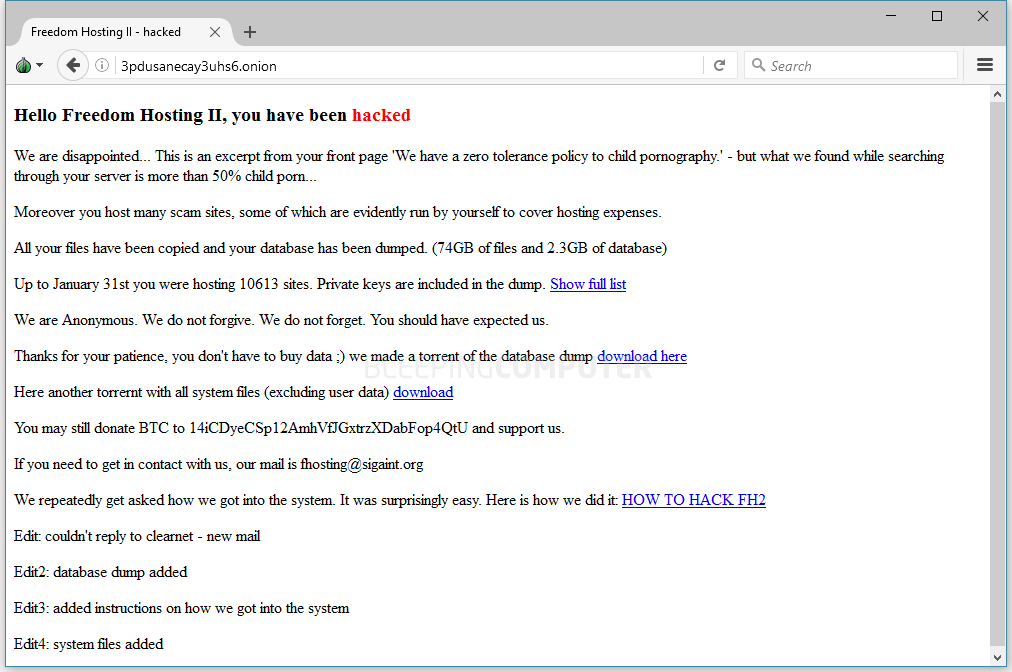
Anonymous Takes Down 10,613 Dark Web Portals (bleepingcomputer.com) 120

An anonymous reader writes: Anonymous hackers have breached Freedom Hosting II, a popular Dark Web hosting provider, and have taken down 10,613 .onion sites. In a message left on all Freedom Hosting II sites, the hackers claim to have found massive troves of child pornography imagery hosted on the company's servers. The hackers dumped 74GB of server files (half of which they say contained child pornography) and a database dump of 2.3GB. Security researcher Chris Monteiro has analyzed some of the dumped data. He says he discovered .onion URLs hosting botnets, fraud sites, sites peddling hacked data, weird fetish portals, more weird stuff, and child abuse websites targeting both English- and Russian-speaking buyers. Freedom Hosting II hosts about a fifth of all .onion URLs. The first Freedom Hosting service was targeted by Anonymous in 2011 and eventually shut down in 2013 after the FBI also found child pornography hosted on its sites.
Security

Can The Mayhem AI Automate Bug-Patching? (technologyreview.com) 23

"Now when a machine is compromised it takes days or weeks for someone to notice and then days or weeks -- or never -- until a patch is put out," says Carnegie Mellon professor David Brumley. "Imagine a world where the first time a hacker exploits a vulnerability he can only exploit one machine and then it's patched." An anonymous reader quotes MIT Technology Review: Last summer the Pentagon staged a contest in Las Vegas in which high-powered computers spent 12 hours trying to hack one another in pursuit of a $2 million purse. Now Mayhem, the software that won, is beginning to put its hacking skills to work in the real world... Teams entered software that had to patch and protect a collection of server software, while also identifying and exploiting vulnerabilities in the programs under the stewardship of its competitors... ForAllSecure, cofounded by Carnegie Mellon professor David Brumley and two of his PhD students, has started adapting Mayhem to be able to automatically find and patch flaws in certain kinds of commercial software, including that of Internet devices such as routers.

Tests are underway with undisclosed partners, including an Internet device manufacturer, to see if Mayhem can help companies identify and fix vulnerabilities in their products more quickly and comprehensively. The focus is on addressing the challenge of companies needing to devote considerable resources to supporting years of past products with security updates... Last year, Brumley published results from feeding almost 2,000 router firmware images through some of the techniques that powered Mayhem. Over 40%, representing 89 different products, had at least one vulnerability. The software found 14 previously undiscovered vulnerabilities affecting 69 different software builds. ForAllSecure is also working with the Department of Defense on ideas for how to put Mayhem to real world use finding and fixing vulnerabilities.

Security

Which US Cities Have The Worst Malware Infection Rates? (techrepublic.com) 52

A new report from Enigma Software Group identifies the American cities with abnormally high infection rates for malware. An anonymous reader quotes TechRepublic: In 2016, Tampa, Orlando, and St. Louis each had malware infection rates per capita more than five times the national average -- the highest in the U.S., the report found. Those same three cities were also at the top of the list of highest infection rates in 2015... ESG compiled malware detection data from its SpyHunter anti-spyware software in the 100 largest cities in the US in all of 2016.
Two Ohio cities also made it into the top ten for malware infection rates -- Cleveland and Cincinnati -- as well as Washington D.C. (with an infection rate 242% higher than the national average). But the infection rates drop noticeably after the top 10, with Miami (at #14) the last city with an infection rate more than double the national average. Interestingly, the top 35 cities include major high-tech centers like Seattle, Austin, Boston, and San Jose.
Programming

Developer Argues For 'Forgotten Code Constructs' Like GOTO and Eval (techbeacon.com) 600

mikeatTB quotes TechBeacon: Some things in the programming world are so easy to misuse that most people prefer to never use them at all. These are the programming equivalent of a flamethrower... [But] creative use of features such as goto, multiple inheritance, eval, and recursion may be just the right solution for experienced developers when used in the right situation. Is it time to resurrect these four forgotten code constructs?
The article notes that the Linux kernel uses goto statements, and links to Linus Torvalds' defense of them. ("Any if-statement is a goto. As are all structured loops...") And it points out that eval statements are supported by JavaScript, Python, PHP, and Ruby. But when the article describes recursion as "more forgotten than forbidden," it begs the inevitable question. Are you using these "forgotten code constructs" -- and should you be?
Social Networks

Ask Slashdot: How Do You Deal With Aggressive Forum Users? 477

Slashdot reader dryriver writes: I've noticed a disturbing trend while trying to resolve a rather tricky tech issue by asking questions on a number of internet forums. The number of people who don't help at all with problems but rather butt into threads with unhelpful comments like "Why would you want to do that in the first place?" or "why don't you look at X poorly written documentation page " was staggering. One forum user with 1,500+ posts even posted "you are such a n00b if you can't figure this out" in my question thread, even though my tech question wasn't one that is obvious or easy to resolve...

I seem to remember a time when people helped each other far more readily on the internet. Now there seems to be a new breed of forum user who a) hangs out at a forum socially all day b) does not bother to help at all and c) gets a kick out of telling you things like "what a stupid question" or "nobody will help you with that here" or similar... Where have the good old days gone when people much more readily gave other people step-by-step tips, tricks, instructions and advice?

The original submission claims the ratio of unhelpful comments to helpful ones was 5 to 1. Has anyone else experienced this? And if so, what's the best response? Leave your best answers in the comments. How do you deal with aggressive forum users?
Privacy

Privacy-Centric Linux Distro Tails 3.0 Will Drop 32-Bit Processor Support (betanews.com) 97

All of its outgoing connections are routed through Tor, and it even blocks non-anonymous connections. You can carry it around on a USB stick, and Edward Snowden uses it. But a big change is coming with Tails 3.0. BrianFagioli quotes BetaNews: Unfortunately for some users, Tails will soon not work on their computers. The upcoming version 3.0 of the operating system is dropping 32-bit processor support. While a decline in compatibility is normally a bad thing, in this case, it is good. You see, because there are so few 32-bit Tails users, the team was wasting resources by supporting them. Not to mention, 64-bit processors are more secure too...

"In the beginning of 2016, only 4% of Tails users were still using a 32-bit computer. Of course, some of these computers will keep working for a while. But once the number had fallen this low, the benefits of switching Tails to 64-bit outweighed the reasons we had to keep supporting 32-bit computers," says the Tails team... "In the last few years, the developers who maintain Tails have spent lots of time addressing such issues. We would rather see them spend their time in ways that benefit our users on the long term, and not on problems that will vanish when Tails switches to 64-bit eventually."

Slashdot Top Deals