Science

Chemists Discover Water Microdroplets Spontaneously Produce Hydrogen Peroxide (phys.org) 36

An anonymous reader quotes a report from Phys.Org: Stanford researchers report Aug. 26 in Proceedings of the National Academy of Sciences that microscopic droplets of water spontaneously produce hydrogen peroxide. The discovery could pave the way for greener ways to produce the molecule, a common bleaching agent and disinfectant, said Richard Zare, the Marguerite Blake Wilbur Professor in Natural Science and a professor of chemistry in the Stanford School of Humanities and Sciences. The discovery was made serendipitously while Zare and his lab were studying a new, more efficient way to create gold nanostructures in tiny water droplets known as microdroplets. To make those structures, the team added an additional molecule called a reducing agent. As a control test, Zare suggested seeing if they could create gold nanostructures without the reducing agent. Theoretically that should have been impossible, but it worked anyway -- hinting at an as yet undiscovered feature of microdroplet chemistry.

The team eventually traced those results to the presence of a molecule called hydroxyl -- a single hydrogen atom paired with an oxygen atom -- that can also act as a reducing agent. That equally unexpected result led Katherine Walker, at the time a graduate student in Zare's lab, to wonder whether hydrogen peroxide -- a molecule with two hydrogen and two oxygen atoms -- was also present. To find out, Zare, Walker, staff scientist Jae Kyoo Lee and colleagues conducted a series of tests, the simplest of which involved spraying ostensibly pure water microdroplets onto a surface treated so that it would turn blue in the presence of hydrogen peroxide -- and turn blue it did. Additional tests confirmed that water microdroplets spontaneously form hydrogen peroxide, that smaller microdroplets produced higher concentrations of the molecule, and that hydrogen peroxide was not lost when the microdroplets recombined into bulk water.
The researchers suggest that a strong electric field near the surface of water microdroplets in air triggers hydroxyl molecules to bind into hydrogen peroxide.
Medicine

Study Suggests Link Between Air Pollution and Psychiatric Disorders 87

pgmrdlm shares a report from StudyFinds: Could the very air we breathe have an impact on our mental health? That's the suggestion coming out of a new international study conducted in the United States and Denmark. After analyzing long-term data sets from both countries, researchers from the University of Chicago say they have identified a possible link between exposure to environmental pollution, specifically polluted air, and an increase in the onset of psychiatric and mental health problems in a population. According to the findings, air pollution is associated with increased rates of depression and bipolar disorder among both U.S. and Danish populations. That association was actually found to be even greater in Denmark, where poor air quality exposure during the first 10 years of a person's life was found to predict a two-fold increase in the likelihood of developing schizophrenia or a personality disorder.

For the study, researchers analyzed two population data sets. The first was a U.S. health insurance claims database housing 11 years worth of claims across 151 million people. The second data set included all 1.4 million people born in Denmark between 1979-2002 who were still alive, and still living in Denmark by their 10th birthday. Air pollution levels in specific areas were measured using the air quality standards set by both countries, respectively. For example, for the U.S. the EPA's air quality measurements were used. As far as estimating each person's exposure to polluted air, it was a bit easier for researchers to track individual Danes because they had access to each Danish participants' citizen ID number. For Americans, air pollution exposure estimates were limited to county areas.
The study has been published in the journal PLOS Biology.
It's funny.  Laugh.

A Growing Community Called Randonauts Believe That Journeying To Random Locations Can Help Put Us in New Realities (theoutline.com) 134

A small but quickly growing online community believes that transforming randomly generated numbers into clusters of location data could help us tunnel out of reality. Their name for themselves: Randonauts. From a report: It's a sad truth that most of our lives are pretty boring, geographically speaking. Live in one place long enough and you will develop routines, walking the same streets and patronizing the same coffee shops and generally making it easy for a simulation, should one exist, to anticipate where you will be at any given time. Randonauts hope to use this tedium to their advantage, by introducing unpredictability. They argue that by devising methods that force us to diverge from our daily routines and instead send us to truly random locations we'd otherwise never think twice about, it just might be possible to cross over into somebody else's reality. "New information and causality can pull you out of the filter-bubble and change your life," writes The Fatum Project, the online team responsible for the technological and philosophical framework of the movement. Even if you don't buy into the dense thicket of theoretical quantum physics underpinning the logic of it all, going on a Randonaut-style adventure can be a lovely way to spend an afternoon.

According to the The Fatum Project, there's hard science behind all this. Building on research conducted by Princeton University's Engineering Anomalies Research Lab into whether human thought could influence real-world events, they hope that Randonauts will be able to leave their "reality tunnels" and discover new contexts, appreciate daily life in fresh ways, or even venture into parallel iterations of their own realities. Getting started is easy. Log into the Telegram messaging app and send the command "/getattractor" along with your location to @shangrila_bot (formerly, you could also message @Randonaut_bot). The bot will plot out thousands of nearby geolocation points using a quantum random number generator, and spit out the area with the highest concentration of points near you. Conversely, if computer-determined desolation is more your style, you can send the command "/getvoid" and through a similar process, the bot will send you a location where there are no randomly plotted points. On Reddit, Randonauts have reported finding things like an upside-down airplane; a llama, standing totally still; three identical black cats; a family of horses in a public park; and a bird that also refused to move. Under the auspices of "/getvoid," users have reported finding derelict locales, creepy signage, and other marks of decay. Think of it as geocaching by way of Marianne Williamson.

Businesses

Purdue Pharma Offers $10-12B To Settle Opioid Claims (nbcnews.com) 68

The maker of OxyContin, Purdue Pharma, and its owners, the Sackler family, are offering to settle more than 2,000 lawsuits against the company for $10 billion to $12 billion. From a report: The potential deal was part of confidential conversations and discussed by Purdue's lawyers at a meeting in Cleveland last Tuesday, Aug. 20, according to two people familiar with the mediation. Brought by states, cities and counties, the lawsuits -- some of which have been combined into one massive case -- allege the company and the Sackler family are responsible for starting and sustaining the opioid crisis. At least 10 state attorneys general and the plaintiffs' attorneys gathered in Cleveland, where David Sackler represented the Sackler family, according to two people familiar with the meeting. David Sackler, who was a board member of the company, has recently been the de facto family spokesperson. The lawsuits that Purdue and the Sacklers are seeking to settle allege that their company's sales practices were deceptive and at least partly responsible for the opioid crisis, which claimed more than 400,000 lives from 1999 to 2017, according to the Centers for Disease Control and Prevention. Some of the lawsuits also allege that after 2007 the Sackler family drained the company of money to enrich themselves.
Medicine

Mutant Sheep Are Being Bred in Lab To Fight Lethal Child Brain Disease (theguardian.com) 53

Scientists have created a flock of sheep that carry the gene for a lethal inherited brain disorder in humans. The condition, Batten disease, usually starts in childhood and is invariably fatal, often within a few years of diagnosis. From a report: The project, which is designed to test treatments for the disease, is based at Edinburgh University's Roslin Institute, where cloning techniques were used to create Dolly the sheep in 1996. The scientists acknowledge that the approach could be controversial as it involves creating animals programmed to die, but stress that their aim is to alleviate human suffering. "We have deliberately re-created the condition in a large mammal because sheep have a brain of a similar size and complexity to that of a child," said Tom Wishart, project leader. "That means treatments we test on them are much more likely to be relevant to humans than those tested only on cell cultures or mice and rats."

In the UK, Batten disease affects between 100 and 150 children and young adults. It is inherited from two symptomless parents who each carry a rare recessive gene mutation. That mutation interferes with the operation of lysosomes, which act as the waste disposal systems for cells. Children who carry two copies of the faulty gene begin to suffer loss of vision, impaired cognition and mobility problems. Seizures and early death follow. "It is devastating for families," Wishart said. There are several types of Batten disease, he added. "One of the more rapid types is CLN1, and that's what we have recreated in our sheep." The Roslin scientists used the gene-editing technique Crispr-Cas9 to create the faulty CLN1 gene in the sheep. "We collected sheep embryos from the abattoir," Wishart said. "Then we fertilised them and added Crispr reagents to alter their genetic structure before implanting the embryos into a surrogate sheep's uterus."

Businesses

KFC is Testing Beyond Meat 'Chicken' in an Atlanta Restaurant (engadget.com) 160

Plant-based meat substitutes may soon be an option for fast food chicken. CNBC reports that KFC will start testing Beyond Fried Chicken at an Atlanta restaurant on August 27. From a report: Yes, you could grab a bucket of chicken without feeling quite so guilty -- or greasy, if Beyond Meat's earlier work is any indication. Whether or not availability grows will depend on feedback, but other restaurant chains (such as Del Taco) have seen upticks in demand since adding meat substitutes. KFC had acknowledged talking to suppliers months ago to investigate meatless chicken, but didn't have any definitive plans until now. This could mark a triumphant return for Beyond Meat's chicken efforts. It pulled its meatless chicken from grocery stores earlier in 2019 after deciding it didn't meet the company's standards.
Space

Sheriff Warns Angry Locals To Vacate Houses Before SpaceX's 'Starhopper' Test (businessinsider.com) 121

An anonymous reader quotes Business Insider: A small community of people at the southern tip of Texas just received what some of its residents are calling a "shocking" and "concerning" warning about SpaceX's upcoming launch attempt of a Mars rocket ship prototype. Residents told Business Insider a county sheriff went door-to-door on Saturday night to hand-deliver printed notices to the community, where approximately 20 people own homes...

The notice says "action required" and warns of "potential risk to health and safety" during SpaceX's upcoming launch attempt of Starhopper: a stubby yet roughly 60-foot-tall (18-meter-tall) steel prototype with a single, truck-size Raptor rocket engine... The notice issued to residents says police will sound their sirens to warn residents about 10 minutes before liftoff. According to the notice, a roughly 15-minute flight window will open at 5 p.m. ET (4 p.m. CT) on Monday night. The notice then says:

"There is a risk that a malfunction of the SpaceX vehicle during flight will create an overpressure event that can break windows. Therefore, in order to protect Public Health and Safety, it is recommended that you consider temporarily vacating yourself, other occupants, and pets, from the area during the Space Flight Activities. At a minimum, you must exit your home or structure and be outside of any building on your property when you hear the police sirens which will be activated at the time of the Space Flight Activity to avoid or minimize the risk of injury."

An "overpressure event" is a blastwave that's often caused by a rapid explosion...

The public health and safety notice comes about a month after SpaceX's most recent launch of Starhopper. That flight inadvertently ignited a grass fire that burned through more than 100 acres of coastal wildlife refuge, thousands of acres of which surround the launch site and hamlet. SpaceX has responded to the incident by putting together a better fire-prevention and response plan, according to Bryan Winton, manager of the Lower Rio Grande Valley national wildlife refuge at the US Fish and Wildlife Service. SpaceX is now coordinating more closely with local agencies on its launch plans and fire safety, has installed five new remote-control water cannons on its launchpad to douse flames (there used to be only one), is helping perform controlled burns, and more, Winton told Business Insider on Thursday.

The Internet

Musk and Bezos' Satellite Internet Could Save Consumers Billions of Dollars (thenextweb.com) 96

"The fight for space internet supremacy is on," writes the consumer policy expert at BroadbandNow, calculating the benefits of these additional broadband competitors: Low Earth orbit (LEO) satellites for broadband internet access are beginning to display signs of real potential. Recently, Amazon chief Jeff Bezos' Blue Origin pulled back the curtain on its space intentions by announcing Project Kuiper, a 3,236-satellite constellation. Additionally, Elon Musk's SpaceX Starlink recently launched a rocket containing 60 satellites from Florida's Cape Canaveral... Both players, alongside others like OneWeb, are spending billions in space in hopes of making further billions annually once the satellites go into service for consumers in the US and around the globe. SpaceX will initially launch service to North America, but once its full array is in place, the company has plans to roll the service out across the entire planet. Ostensibly, anywhere with access to open skies could be covered. Amazon has global aspirations for its project as well...

The arrival of this technology is likely to drive down monthly internet prices for hundreds-of-millions of Americans... According to further analysis of our market-wide pricing database covering plans and pricing from more than 2,000 ISPs, the average "lowest available monthly price" for the estimated 104 million Americans with only one wired broadband provider is $68. For the 75 million Americans with two choices, that average lowest price drops to $59. For the lucky 15 million Americans with five or more choices, it's $47. Because LEO technology will ostensibly be available everywhere in the US, as well as globally, this indicates the powerful influence the entrance of the technology will have on internet prices as new markets gain access to an additional true "broadband" option and competition heats-up.

Our projections show that that low-latency, LEO satellite internet is likely to have a similar impact on average regional prices as wired, low-latency wired providers. Extrapolating this additional competitor across all US households, the introduction of LEO satellite internet could save Americans over $30 billion... Shortly after, these same transformative benefits could spread to countries across the globe, permanently altering the landscape of the internet as we know it.

Biotech

New Technique Can Bioprint Living Tissue In Seconds (engadget.com) 19

An anonymous reader quotes Engadget: Bioprinting holds great potential for repairing injuries, testing drugs or replacing whole organs, but it's currently limited in complexity, viability and speed -- you can't just create tissue on a whim. Soon, though, it might be a matter of crafting whatever you need when you need it. Scientists at EPFL and University Medical Center Utrecht have developed an optical system that can bioprint complex, highly viable living tissue in "just a few seconds." It would represent a breakthrough compared to the clunky, layer-based processes of today.

The approach, volumetric bioprinting, forms tissue by projecting a laser down a spinning tube containing hydrogel full of stem cells. You can shape the resulting tissue simply by focusing the laser's energy on specific locations to solidify them, creating a useful 3D shape within seconds. After that, it's a matter of introducing endothelial cells to add vessels to the tissue.

The resulting tissues are currently just a few inches across. That's still enough to be "clinically useful," EPFL said, and has already been used to print heart-like valves, a complex femur part and a meniscus. It can create interlocking structures, too.

Space

US Govt Considers Changing Requirements for Rocket Launches. Commercial Space Group Objects (theverge.com) 14

Long-time Slashdot reader apoc.famine writes: In a proposed change to the licensing of spaceflight operations, the FAA writes:

"This action would fundamentally change how the FAA licenses launches and reentries...by proposing a regulatory approach that relies on performance-based regulations rather than prescriptive regulations.....This action would also enable flexible timeframes, remove unnecessary ground safety regulations, redefine when launch begins to allow specified pre-flight operations prior to license approval, and allow applicants to seek a license to launch from multiple sites. This proposal would significantly streamline and simplify licensing of launch and reentry operations, would enable novel operations, and would result in net cost savings."

The Verge reports that the government's proposed update "is pissing off the commercial space industry," citing comments from the Commercial Spaceflight Federation (CSF), a nonprofit that represents various companies within the private space industry: CSF representatives note the irony of the situation since the organization and its companies were the ones to ask for changes in the first place. Its members even made recommendations for how to update the rules. "The FAA took them, and they went and started formulating," Eric Stallmer, president of CSF, tells The Verge. "And it came back, and we read it, and we tried to digest it. And then we walked away saying, 'This is no better than what we had.' In fact, I think it's worse. It doesn't answer the mail at all...."

CSF represents the newer players in the field, like SpaceX, Blue Origin, Rocket Lab, Virgin Orbit, Relativity, and more. The organization argues that the new rules will have a heavier burden on these younger companies, which have been launching commercial missions much more frequently.

ISS

First Alleged Crime In Space? (bbc.com) 70

bobstreo tipped us off to an interesting story. The BBC reports that NASA "is reported to be investigating a claim that an astronaut accessed the bank account of her estranged spouse from the International Space Station, in what may be the first allegation of a crime committed in space." Anne McClain acknowledges accessing the account from the ISS but denies any wrongdoing, the New York Times reports... The astronaut told the New York Times through a lawyer that she was merely making sure that the family's finances were in order and there was enough money to pay bills and care for Ms Worden's son -- who they had been raising together prior to the split. "She strenuously denies that she did anything improper," said her lawyer, Rusty Hardin, adding that Ms McClain was "totally co-operating..."

Her estranged spouse, Summer Worden, reportedly filed a complaint with the Federal Trade Commission. Ms McClain has since returned to Earth...

Ms McClain graduated from the prestigious West Point military academy and flew more than 800 combat hours over Iraq as an Army pilot. She went on to qualify as a test pilot and was chosen to fly for NASA in 2013.

Moon

India's Chandrayaan-2 Spacecraft Enters the Moon's Orbit (ctvnews.ca) 14

Long-time Slashdot reader William Robinson writes: An unmanned spacecraft, Chandrayaan 2, India launched last month has begun orbiting the moon before it lands on the far side to search for water. The spacecraft is in orbit of 114 km x 18072 km and will continue circling the moon in a tighter orbit until reaching a distance of about 100 km x 30 km from the moon's surface. "The lander will then separate from the orbiter and use rocket fuel to brake as it attempts to land in the south polar region of the moon on Sept. 7 -- an area where no moon landing has been attempted before," reports CTV News. The mission is carrying a total of 14 payloads -- 13 Indian and one passive payload from NASA -- with special focus of the orbiter on mapping craters in the polar region, besides checking for water again.
Space.com shares the first photo of the moon snapped by the spacecraft on Wednesday, noting that "If the lander safely touches down, India will become the fourth country to complete that feat, after the Soviet Union, the U.S. and China.

"The lander and rover would operate for one lunar day but are not designed to withstand the frigid lunar nights."
Science

Quantum Radar Has Been Demonstrated For the First Time (technologyreview.com) 37

An anonymous reader quotes a report from MIT Technology Review: Shabir Barzanjeh at the Institute of Science and Technology Austria and a few colleagues have used entangled microwaves to create the world's first quantum radar. Their device, which can detect objects at a distance using only a few photons, raises the prospect of stealthy radar systems that emit little detectable electromagnetic radiation. The device is simple in essence. The researchers create pairs of entangled microwave photons using a superconducting device called a Josephson parametric converter. They beam the first photon, called the signal photon, toward the object of interest and listen for the reflection. In the meantime, they store the second photon, called the idler photon. When the reflection arrives, it interferes with this idler photon, creating a signature that reveals how far the signal photon has traveled. Voila -- quantum radar!

The researchers go on to compare their quantum radar with conventional systems operating with similarly low numbers of photons and say it significantly outperforms them, albeit only over relatively short distances. That's interesting work revealing the significant potential of quantum radar and a first application of microwave-based entanglement. But it also shows the potential application of quantum illumination more generally. A big advantage is the low levels of electromagnetic radiation required. Then there is the obvious application as a stealthy radar that is difficult for adversaries to detect over background noise. The researchers say it could be useful for short-range low-power radar for security applications in closed and populated environments.
The researchers detail their findings in a paper on arXiv.org.
Science

Complex Quantum Teleportation Achieved For the First Time (phys.org) 17

An anonymous reader quotes a report from Phys.Org: Researchers from the Austrian Academy of Sciences and the University of Vienna have experimentally demonstrated what was previously only a theoretical possibility. Together with quantum physicists from the University of Science and Technology of China, they have succeeded in teleporting complex high-dimensional quantum states. The research teams report this international first in the journal Physical Review Letters. In their study, the researchers teleported the quantum state of one photon (light particle) to another distant one. Previously, only two-level states ("qubits") had been transmitted, i.e., information with values "0" or "1". However, the scientists succeeded in teleporting a three-level state, a so-called "qutrit." In quantum physics, unlike in classical computer science, "0" and "1" are not an 'either/or' -- both simultaneously, or anything in between, is also possible. The Austrian-Chinese team has now demonstrated this in practice with a third possibility "2".

The quantum state to be teleported is encoded in the possible paths a photon can take. One can picture these paths as three optical fibers. Most interestingly, in quantum physics a single photon can also be located in all three optical fibers at the same time. To teleport this three-dimensional quantum state, the researchers used a new experimental method. The core of quantum teleportation is the so-called Bell measurement. It is based on a multiport beam splitter, which directs photons through several inputs and outputs and connects all optical fibers together. In addition, the scientists used auxiliary photons -- these are also sent into the multiple beam splitter and can interfere with the other photons. Through clever selection of certain interference patterns, the quantum information can be transferred to another photon far from the input photon, without the two ever physically interacting. The experimental concept is not limited to three dimensions, but can in principle be extended to any number of dimensions, as Erhard emphasizes.

United States

Seattle Has Figured Out How To End the War On Drugs (nytimes.com) 316

Nicholas Kristof writes in an opinion piece for The New York Times about Seattle's "bold approach to narcotics that should be a model for America." Instead of being prosecuted for being caught with small amounts of drugs, that person is steered toward social services to get help. "In effect, Seattle is decriminalizing the use of hard drugs," writes Kristof. "It is relying less on the criminal justice toolbox to deal with hard drugs and more on the public health toolbox." From the report: This model is becoming the consensus preference among public health experts in the U.S. and abroad. Still, it shocks many Americans to see no criminal penalty for using drugs illegally, so it takes courage and vision to adopt this approach: a partial retreat in the war on drugs coupled with a stepped-up campaign against addiction. The number of opioid users has surged, and more Americans now die each year from overdoses than perished in the Vietnam, Afghan and Iraq wars combined. And that doesn't account for the way drug addiction has ripped apart families and stunted children's futures. More than two million children in America live with a parent suffering from an illicit-drug dependency.

So Seattle is undertaking what feels like the beginning of a historic course correction, with other cities discussing how to follow. This could be far more consequential than the legalization of pot: By some estimates, nearly half of Americans have a family member or close friend enmeshed in addiction, and if the experiment in Seattle succeeds, we'll have a chance to rescue America from our own failed policies. Decriminalization is unfolding here in part because of Dan Satterberg, the prosecuting attorney for King County, which includes Seattle. It's also arguably underway because of what happened to his little sister, Shelley Kay Satterberg. At the age of 14, Shelley ran away from home because her parents wouldn't let her go to a concert on a school night. It was a rebellion that proved devastating. She was away for several months, was gang-raped by two men, was introduced to hard drugs and began to self-medicate with those drugs to deal with the trauma of rape. Dan told me that he was angry at Shelley -- angry that she had made terrible choices, angry that she had hurt their parents. But over time he also concluded that his own approach of prosecuting drug users accomplished little, except that it isolated them from the family and friends who offered the best support system to escape addiction.
The report mentions a program called Law Enforcement Assisted Diversion (LEAD) that appears to be working. It was started in 2011 by Satterberg and others and has spread across the country, with 59 localities now offering LEAD initiatives or rolling them out. "The idea is that instead of simply arresting drug users for narcotics or prostitution, police officers watch for those who are nonviolent and want help, and divert them to social service programs and intensive case management," writes Kristof.

One 2017 peer-reviewed study found that drug users assigned to the program "were 58 percent less likely to be rearrested, compared with a control group." It also found that "participants were almost twice as likely to have housing as they had been before entering LEAD, and 46 percent more likely to be employed or getting job training." And while it costs about $350 per month per participant to provide case managers, it is still cheaper than jail, courts and costs associated with homelessness.
Science

Graphics That Seem Clear Can Easily Be Misread (scientificamerican.com) 54

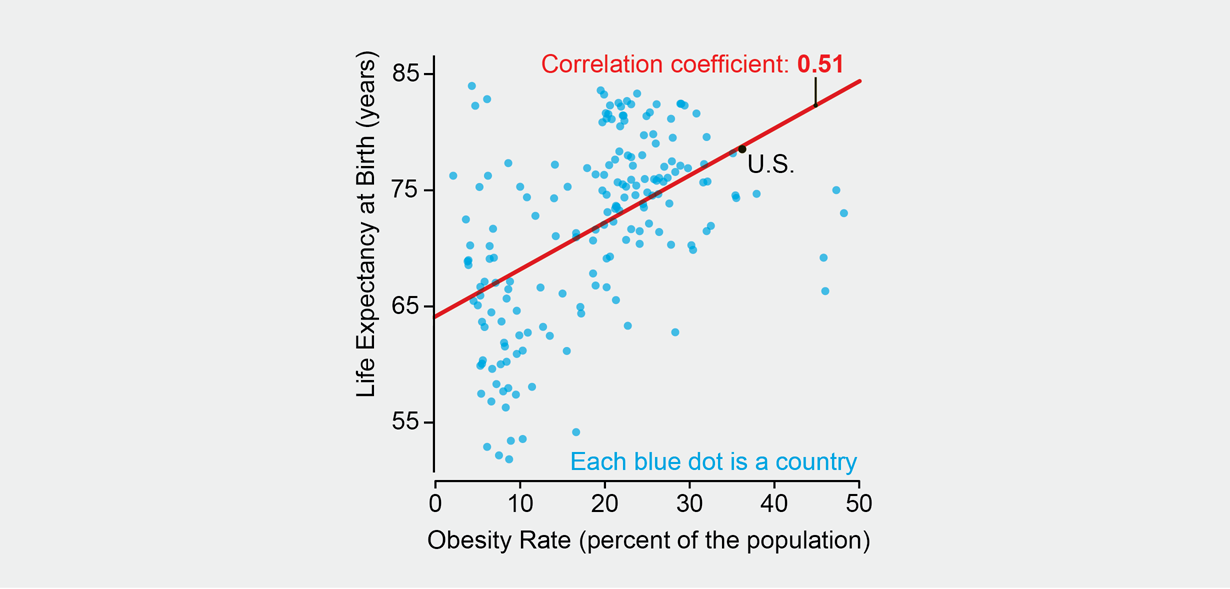
An anonymous reader shares a report: "A picture is worth a thousand words." That saying leads us to believe that we can readily interpret a chart correctly. But charts are visual arguments, and they are easy to misunderstand if we do not pay close attention. Alberto Cairo, chair of visual journalism at the University of Miami, reveals pitfalls in an example diagrammed here. Learning how to better read graphics can help us navigate a world in which truth may be hidden or twisted. Say that you are obese, and you've grown tired of family, friends and your doctor telling you that obesity may increase your risk for diabetes, heart disease, even cancer -- all of which could shorten your life. One day you see this chart. Suddenly you feel better because it shows that, in general, the more obese people a country has (right side of chart), the higher the life expectancy (top of chart). Therefore, obese people must live longer, you think. After all, the correlation (red line) is quite strong.

The chart itself is not incorrect. But it doesn't really show that the more obese people are, the longer they live. A more thorough description would be: "At the national level -- country by country -- there is a positive association between obesity rates and life expectancy at birth, and vice versa." Still, this does not mean that a positive association will hold at the local or individual level or that there is a causal link. Two fallacies are involved. First, a pattern in aggregated data can disappear or even reverse once you explore the numbers at different levels of detail. If the countries are split by income levels, the strong positive correlation becomes much weaker as income rises. In the highest-income nations (chart on bottom right), the association is negative (higher obesity rates mean lower life expectancy). The pattern remains negative when you look at the U.S., state by state: life expectancy at birth drops as obesity rises. Yet this hides the second fallacy: the negative association can be affected by many other factors. Exercise and access to health care, for example, are associated with life expectancy. So is income.

Medicine

Vaping Is Suspected In Severe Lung Illnesses (theverge.com) 166

U.S. health authorities from the Centers for Disease Control and Prevention are investigating the cases of 153 people, mostly teenagers and young adults, who developed several lung illnesses after using electronic cigarettes (Warning: source paywalled; alternative source). The Wall Street Journal reports: The cases have occurred in 16 states over the past two months, with many of the injured rushing to emergency rooms with difficulty breathing and other symptoms. No deaths have been reported, but some patients were so ill they spent days in intensive-care units on mechanical ventilators, the health authorities said. What exactly is causing the acute illnesses is unknown, though health experts suspect vaping plays a role. Vaping refers to the use of an electronic cigarette to inhale.

Many of the injured have told doctors or health authorities they were vaping products containing tetrahydrocannabinol, or THC, a key ingredient in marijuana, according to the Centers for Disease Control and Prevention, which is working with state health departments to identify the cause. At least some of the products were purchased from unlicensed sellers. "Investigators have not identified any specific product or compound that is linked to all cases," the CDC said in a statement. The Food and Drug Administration said it is testing e-cigarette products that the patients used. The health effects of vaping any product, even a well-known brand name, are under research and not yet fully known, tobacco researchers said.

Medicine

Maglev Heart Could Keep Cardiac Patients Alive 49

Bivacor is working toward human trials of their artificial heart after the implant successfully kept a calf alive for 90-days, helping it stay healthy, energetic, and gain weight at a normal rate. It even jogged on a treadmill for 30-minute stretches. Artificial hearts have been discussed among cardiac surgeons and biomedical engineers for more than 50 years, but what makes Bivacor's artificial heart so unique is its use of a levitating disk, suspended in a magnetic field, that spins 2,000 times per minute to keep blood flowing. IEEE Spectrum reports: We had to overcome many technical challenges to make an artificial heart that's small, biocompatible, energy efficient, and durable. Consider that the human heart beats about 112,000 times a day, which adds up to 42 million times a year, and you'll understand the magnitude of the challenge. We've tested the Bivacor heart in 15 cows so far. While the need for animal testing is unfortunate, it's the only way to prove the device's safety and move forward to clinical trials in humans. These Corriente calves, which are relatively small, are the right size to serve as analogues for adult patients. We've also implanted the Bivacor heart in several sheep, which are more representative of patients with smaller bodies, including children. Our tests have shown that the heart holds up well: With its one moving part levitating in a magnetic field, there's no worry that friction and mechanical wear will cause the machine to give out. Our tests have also shown that the device can adapt to the user's cardiovascular requirements.

The Bivacor heart would fit in the palm of your hand -- it's about 650 grams, slightly heavier than an adult human heart. Its shell is made of titanium, a noncorroding material that almost never triggers an immune response. Patients will wear a 4-kg external controller pack that contains two rechargeable batteries (providing about 5 hours of operation each), although they can also plug in directly to a power outlet. Throughout our design process, we used 3D printers to make both titanium and plastic parts for our prototypes, allowing us to rapidly experiment with different geometries. For testing, we built a hardware simulation of the human circulatory system in our engineering office in Los Angeles; this mock-up allows us to validate a device's function thoroughly and repeatedly in a controlled environment, and reduces the need for animal testing.
Science

Researchers Are Creepily Close To Predicting When You're Going To Die (arstechnica.com) 77

An anonymous reader quotes a report from Ars Technica: If death is in the cards, it may also be in your blood. Measurements of 14 metabolic substances in blood were pretty good at predicting whether people were likely to die in the next five to 10 years. The data was published this week in Nature Communications. A team of researchers led by data scientists in the Netherlands came up with the fateful 14 based on data from 44,168 people, aged 18 to 109. The data included death records and measurements of 226 different substances in blood. Of the 44,168 people, 5,512 died during follow-up periods of nearly 17 years.

The researchers then put their death panel to the test. They used the 14 blood measurements to try to predict deaths in a cohort of 7,603 Finnish people who were surveyed in 1997. Of those Finns, 1,213 died during follow-up. Together, the 14 blood measurements were about 83% accurate at predicting the deaths that occurred within both five years and 10 years. The accuracy dropped to about 72% when predicting deaths for people over 60 years old, though.

Facebook

How Flat Earthers Nearly Derailed a Space Photo Book (nytimes.com) 167

An anonymous reader writes: A photographer trying to raise money for a self-published book of historical space artifacts had his Facebook ads repeatedly removed by Facebook because flat-Earthers and Moon hoax conspiracy theorists were offended. About 24 hours after the ads were approved, he got a notification telling him the ad had been removed. He resubmitted it. It was accepted -- and then removed again -- 15 or 20 times, he said. The explanation given: He had run "misleading ads that resulted in high negative feedback."

He understood that it was Facebook's algorithm that rejected the ads, not a person. Getting additional answers proved difficult, a common complaint with advertising on Facebook. The best clues he could find came in the comments under the ads, which he and his colleagues captured in screenshots before they were removed and in responses to other posts about the project: There were phrases such as "The original moon landing was faking" and "It's all a show," along with memes mocking space technology. Some comments were hard to gauge, with users insisting that the earth was flat but that they'd buy the book anyway.

Mr. Redgrove didn't entirely blame the commenters. If these were their beliefs, then of course they were going to be annoyed by the ads. But how these individuals had ended up with the power to derail his campaign perplexed him. "They don't really have their systems in place to protect people," Mr. Redgrove said of Facebook. Facebook said it could not immediately comment on what had gone wrong. On Thursday, after the publication of this article, a representative for the company said it had investigated the issue and had confirmed that, as Mr. Redgrove had said, all the ads were originally approved.

Slashdot Top Deals