Sci-Fi

FBI, Air Force Agents Mysteriously Raid House of Guy Who Runs Area 51 Blog (gizmodo.com) 107

Earlier this month, agents from both the FBI and the U.S. Air Force raided multiple homes belonging to a man who runs a little-known blog about Area 51. Gizmodo reports: That man, Joerg Arnu, said the swarm of federal agents in riot gear busted into his primary residence, handcuffed him, then marched him outside to wait in the freezing cold while they rifled through his apartment and took pretty much every piece of electronic equipment that he owned. So far, the government has been pretty tight-lipped about the whole thing, but officials did verify that it happened. In a statement provided to the Las Vegas Review-Journal, Lt. Col. Bryon McGarry confirmed the raid. He did not elaborate on its purpose, saying only: "This is an open and ongoing law enforcement investigation between the Las Vegas FBI and Air Force OSI."

What did cops want? It's not exactly clear. Since 1999, Arnu has run Dreamland Resort, a website that covers activities in and around Area 51, the notoriously secretive government facility located in Groom Lake, Nevada. Long the subject of speculation and curiosity, the highly classified facility is the site of myriad UFO sightings. Coincidentally (or not), it is also the location where the Air Force reportedly tests and develops some of its most sensitive and experimental new projects and aircraft (see: the U-2 spy plane in the 1950s, for instance). Among other things, Arnu's site features pictures and writing about the Air Force's so-called "black projects" -- opaque, classified operations carried out behind a veil of government secrecy.
Arnu claims that the agents confiscated his "laptops, phones, backup drives, camera gear, and my drone were seized." He describes the situation in detail in a blog post on his website.
The Courts

Epic Says Google Paid Activision Millions Not To Launch Rival App Store (cnet.com) 16

An anonymous reader quotes a report from CNET: Fortnite developer Epic Games said Google paid the equivalent of $360 million to Call of Duty developer Activision Blizzard as part of a broad agreement that included a promise the gaming giant would not create a rival app store. The move, Epic said, helped solidify Google's hold on phones and tablets powered by its Android software. In the filing, newly unredacted Thursday, Epic said Google paid other developers in a similar way to Activision. Epic cited an agreement Google struck with Tencent, the Chinese company that owns League of Legends developer Riot Games, giving it about $30 million over one year. Like Activision, that money too was part of a larger agreement for Riot to maintain its Google-powered games and spend money promoting them as part of Android.

Google and Activision Blizzard both denied Epic's allegations about competing app stores. Google said the agreements are designed to provide incentives for developers to create apps for Google Play. "Epic is mischaracterizing business conversations," a Google spokesperson said in a statement. "It does not prevent developers from creating competing app stores, as Epic falsely alleges." Activision, for its part, said Google never "asked us, pressured us, or made us agree not to compete with Google Play." Activision is in the midst of being acquired by software giant Microsoft for $68.7 billion. [...] The filing is the latest allegation in Epic's ongoing lawsuit against Google, which it accuses of operating a monopoly with Google Play, which sells apps for Android. Epic's ongoing lawsuit is similar to another battle it's waging against Apple and its App Store over similar concerns of monopolistic practices. In both cases, Epic is pushing the companies to reduce the control they exert over their respective platforms, both in terms of how phone and tablet owners pay for apps and where to download them from.

It's unclear whether Epic's argument that Google paid developers to not compete will win in an eventual court case. Epic said in its complaint that "Google understood" the agreement would mean that Activision would "abandon its plans to launch a competing app store, and Google intended this result." But Armin Zerza, now Activision Blizzard's finance chief, said in one of the court filings that the company chose not to launch a rival app store because of the risk of failure, in addition to costs for development and marketing. When asked about entering a deal with Google that "accomplished your objectives," Zerza said that the Activision Blizzard board approved a deal with the Android maker because it "created multi-hundred-million dollars of value for us across multiple ecosystems." If Activision is ultimately purchased by Microsoft though, it may end up helping create an app store after all. Microsoft told regulators in October that it intends to build its own mobile app store to rival Google and Apple. Activision's deep library of popular games, including Candy Crush Saga and World of Warcraft, will be a key part of that effort.
"Epic's allegations are nonsense," an Activision representative said in a statement sent to PC Gamer. "We can confirm that Google never asked us, pressured us, or made us agree not to compete with Google Play -- and we've already submitted documents and testimony that prove this."
The Internet

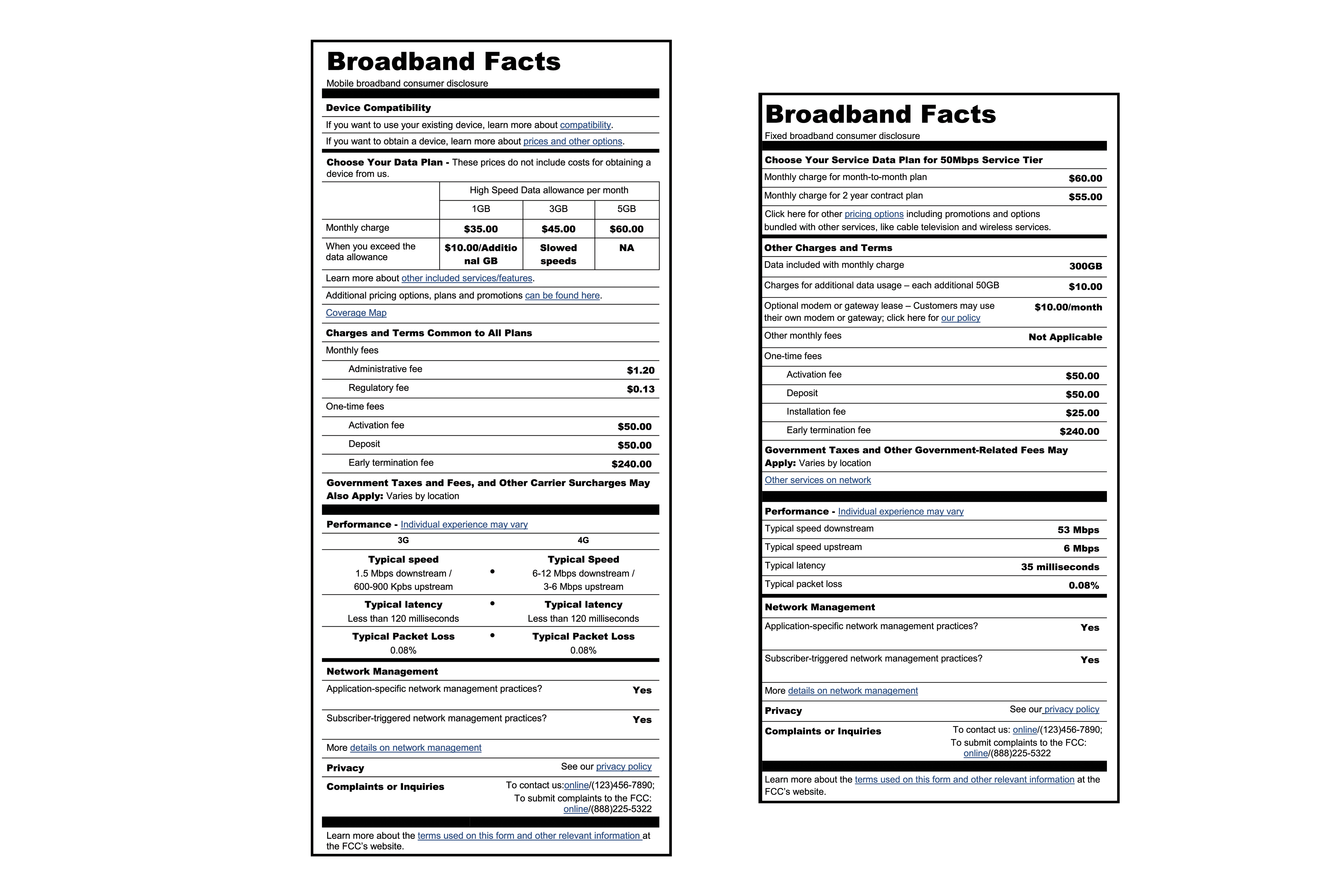
Nutrition Labels For Broadband Internet Are Finally Nearly Here (theverge.com) 23

Six years after we saw the FCC formally propose "nutrition labels" for your carrier's potentially confusing array of plans, the agency says it's finally happening. The Verge reports: This week, it's ordering US internet service providers to adopt the label format you're looking at [here] -- or it will, as soon as some last bureaucratic elements get worked out. They've changed a bit since 2016 -- now, each plan will apparently have its own label rather than ISPs trying to cram all of them into a single sheet, they don't warn you about coverage, and apparently, ISPs will be able to point you to their network management policy legalese instead of having to ding themselves for throttling data or giving some apps a fast lane. They won't have to report packet loss, either, it seems. Thankfully, ISPs will still need to report their typical speeds and latency, not just reiterate their advertised speed. Hopefully, someone will audit that.

Most big ISPs will have six months to slap the new labels onto their websites and distribute them in stores, though the FCC's giving ones with less than 100,000 subscribers a full year to comply. But none of those shot clocks start until the Office of Management and Budget reviews the order to make sure it complies with the Paperwork Reduction Act and similar statutes, the FCC notes, so it might be a bit longer. In the meanwhile, FCC Chair Jessica Rosenworcel suggests that ISPs might want to get ahead of things and adopt them on their own. The FCC also says it hopes these labels will evolve from here [...].

United States

Justice Department Said To Investigate Ticketmaster's Parent Company (nytimes.com) 63

The Justice Department has opened an antitrust investigation into the owner of Ticketmaster, whose sale of Taylor Swift concert tickets descended into chaos this week, The New York Times reported Friday, citing sources. The investigation is focused on whether Live Nation Entertainment has abused its power over the multibillion-dollar live music industry. From the report: That power has been in the spotlight after Ticketmaster's systems crashed while Ms. Swift fans were trying to buy tickets in a presale for her upcoming tour, but the investigation predates the botched sale, the people said. Staff members at the agency's antitrust division have in recent months contacted music venues and players in the ticket market, asking about Live Nation's practices and the wider dynamics of the industry, said the people, who spoke on condition of anonymity because the investigation is sensitive. The inquiry appears to be broad, looking at whether the company maintains a monopoly over the industry, said one of the people. Officials in the Biden administration have spent the last two years trying to push the boundaries of antitrust law. The Justice Department has mounted several challenges to major mergers, successfully convincing a judge to block Penguin Random House's purchase of Simon & Schuster but losing some other cases. The Federal Trade Commission has sued to block Meta, Facebook's parent company, from acquiring a small virtual reality start-up.
Google

Italy Court Rejects Google's Appeal Against Watchdog Fine, Accepts Apple's One 6

An Italian administrative court on Friday rejected an appeal by Alphabet's Google against a decision by Italy's antitrust authority to fine the group, but accepted iPhone maker Apple's appeal against the watchdog's ruling. From a report: Last year, Italy's antitrust regulator fined Google and Apple 10 million euros ($10.36 million) each, claiming that the two tech groups had not provided "clear and immediate information" on how they collect and use the data of those who access their services.
Facebook

Meta's Latest Large Language Model Survived Only Three Days Online (technologyreview.com) 57

On November 15 Meta unveiled a new large language model called Galactica, designed to assist scientists. But instead of landing with the big bang Meta hoped for, Galactica has died with a whimper after three days of intense criticism. Yesterday the company took down the public demo that it had encouraged everyone to try out. From a report: Meta's misstep -- and its hubris -- show once again that Big Tech has a blind spot about the severe limitations of large language models. There is a large body of research that highlights the flaws of this technology, including its tendencies to reproduce prejudice and assert falsehoods as facts.

Galactica is a large language model for science, trained on 48 million examples of scientific articles, websites, textbooks, lecture notes, and encyclopedias. Meta promoted its model as a shortcut for researchers and students. In the company's words, Galactica "can summarize academic papers, solve math problems, generate Wiki articles, write scientific code, annotate molecules and proteins, and more." But the shiny veneer wore through fast. Like all language models, Galactica is a mindless bot that cannot tell fact from fiction. Within hours, scientists were sharing its biased and incorrect results on social media.

Facebook

Facebook To Remove Several Information Fields From Profiles, Including Religious and Political Views (engadget.com) 55

Meta has confirmed that it's removing addresses, "interested in", political views and religion from Facebook profiles as of December 1st. Engadget reports: The move is meant to make Facebook "easier to navigate and use," a spokesperson told TechCrunch. If you've filled out any of these fields, you'll get a notification about the change. Other details you provide, such as your contact information and relationship status, will persist. You can download a copy of your Facebook data before December 1st if you're determined to preserve it, and you still have control over who can see the remaining profile content.
OS X

Nearly 50% of macOS Malware Comes From One App (neowin.net) 74

joshuark writes: Yikes, gadzooks, and shiver my timbers! Elastic Labs has found surprisingly that 50% of malware comes from one app: MacKeeper, ironically. Ironic in that MacKeeper claims to "keep your Mac clean and safe with zero effort." MacKeeper also has a tainted reputation for being difficult to completely uninstall and as a malicious antivirus.

A new spin on the biblical phrase, "Am I my brother's keeper..." Well, when the inmate is running the asylum.
The findings appear in Elastic Security Labs' recently released 2022 Global Threat Report. As Neowin reports, MacKeeper "can be abused by threat actors because it has extensive permissions and access to processes and files."

With that said, the report found that only 6.2% of malware ends up on macOS devices, compared to 54.4% and 39.4% on Windows and Linux, respectively.
Google

Google Rolls Out New Features Across Maps, Search and Shopping (techcrunch.com) 25

Google announced today that it's introducing a slew of new Maps, Search and Shopping features. The company revealed a majority of the new features during its Search On event in September and is now starting to roll them out to users. TechCrunch reports: Search
Starting today, users will be able to use Search to find their favorite dish at a restaurant near them. For example, you can search "truffle mac and cheese near me" to see which nearby restaurants carry the dish on their menu. Once you find a specific dish that you're looking for, you can get more information about its price, ingredients and more. Another new Search functionality lets you use Google's multisearch feature to find specific food near you. Say you see something tasty-looking online, but don't know what it is or where to find it. You can now use Lens in the Google app for Android or iOS to snap a picture or take a screenshot of a dish and add the words "near me" to find a place that sells it nearby. Later this year, Google is going roll out an update to its Lens AR Translate capabilities so users can more seamlessly translate text on complex backgrounds. Instead of covering up the original text like it currently does, Google is going to erase the text and re-create the pixels underneath with an AI-generated background, and then overlay the translated text on top of the image.

Maps
As for the new Maps features, Google is launching a new visual search experience called Live View in London, Los Angeles, New York, Paris, San Francisco and Tokyo. [...] In addition to displaying information about where places are, users will be able to see key information about each spot overlaid, such as whether the location is busy, if its open, what the price range is, etc. Another new Maps feature makes it easier for EV owners to find the best charging station for their vehicle. Now, you can search for "EV charging stations" and select the "fast charge" filter. You can also filter for stations that offer your EV's plug type. Google also announced that it's expanding its "accessible places" feature globally after initially launching it in the U.S., Australia, Japan and the U.K. in 2020. The feature is designed to help people determine whether a place is wheelchair accessible.

Shopping
Google has announced a new AR shopping feature that is designed to make it easier to find your exact foundation match. The company says its new photo library features 148 models representing a diverse spectrum of skin tones, ages, genders, face shapes, ethnicities and skin types. As a result, it should be easier for shoppers to better visualize what different products will look like on them. [...] Users can now also shop for shoes using AR.

Power

Ford CEO: 40% Less Labor To Build Electric Vehicles 162

An anonymous reader quotes a report from CleanTechnica: Ford CEO Jim Farley made a blockbuster of a statement this week. According to the somewhat jovial and optimistic cousin of late comedic actor Chris Farley, producing electric vehicles requires about 40% less labor than producing the same number of fossil-powered cars. The fact that electric vehicles are "simpler" than internal combustion engine (ICE) vehicles has long been a talking point of electric vehicle fans and evangelists (aka EVangelists). This has mostly come into play when talking about lower maintenance costs. There aren't all the belts, tubes, hoses, etc. that you find in a gasmobile. That means fewer parts that can break and less maintenance over time. What is less discussed is what Jim Farley has highlighted this week -- that it also means simpler production and a smaller labor force manufacturing the world's cars and trucks.

Interestingly, Farley is also taking this difference to shift Ford back to more vertical integration. Rather than lay off workers, Farley aims to retrain them to produce more parts within the walls of Ford. As Farley says it, "we have to insource, so that everyone has a role in this growth." Nonetheless, that's not easy and certainly not going to be 100% smooth. Farley noted that the transition to EVs would involve "storm clouds." Recall that Ford aims to reach 50% EV sales by 2030, up from just a few percent in 2022. Making that massive transition provides the opportunity for a new approach and retraining, but also plenty of likely hurdles and challenges.

The FT highlighted that back in the days of Henry Ford, vertical integration was the name of the game. "A shift in corporate strategy towards more vertical integration at Ford would hark back to the company's early days when founder Henry Ford owned forest, iron mines, limestone quarries and even a rubber plantation in Brazil to wholly control the company's supply chain," the media outlet stated. "If Henry Ford came back to life, he would have thought the last 60 years weren't that exciting, but he would love it right now because we're totally reinventing the company," Farley said.
The Courts

Nvidia Hit With Class Action Suit Over Melting RTX 4090 GPU Adapters 45

A frustrated owner of an RTX 4090 graphics card, suffering from the infamous melty power connector problem, has filed a class action suit against Nvidia. From a report: Filed in a California court on November 11th, the suit may make for painful reading for Nvidia and includes numerous allegations from fraud to unjust enrichment. The case refers to widely reported instances of the new-style 16-pin power connector used by Nvidia's GeForce RTX 4090 boards overheating and melting under heavy load. Reportedly, the lawsuit claims that Nvidia sold RTX 4090s with, "defective and dangerous power cable plug and socket(s), which has rendered consumers' cards inoperable and poses a serious electrical and fire hazard for each and every purchaser." It's notable that the claimant, one Lucas Genova, describes himself as "experienced in the installation of computer componentry like graphics cards," thereby aiming to head off any implication of user error at the pass.
Technology

USB-C Will Be Mandatory For All Smart Devices Sold in India (livemint.com) 37

India will be adopting USB-C type as a common charging port for smart devices, with stakeholders reaching a consensus at a meeting of an inter-ministerial task force, consumer affairs secretary Rohit Kumar Singh said on Wednesday. From a report: The government held wide-ranging consultations to standardize charging ports for all compatible smart devices, but it is yet to reach a decision on chargers for low-cost feature phones. With universal chargers consumers will no longer need a different charger every time they purchase a new device. Besides, the move will also reduce massive amounts of e-waste. In 2021, India is estimated to have generated 5 million tonnes of e-waste , only behind China and the US, according to an ASSOCHAM-EY report, Electronic Waste Management in India.
Windows

Windows 10 Still Having Problems With the Desktop and Taskbar (theregister.com) 68

Microsoft has fixed yet another problem in some versions of Windows 10, a bug that makes the taskbar and desktop temporarily vanish or causes the system to ignore you. From a report: According to Redmond, users "might experience an error in which the desktop or taskbar might momentarily disappear, or your device might become unresponsive." The issue affects PCs running Windows 10 versions 22H2, 21H2, 21H1, and 20H2, the company wrote on its Windows Health Dashboard. Microsoft didn't outline the exact cause but notes it was related to the KB5016688 220820_03051 cumulative update and later.

The software giant is using its Known Issue Rollback (KIR) feature -- which enables IT administrators to roll back the unwanted changes of an update -- to resolve the problem, adding that it could take up to 24 hours for the fix to reach non-managed business systems and consumer devices. Restarting the device may accelerate the timeframe. Organizations that use enterprise-managed devices can install and configure a special Group Policy by going to "Computer Configuration" and then "Administrative Templates" and "Group Policy name." If the resolution doesn't work, users can try restarting the Windows device, according to Microsoft. The latest fix comes after a number of other problems were resolved this week.

Google

10,000 Google Employees Could Be Rated as Low Performers (theinformation.com) 95

Jon Victor, reporting for The Information: As layoffs spread across Silicon Valley, Google has stood out by not cutting employees so far. But as outside pressure builds on the company to improve the productivity of its workers, a new performance management system could help managers push out thousands of underperforming employees starting early next year. Managers could also use the ratings to avoid paying them bonuses and stock grants.

Under the new system, managers have been asked to categorize 6% of employees, or roughly 10,000 people, as low performers in terms of their impact for the business, according to people with knowledge of the system. In the previous performance review system, managers were expected to put 2% of employees in that bucket. The new system, which Google in May announced in broad terms, also reduces the percentage of employees that can score a high rating. Details of the rating system haven't been previously reported.

Facebook

Meta Employees, Security Guards Fired for Hijacking User Accounts (wsj.com) 31

Meta has fired or disciplined more than two dozen employees and contractors over the last year whom it accused of improperly taking over user accounts, in some cases allegedly for bribes, The Wall Street Journal reported Thursday, citing people familiar with the matter and documents. From the report: Some of those fired were contractors who worked as security guards stationed at Meta facilities and were given access to the Facebook parent's internal mechanism for employees to help users having trouble with their accounts, according to the documents and people familiar with the matter. The mechanism, known internally as "Oops," has existed since Facebook's early years as a means for employees to help users they know who have forgotten their passwords or emails, or had their accounts taken over by hackers.

As part of the alleged abuse of the system, Meta says that in some cases workers accepted thousands of dollars in bribes from outside hackers to access user accounts, the people and documents say. The disciplinary actions are part of a lengthy internal probe led by Meta executives, according to the documents and one of the people. "Individuals selling fraudulent services are always targeting online platforms, including ours, and adapting their tactics in response to the detection methods that are commonly used across the industry," said Meta spokesman Andy Stone. He added that the company "will keep taking appropriate action against those involved in these kinds of schemes."

Mozilla

Mozilla Looks To Its Next Chapter (techcrunch.com) 111

Mozilla today released its annual "State of Mozilla" report and for the most part, the news here is positive. From a report: Mozilla Corporation, the for-profit side of the overall Mozilla organization, generated $585 million from its search partnerships, subscriptions and ad revenue in 2021 -- up 25% from the year before. And while Mozilla continues to mostly rely on its search partnerships, revenue from its new products like the Mozilla VPN, Mozilla Developer Network (MDN) Plus, Pocket and others now accounts for $57 million of its revenue, up 125% compared to the previous year. For the most part, that's driven by ads on the New Tab in Firefox and in Pocket, but the security products now also have an annual revenue of $4 million.

With the launch of this year's report, the Mozilla leadership team is also taking some time to look ahead, because in many ways, this is an inflection point for Mozilla. When Mozilla was founded, the internet was essentially the web and the browser was the way to access it. Since then, the way we experience the internet has changed dramatically and while the browser is still one of the most important tools around, it's not the only one. With that, Mozilla, too, has to change. Its Firefox browser has gone from dominating the space to being something of a niche product, but the organization's mission ("to ensure the internet is a global public resource, open and accessible to all") is just as important today -- and maybe more so -- as it was almost 25 years ago when Mozilla was founded.

Open Source

Thanks To Open Source, 5G Cracks 50% of the Telecom Market 25

An anonymous reader quotes a report from ZDNet: For years, 5G wasn't able to deliver on its high-speed, low-latency promises. Things have changed. Today, 5G is finally delivering on its performance promises. A big reason for that, proclaimed Arpit Joshipura, the Linux Foundation's general manager of Networking, Edge, and IoT at ONE Summit North America, a networking trade show, is 5G's open-source networking foundation. Joshipura said, "The industry has surpassed the tipping point when it comes to leveraging open source for enabling digital transformation. Leading organizations are using our projects' code -- which continues to evolve and mature -- in real-world deployments to scale."

How big a tipping point? According to Joshipura, 5G deployment is now over 50%. And according to some analysts, by 2030, 5G will reach $7 trillion -- that's trillion, not billion -- in economic value. Behind all this, Joshipura said, "is a radical shift toward open networks and frameworks. This continues irrespective of economic and political headwinds. Indeed, open source is probably the only area that hasn't been impacted because of its ability to cross borders and boundaries to do what needs doing."
The Linux Foundation is working on an End-to-End, 5G Super Blueprint to bring together a wide variety of open-source networking programs and projects.

"While still a work in progress, it maps out a way to bring together multiple open-source and cloud-native projects into a relatively simple 5G deployment map," adds ZDNet. "It's designed so that any telecom can put together a high-bandwidth, low-latency, scalable, and cost-effective digital networking infrastructure all the way from end-user devices to the edge to cloud applications."
Android

DuckDuckGo's Anti-Tracking Android Tool Could Be 'Even More Powerful' Than iOS (arstechnica.com) 31

An anonymous reader quotes a report from Ars Technica: Privacy-focused search site DuckDuckGo has added yet another way to prevent more of your data from going to advertisers, opening its App Tracking Protection for Android to beta testers. DuckDuckGo is positioning App Tracking Protection as something like Apple's App Tracking Transparency for iOS devices, but "even more powerful." Enabling the service in the DuckDuckGo app for Android (under the "More from DuckDuckGo" section) installs a local VPN service on your phone, which can then start automatically blocking trackers on DDG's public blocklist. DuckDuckGo says this happens "without sending app data to DuckDuckGo or other remote servers."

Google recently gave Android users some native tools to prevent wanton tracking, including app-by-app location-tracking approval and a limited native ad-tracking opt-out. Apple's App Tracking Transparency asks if users want to block apps from accessing the Identifier for Advertisers (IDFA), but apps can still use the largest tracking networks across many apps to better profile app users. Allison Goodman, senior communications manager for DuckDuckGo, told Ars Technica that App Tracking Protection needs Android's VPN permission so it can monitor network traffic. When it recognizes a tracker from its blocklist, it "looks at the destination domain for any outbound request and blocks them if they are in our blocklist and the requesting app is not owned by the same company that owns the domain." Goodman added that "much of the data collected by trackers is not controlled by [Android] permissions," making App Tracking Protection a complementary offering.

Transportation

US Safety Watchdog Warns Against Onewheel Boards After Reported Ejection Injuries (engadget.com) 71

The U.S. Consumer Product Safety Commission (CPSC) warned Americans against buying or using any Onewheel self-balance skateboardings, ranging from the original through to newer models like the GT and Pint X. Engadget reports: The vehicles can forcefully eject riders, the CPSC said. The Commission added that here have been reports of "at least" four deaths and multiple serious injuries between 2019 and 2021 after the boards either stopped balancing properly or came to an abrupt stop.

Onewheel creator Future Motion has refused a recall and rejected the CPSC's stance. The company believes the Commission's warning is "unjustified and alarmist," and that its boards are safe if they're used responsibly with appropriate safety equipment. Board owners are "adults" who know that there's always a risk to any board sport or even riding a bike, Future Motion argued. To that end, it noted that the CPSC itself prized safety education over warnings when snowboarding took off in the 1990s.

The firm said it had studied boards affected by sudden stops, and hadn't found any inherent technical problems. Onewheels have lower serious injury rates than bikes, ATVs and motorcycles, Future Motion claimed. It also accused the CPSC of preferring a "sensational" alert over cooperating on safety improvements.

United States

US House Committee To Hold Hearing on FTX Collapse and Crypto Fall Out (theblock.co) 75

The House Financial Services Committee will hold a hearing next month on FTX's collapse and the broader implications for the digital asset industry. From a report: The committee says it expects to hear from "the companies and individuals involved, the companies and individuals involved, including Sam Bankman-Fried, Alameda Research, Binance, FTX, and related entities, among others," for a hearing to take place in December. "Oversight is one of Congress' most critical functions and we must get to the bottom of this for FTX's customers and the American people," said Rep. Patrick McHenry, R-N.C., the top committee Republican, in a statement. "It's essential that we hold bad actors accountable so responsible players can harness technology to build a more inclusive financial system." Rep. Maxine Waters, D-Calif., the current but likely outgoing chair of the House Financial Services Committee, added: "The fall of FTX has posed tremendous harm to over one million users, many of whom were everyday people who invested their hard-earned savings into the FTX cryptocurrency exchange, only to watch it all disappear within a matter of seconds. Unfortunately, this event is just one out of many examples of cryptocurrency platforms that have collapsed just this past year."

Slashdot Top Deals