
Why Meetings Can Harm Employee Well-Being (phys.org) 72
Phys.org republishes this article from The Conversation:
On average, managers spend 23 hours a week in meetings. Much of what happens in them is considered to be of low value, or even entirely counterproductive. The paradox is that bad meetings generate even more meetings... in an attempt to repair the damage caused by previous ones...
A 2015 handbook laid the groundwork for the nascent field of "Meeting Science". Among other things, the research revealed that the real issue may not be the number of meetings, but rather how they are designed, the lack of clarity about their purpose, and the inequalities they (often unconsciously) reinforce... Faced with what we call meeting madness, the solution is not to eliminate meetings altogether, but to design them better. It begins with a simple but often forgotten question: why are we meeting...?
The goal should not be to have fewer meetings, but better ones. Meetings that respect everyone's time and energy. Meetings that give a voice to all. Meetings that build connection.
Slashdot reader ShimoNoSeki shares an obligatory XKCD comic...
A 2015 handbook laid the groundwork for the nascent field of "Meeting Science". Among other things, the research revealed that the real issue may not be the number of meetings, but rather how they are designed, the lack of clarity about their purpose, and the inequalities they (often unconsciously) reinforce... Faced with what we call meeting madness, the solution is not to eliminate meetings altogether, but to design them better. It begins with a simple but often forgotten question: why are we meeting...?
The goal should not be to have fewer meetings, but better ones. Meetings that respect everyone's time and energy. Meetings that give a voice to all. Meetings that build connection.
Slashdot reader ShimoNoSeki shares an obligatory XKCD comic...

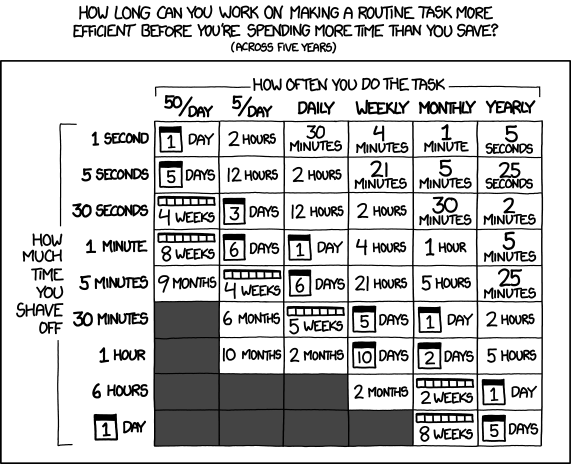
So (Score:5, Funny)
Re:So (Score:5, Insightful)
I'm not even a manager and there are, at present count, 30 hours of meetings on my calendar. I go to less than half, I just let the meetings sandbag my calendar so that new meetings are difficult to schedule. Either you know me and we have a reason to meet, or fuck you.
The actual managers are much worse off. Corporate life is stupid.
Re: (Score:3)
Re: (Score:3)
It all depends on the manager. A good manager (and good managers do exist) will find ways to use their time wisely, they will limit their time in meetings, and the meetings they do attend or run, will be productive.
Re: (Score:3)
With the other half being of negative worth? Color me non-surprised.
Modified XKCD here (Score:2)
Having to attend multiple what happened after the fact post-outtage report meetings......
A modified XKCD fits here - https://www.reddit.com/r/Progr... [reddit.com]
What I've noticed is that most every project turns into an infrastructure project at some point due to the developers being expected to do what was 5 different jobs pre-cloud and be experts in all of them.
Re: (Score:2)
Nice! Also pretty accurate. Well, build houses of cards on sand and this happens. What I do not get is that these people do not see it. It is neither difficult to understand not is it without precedent. In fact, there is a very large body of examples from when other engineering disciplines struggled to get to maturity. And it is even in the mainstream media (for example the Titanic, Tchernobyl and Fukushima).
These people must be determinedly dumb, uneducated and incompetent.
Re: So (Score:3)
Re: (Score:2)
Replacing unreliable, poorly informed middle managers that the rank and file have to work around to get their jobs done with unreliable hallucinating LLMs that the rank and file have to work around to get their jobs done...
(And yet wouldn't take much to be better than half the people I dealt with when last at a Fortune X company!)
(How do Fortune X companies function, you ask? Usually despite themselves!)
(For those not initiated, let me give it to you straight: many megacorps actually manage to look dumber
Re: (Score:2)
Half the work of managers is of low quality or low value. Who saw that coming?
It could be worse, a lot worse.
Imagine if those useless middle managers were tasked with doing something important rather than merely wasting the time of people capable of doing something important.
Re: (Score:2)
Clear Agenda (Score:5, Interesting)
Re: Clear Agenda (Score:1)
Re: (Score:2)
Good advice.
I'd personally instigate a rule that any meeting with more than 3 occurrences gets deleted. That is, you get to book your "weekly catchup", but it magically disappears from the calender in week 4. If you still need it, then go ahead and re-book it, otherwise, it's a talking shop and we didn't need it.
I'd do the same for "weekly reports" too - pretty much any repeating task performed by anyone ;-)
Re: (Score:2)
no... (Score:1)
Re: (Score:2)
No managers, huh? How does that work when two people disagree, and can't come to an agreement? Who makes decisions about who to hire? Who decides when it's time to let somebody go, and who carries out that unpleasant task? Who decides what projects are higher priority? Who reins in executives who want everything right now? Who do you go to when you want to talk about your next pay raise?
You might have gotten rid of your managers, but I'll bet somebody is still doing all these tasks. In other words, somebody
Re: (Score:2)
Right...new managers have been spawned from within existing employees - think agents in The Matrix - that's why the productivity increase was limited to 3x :-)
Re: no... (Score:2)
Re: (Score:2)
So in your scenario, who is going to determine which product is better? Wouldn't that be a...manager? And what happens when someone in your smaller team disagrees with someone else in the smaller team? No, this scenario doesn't make anything better, it just makes the groups smaller. If you have more than one person on a "team" you will have issues to resolve between team members. It's called human nature.
I actually lived through your approach once. Two dev teams were given the same assignment. The better pr
Re: no... (Score:2)
Re: (Score:2)
So you have to _release_ both products (because if you don't release them, the customer never sees them) and then let the customer decide?
What does happen to the team that loses? Maybe some customers like the losing product better, and some customers like the winning product better. Now what?
And your approach wastes a LOT of money to make a point that managers aren't needed. You now have two teams doing essentially the same project, in different ways. You are essentially throwing away all the hours spent by
Re: no... (Score:2)
Re: (Score:2)
What if there are three approaches being pushed by three team members? Or four? Are you going to create four teams to prove out all four ways? What if you start building out all these teams, and two people in one of the teams disagrees?
The reality is, as long as a team has more than one person, there will be disagreements. Somebody has to resolve those disagreements. Your managerless-solution quickly becomes a management nightmare.
Re: no... (Score:2)
Re: (Score:2)
So those teams report to _no one_? Really?
What you're describing is actually a cluster of teams that (in all likelihood) report to a single manager (or director, or whatever).
I don't believe that your teams are truly autonomous.
Re: (Score:2)
Re: (Score:2)
Glad to hear you do have...managers, and that they are good ones. Good managers do exist, and they do delegate.
Oh, and among your 100 people that report to these two managers? My guess is that there are *numerous* leaders within this group, who are responsible for various specific aspects of the way your team does things, or various specific groups of people. These people would have those responsibilities delegated to them by your two "managers." You aren't working *without* managers, just a distributed man
Re: no... (Score:2)
Re: (Score:2)
The point is, you have managers, you just don't call them that. The first level of the hierarchy *are* your managers. Under them, you also have people who have the authority to make decisions. By whatever name, you can't dodge the need for managers by calling them something else.
Re: (Score:2)
Re: (Score:2)
Whatever. You are sidestepping the point.
How does that work when two people disagree, and can't come to an agreement? Who makes decisions about who to hire? Who decides when it's time to let somebody go, and who carries out that unpleasant task? Who decides what projects are higher priority? Who reins in executives who want everything right now? Who do you go to when you want to talk about your next pay raise?
All these tasks are done by somebody. That somebody or somebodies, is acting as a manager, when they perform these functions. Just because you don't call them managers, doesn't make them "not" managers.
It's kind of like Walmart calling cashiers and stockers "associates" or Starbucks calling them "partners." It's essentially a euphemism.
Re: no... (Score:2)
Re: no... (Score:2)
Re: (Score:2)
Re: (Score:2)
If "being a tie breaker" were the only thing a manager does, then I'd agree with you. But you conveniently left out all the other items in my list, making your argument artificially simple.
Limit to Seven People (Score:5, Interesting)
I think about the many thousands of man-hours wasted during these meetings throughout the year, and the salary that costs, when I hear a PHB stating that new hardware, software, training, or personnel just aren't in the budget.
Re: (Score:2)
I recall reading that if you have a meeting with more than seven people, you are probably having an ineffective meeting. I am regularly forced to attend meetings with 20-30 people. It's always the same 3-4 people who speak, everyone else remains silent.
In my experience, with only rare exceptions, the limit should be three. More than three, and you are likely involving people working on multiple projects who don't really need to know what the people on other projects are doing beyond what an email every few months would provide.
Those rare exceptions are situations where you have a meeting of managers in an org or similar with each other, where everybody is working towards the same goals, and they're planning towards those goals.
Or the way I usually descri
Re: (Score:2)
Depends on the meeting. A great many of my meetings over a couple of people are those with information dumps. It may only be 3 or 4 who speak and discuss, but a great many more may need information.
Mind you I work in an industry where multi-disciplinary meetings are essential. Add in if you work with a contractor and you get meetings which require a minimum of 8 people, or you have 1 meeting and then 4 follow ups just so people can forward information which isn't effective either.
Re: (Score:1)
7 people is already too much.
If you have a meeting with more than 3-4 people, what you are doing is a _presentation_ rather than a _meeting_.
Gathering from experience, most meeting organizers invite too many people out of fear/missing out. They often miss that it would be more efficient to have the meeting, write down _who_ are the important missing people and organize another meeting with _them_.
Better meeting engineering (Score:4, Interesting)
I used to schedule our weekly meetings where everyone had to stand and started it 30 minutes before lunch. It stuck to important business only and rarely went over.
ALL Meetings (Score:3)
Fixed that for ya'
Re: (Score:3)
There are some ingenious managers who will drag out a meeting, with or without chairs!
Simple solution (Score:5, Interesting)
Back in the aughts, I wrote an Outlook (ugh) plugin to prominently display the cost of a meeting based on the length of the meeting and the midpoints of the salary bands of all participants. I did the same for emails based on the length of the email and again the salary bands of all recipients.
Problems of pointless meetings and emails with half the company in CC disappeared almost overnight.
Re: Simple solution (Score:3)
They wanted to hold a meeting about it. I refused. Out of budget. That got some of them... woke. You have to annoy these guys. Never let them get too comfortable. Keep em busy or else they start spewing brilliant ideas everyone has had before. (take this with a grain of salt)
Re: (Score:2)
Re: (Score:2)
Re: Simple solution (Score:1)
No, but the ideal salary midpoints for each level were communicated.
Re: (Score:2)
I worked for a gov't contractor that would have benefited from that.
Our leadership had a penchant for sending *VPs* to take *notes* to increase the bill rate to the gov. Often enough the gov clients actually complained lol
The dissipated responsibility model (Score:2)
Most problems can be solved by speaking to the SME or stakeholder directly, without involving more people. DM or a quick call. That's all it takes. Why would you need a scheduled meeting with irrelevant, overly-opinionated audience to agree on something that takes 5 minutes to decide? Are you afraid of making a judgement call yourself and are you trying to dissipate the responsibility instead? Don't they pay you to do the actual work?
Does this need to be a meeting? (Score:2)
The first thing to do is ask "Does this need to be a meeting?". If all you're doing is disseminating information, it doesn't. Send the information in an email instead. If you expect questions, send it in an email and have people ask their questions via an email thread. If you start getting debate on a question, then you need to schedule a meeting or take it to real-time chat. If you want feedback and expect debate on changes, send it in an email and schedule a meeting later to give people enough time to und
Re: (Score:3)
Not everyone is good at absorbing written material. For that matter, not everyone is good at writing informative emails. Often, the conversation *is* the thing that has value.
Re: (Score:1)
and not everyone is good ad absorbing verbal material, but here we are.
I would prefer written for two reasons:
I can read faster than you can speak
We now have written evidence of what was asked for or what was delivered.
That second point may be a disadvantage for some...
Re: (Score:2)
I hear you, but when people send long emails, it's my experience that most people don't read them, and especially they don't read them paying attention to the details.
Re: (Score:3)
And their inability or unwillingness to do their job is my problem... how again?
I found it saves a lot of time for everyone if I refuse to indulge the person who didn't read the e-mail and proceed with everyone else's questions, or if it's wide-spread enough just reschedule the meeting to give everyone more time and call it there.
Re: (Score:3)
In the real world, we have to get work done with flawed, imperfect humans. If our expectation is that everyone will always read their emails carefully, we are delusional. Perfection is the enemy of good.
A person who refuses to indulge others' weaknesses, within reason, is someone who will not get far or make friends in the real world. You certainly won't make friends with *me* with that attitude. You, yes you too, have weaknesses, despite your apparent insistence on perfection.
Re: (Score:2)
I read something once that this jogged in my brain...
There are 4 types of people:
1. Gets work done, espouses company ethics - easy keep
2. Doesn't get work done, doesn't follow ethics - easy fire
3. Doesn't get work done but shows ethics and effort - keep and help
4. Gets work done but doesn't espouse company ethics.
#4 needs to be shown the door LOUDLY so people understand.
Re: (Score:2)
Re: (Score:2)
Which is an argument for e-mails, really. It's sitting there waiting for them to need the information, and they can just refer to it at that point if they need to. I have little sympathy for the position of "But I don't want to do my job...".
I need to coordinate with my peers (Score:2)
I don't necessarily need a manager present to do this. I'm a big boy and can schedule a meeting and politely invite the small number of people it takes to coordinate.
Don't show up to bad meetings (Score:3)
I'm a lead programmer in the games industry, and I did not show up to meetings with low value. But that said, 50% of my time was spent on meetings and managerial duties.
Critically, I consider it my job to go to meetings so the other programmers on my team DON'T. We need to talk about the state of the game. We need to discuss mechanics and timelines and all sorts of things. But I don't want other programmers in more than a few hours of meetings a week, and most of those meeting hours should be just in our team giving and getting updates.
We were aggressive about cutting meetings that people felt had little or diminishing value. Sometimes meetings are useful for a time and then they're not. I never went to a meeting that I was invited to where I didn't feel like I needed to hear the information or present something useful. Guard your own time, no matter what level of worker you are.
But yeah, useless meetings feel terrible. I didn't feel bad about the meetings I went to because we often accomplished a lot.
\o/ (Score:1)
Meetings with more than two people are susceptible to ego games - definitely not productive.
really? (Score:2)
A 2015 handbook laid the groundwork for the nascent field of "Meeting Science". Among other things, the research revealed that the real issue may not be the number of meetings, but rather how they are designed, the lack of clarity about their purpose, and the inequalities they (often unconsciously) reinforce...
You needed a handbook for that?
Anyone who ever went to a business meeting could've told you that.
By my experience, it takes only 4 things to make a meeting productive: a) someone is in charge of the meeting and moderation, b) that someone had time to prepare, c) everyone in the meeting has received an agenda with enough lead time to have read it and (if necessary) prepare their part, at least a bit and finally d) there is at least a simple protocol of the meeting for those who couldn't attend, those who doz
Er (Score:1)
Meetings that give a voice to all
This is what drags meetings out, usually.
It's especially lame when there is some meeting protocol that requires everyone to speak."Um, yeah; I agree with the last ten people that we should do what the powers that be have already decided we should do anyway".
Most meetings ... (Score:1)
... could be replaced by an email conversation.
But then, arguments would actually have to be made (from something other then enthusiasm), and could be considered dispassionately. And everything would be in writing. We can't have that!
Regular meetings suck (Score:2)
Weekly status meetings were no better. I could never understand why people felt the need to use the entire hour they'd booked the room for. When I ran them, w
One of the best managers I ever had (Score:2)
A day after he joined our group he went to the weekly [lack of] progress meeting which was scheduled from 15:30 - 16:00.
We had a couple of people who loved the sound of their own voices and would waffle on and on at length. At 16:00 precisely he said "That's it! meeting over!". When some objected he simply said "You knew the times of the meeting, the end time is not unexpected. If you cannot run a meeting on time, you cannot run a project on time!"
Shortly afterwards we also had a meeting where board level
The real reason meetings occur (Score:2)
1. There are too many people who can't be trusted to provide accurate progress updates to everyone.
2. There are too many people who don't know know how to provide concise update reports. I don't want a "War and Peace" but I also don't want 2 sentences
3. There are too many people who don't understand what needs to be done so you got to pull everyone together and explain it
4. Some people just need something to fill up their day so it looks like they're productive
5. Execs
Shocked... (Score:2)
Back in the mid-ninties, working for Ameritech, for a while the idiots in charge demanded a DAILY status update from every team (which by this time, there were 27 of us). This mean the senior technical people had to go to this every single bloody weekday. We'd joke at how fast it ran if it lasted under an hour.
And that was when I was working 12, 13, and a few times 16 hour days. And getting paged at home.
Speaking of wasted time (Score:2)