

US Farmers Are Rejecting Multimillion-Dollar Datacenter Bids For Their Land (theguardian.com) 96
An anonymous reader quotes a report from the Guardian: When two men knocked on Ida Huddleston's door last May, they carried a contract worth more than $33m in exchange for the Kentucky farm that had fed her family for centuries. According to Huddleston, the men's client, an unnamed "Fortune 100 company," sought her 650 acres (260 hectares) in Mason county for an unspecified industrial development. Finding out any more would require signing a non-disclosure agreement. More than a dozen of her neighbors received the same knock. Searching public records for answers, they discovered that a new customer (PDF) had applied for a 2.2 gigawatt project from the local power plant, nearly double its annual generation capacity. The unknown company was building a datacenter. "You don't have enough to buy me out. I'm not for sale. Leave me alone, I'm satisfied," Huddleston, 82, later told the men.
As tech companies race to build the massive datacenters needed to power artificial intelligence across the US and the world, bids like the one for Huddleston's land are appearing on rural doorsteps nationwide. Globally, 40,000 acres of powered land – real estate prepped for datacenter development -- are projected to be needed for new projects over the next five years, double the amount currently in use. Yet despite sums that often dwarf the land's recent value, farmers are increasingly shutting the door. At least five of Huddleston's neighbors gave similar categorical rejections, including one who was told he could name any price.
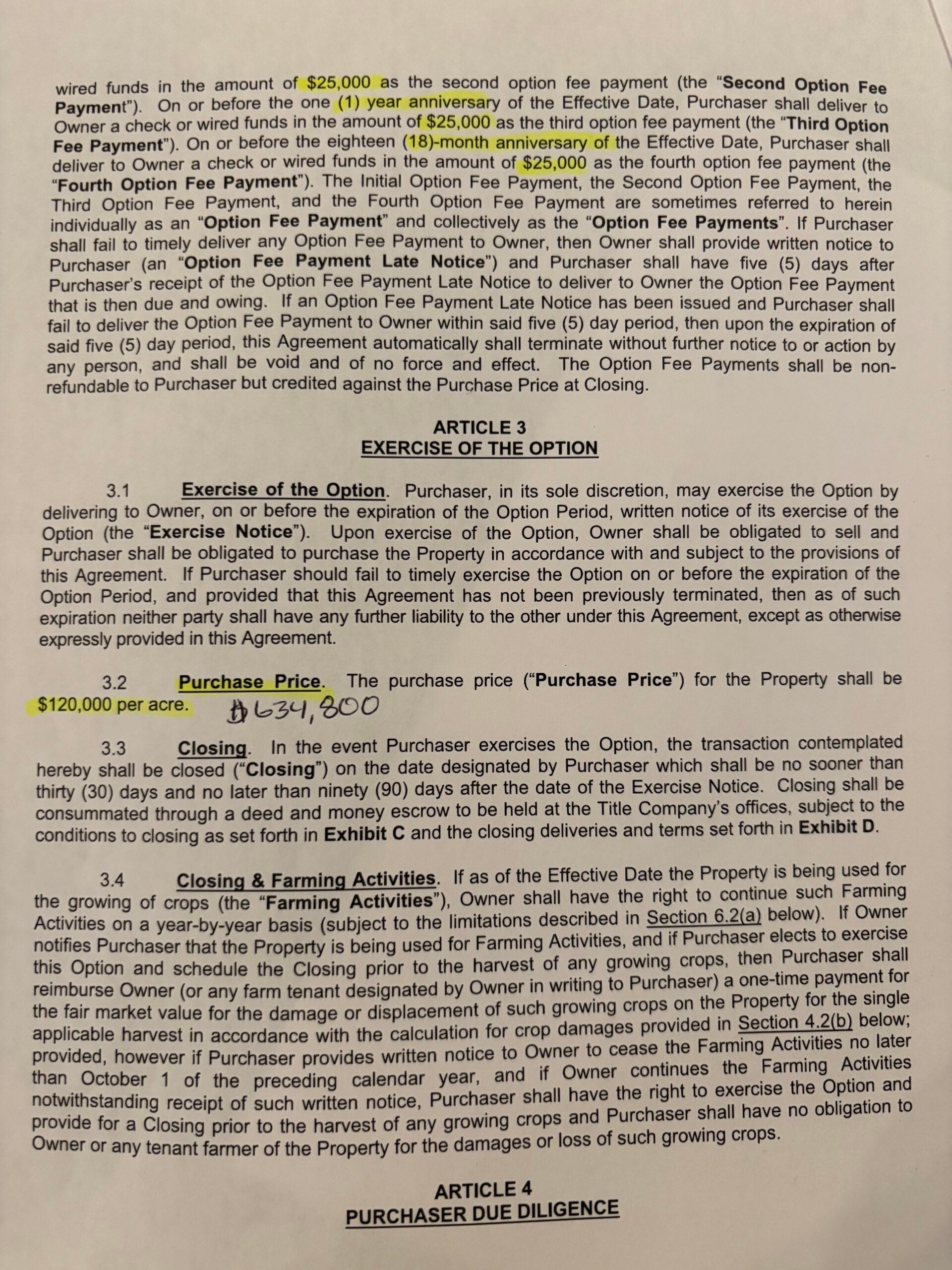
In Pennsylvania, a farmer rejected $15m in January for land he'd worked for 50 years. A Wisconsin farmer turned down $80m the same month. Other landowners have declined offers exceeding $120,000 per acre -- prices unimaginable just a few years ago. The rebuffs are a jarring reminder of AI's physical bounds, and limits of the dollars behind the technology. [...] As AI promises to transcend corporeal fallibility, these standoffs reveal its very physical constraints -- and Wall Street's miscalculation of what some people value most. In the rolling hills of Mason county and farmland across America, that gap is measured not in dollars but in something harder to price: identity.
As tech companies race to build the massive datacenters needed to power artificial intelligence across the US and the world, bids like the one for Huddleston's land are appearing on rural doorsteps nationwide. Globally, 40,000 acres of powered land – real estate prepped for datacenter development -- are projected to be needed for new projects over the next five years, double the amount currently in use. Yet despite sums that often dwarf the land's recent value, farmers are increasingly shutting the door. At least five of Huddleston's neighbors gave similar categorical rejections, including one who was told he could name any price.
In Pennsylvania, a farmer rejected $15m in January for land he'd worked for 50 years. A Wisconsin farmer turned down $80m the same month. Other landowners have declined offers exceeding $120,000 per acre -- prices unimaginable just a few years ago. The rebuffs are a jarring reminder of AI's physical bounds, and limits of the dollars behind the technology. [...] As AI promises to transcend corporeal fallibility, these standoffs reveal its very physical constraints -- and Wall Street's miscalculation of what some people value most. In the rolling hills of Mason county and farmland across America, that gap is measured not in dollars but in something harder to price: identity.

Explains why food got so expensive (Score:4, Insightful)
If farmers are being offered super high prices for their land, well, not all of them are going to have the courage and financial resources to turn down the offers.
The less honorable / farmers in debt are going to sell out and reduce the supply of food. Meanwhile those farmers wishing to buy more land will find inflated prices, so they will raise their own prices.
Re: (Score:3)
40000 acres is not a lot of land. We lose more arable land than that to homebuilders.
Re: (Score:2)
America has about a billion acres of farmland.
40k is 0.004%.
But the 40k is not all in America, and is not all farmland.
Re:Explains why food got so expensive (Score:5, Interesting)
The US is not exactly farm land limited. It's going to be water limited by mid-century though, as the Midwest aquifier is being drained out by farming.
In any case, what I find more interesting in TFA is the fact that a source of people who are not for sale has been found in the US. Wipe DC clean and put these people in charge asap.
Re: (Score:3)
> Wipe DC clean and put these people in charge asap.
Won't work: The people have a relationship with their land, once in washington that relationship would be gone. What you want in washington are very strong altruists: people who care more about others than about themselves.
Re: (Score:2)
Nail on the head. Nobody survives in farming unless they are 1) practical, and 2) forward looking.
At a scale of 100-1000 acres or so where can't easily expand because the lands around you are not for sale, that mostly looks like 'conservationism' to the outsider.
The trash heap and burn pile are still there somewhere on the back 40 out of site and away from where they will contaminate product, the well, etc. If you are expecting a drought that will send the price of hay thru the roof, then beef heard is loo
Re: Explains why food got so expensive (Score:1)
I wish folk like John Dutton from Yellowstone TV series (portrayed by Kevin Costner) would actually exist. In the series, the day he is elected mayor, he walks in to the office and find an entire board voting on multiple programs to take over farm lands and he was not even invited to voice his opinion. Ends up saving a ton of money by firing everyone for that move, and this was a resounding ray of hope to the masses, viewers included.
Re: you've got a couple (Score:2)
"(Note - the "jewish space laser" was not something she ever said - it was made up by zionists to make her sound stupid.)"
Note that Jewish space laser was only a paraphrase of what she actually did say.
Re: (Score:2)
Re: (Score:2)
> Note - the "jewish space laser" was not something she ever said - it was made up by zionists to make her sound stupid.
Right, what she said was
"""
Then oddly there are all these people who have said they saw what looked like laser or blue beams of light causing the fires, and pictures and videos. I don't know anything about that but I do find it really curious PG&Es partnership with Solaren on space solar generators started in 2009. They announced the launch into space in March 2018, and maybe even
Re: (Score:2)
It is well known that food is expensive because of price fixing via 3rd party "price optimization" companies like agristats. Unfortunately, the current administration has other priorities, and the case [justice.gov] hasn't been moving. Farmers are not getting any of the money from these price increases, its all going to the processors and the nationwide retail chains that have pricing power, for example wal-mart.
Re: (Score:2)
Not really, because you can just look at the public record of the motions filed by the DOJ and trivially correlate the the stop in action with the administration change.
Food inflation via price fixing has been steadily increasing for the last like 15 years. I'm not blaming Trump for that. I'm saying the court case to make it stop mysteriously stopped moving forward. (Its not a mystery).
Re:Explains why food got so expensive (Score:5, Informative)
Raise their own prices?! You don't know much about farming do you. Farmers sell commodities. As such they don't set prices. When a farmer wants or needs to sell his crop, grain buyers put out bids based on the futures market and a basis level. Farmers take it or leave it. That's it. Farmers can hedge or speculate in the futures market but individually they have no influence on the market.
During the pandemic when artificial shortages caused companies to arbitrarily triple input costs for farmers, someone said to a friend of mine, I guess now you've got to raise your prices to stay profitable don't you. He was speechless that people generally were that ignorant of the basic facts of food production.
Re: (Score:2)
Someone already mentioned that the US already has a large amount of idle and abandoned arable land, but here are the actual numbers:
Active Cropland: 338 million acres
Pasture Only: 12 million acres
Idle Cropland: 39 million acres
Abandoned Cropland: 30 million acres
Hines Research Data Center Land Needs 2025-2030: 40,000 acres
So even if all new data centers are built on arable land, we would need to activate about 0.06% of our idle or abandoned cropland. This is a non-issue.
Is food expensive? (Score:2)
Let's check commodity prices over the past 5 years:
Corn: down [tradingeconomics.com]
Oats: down [tradingeconomics.com]
Rice: down [tradingeconomics.com]
Wheat: down [tradingeconomics.com]
Milk: down [tradingeconomics.com]
Cheese: down [tradingeconomics.com]
Coffee: up, significantly [tradingeconomics.com]
Sugar: down [tradingeconomics.com]
Cocoa: up [tradingeconomics.com]
So the staple commodities prices over the past 5 years have dropped, and that's in light of 20% inflation in that time period. Coffee prices have surged (as have cocoa, though they're down as of late), but land buyers for data centers aren't surveying land in the tropics.
You may be spending more on food, but I don't think it's because of North America
Re: (Score:2)
The less honorable / farmers in debt are going to sell out and reduce the supply of food. Meanwhile those farmers wishing to buy more land will find inflated prices, so they will raise their own prices.
And the ones who are stuck living within a few miles of the data centres will pay with their health - and eventually, maybe even their lives: https://www.youtube.com/watch?... [youtube.com]
It turns out that data centres create huge amounts of infrasonic energy, which has nasty effects on humans. So these behemoths make great swathes of land around them effectively uninhabitable.
How the infrasound affects other living things remains to be seen. I also wonder if the sustained low frequency sonic energy might trigger earth
AI data centers in power-cheap locations (Score:2)
This is why I've always contended the majority of AI data centers will be located in countries where power is cheap and plentiful. China has a good number of them because they're probably located near one of the many coal-fired powerplants built in the last 35 years.
As such, I expect both Iceland and Norway to be major locations for AI data centers. Iceland because of its vast available geothermal power and Norway because of its vast available hydropower.
Re: (Score:1)
Re: (Score:2)
This is why I've always contended the majority of AI data centers will be located in countries where power is cheap and plentiful.
This could be the case in the US, too. It has huge, sunny, sparsely populated areas. Some of them are pretty dry and no one really wants to farm there either. The US has the space, stability and the industrial capacity to pull it off (the base capacity is still there obviously build out would be needed to produce what's needed at scale).
It would however need the government to pic
Re: (Score:3)
"This could be the case in the US, too. It has huge, sunny, sparsely populated areas. Some of them are pretty dry and no one really wants to farm there either."
The word you're looking for is 'deserts'.
Re: (Score:2)
Yeah, these would be the best locations not only for those reasons, but also the great ambient cooling. It would also be good to build water-proof computers that can be submerged in the Arctic waters and then made to run 24/7/365, powered by a combination of geothermal and ocean currents, plus any other sources of power available near their coastlines. Then they don't have to build them on farmland or other prime real estate
Re: (Score:2)
The weather in Norway and Iceland is cold enough that they can just pump slightly cooled outside air to cool the data server farm.
Just sell, but with a "bubble clause" (Score:2)
that says if the company closes the data center, the original land owner gets their land back. Then when the bubble pops, the farmer may end up with $30m and the farmland.
Re: Just sell, but with a "bubble clause" (Score:5, Insightful)
They probably make more from the Gov to not farm the land.
Re: (Score:2)
....and likely a half built datacenter with billions in lein debt leveraged against it. One might rather that not return
Re: (Score:3)
the farmer may end up with $30m and the farmland.
And a 40 million dollar clean up project...
Re: (Score:2)
The company will need to post a reclamation bond too. An abandoned data center is just as bad as an abandoned mine. There are plenty of old industrial sites about the country, put the data centers there.
Re: Just sell, but with a "bubble clause" (Score:2)
An abandoned data center is much cleaner than an abandoned mine and it can relatively easily be taken away in pieces. It's made out of mostly metal.
Zoning (Score:5, Insightful)
We have zoning in cities. Perhaps it's time to zone farmland as farmland and forbid it from being used for anything else without regulatory review.
Re: Zoning (Score:3)
That's how a normal country would manage a valuable resource and vital infrastructure.
Re: (Score:3)
Zoning is local. That authority lies with the people who actually live in the towns/counties where these datacentres might be built.
Re: Zoning (Score:4, Insightful)
No, it resides with the planning commission who can operate against the locals' wishes. And there's eminent domain. There's a lot of money floating around to get these projects started, so there will be some scandals.
Re: (Score:2)
The planning commissions *are* the locals, or their elected or appointed representatives. There is no politburo directing this, but based on your response, you seem to desire one. Be careful what you wish for.
Re: (Score:2)
That's how a normal country would manage a valuable resource and vital infrastructure.
We already do this in the US. Zoning is local, so it isn't consistent everywhere, but in most jurisdictions you do need to rezone agricultural land to commercial or industrial use.
Re: (Score:2)
True. And zone use changes from time to time, usually after someone petitions the county for it. My property and nearly all my neighbors were rezoned to RA Residential Agricultural Zone in the middle of the 20th century. Which is a mixed-use type that allows limited agriculture as well as a residence. The limits are weirdly specific in some ways, and vague in others. Like specific number of different types of animals. But you can grow what you want as long as it doesn't encroach on your neighbor's land. Gra
Re: (Score:3)
Oh the day has come when people look at vile, despicable anti-capitalist actions in cities and think "lets do the same thing in farmlands".
Zoning laws, not high taxes, are the reason people are fleeing California. The lack of multifamily housing (condos and apartment buildings) is why housing got so expensive.
Doing the same mistakes in the countryside is foolish.
Re: (Score:2)
Oh the day has come when people look at vile, despicable anti-capitalist actions in cities and think "lets do the same thing in farmlands".
Zoning laws, not high taxes, are the reason people are fleeing California.
Uh, it's both, and crime too.
The lack of multifamily housing (condos and apartment buildings) is why housing got so expensive.
Housing got expensive because California become like New York City: A place where the young want to be because its "the center of it all", which creates luxury pricing conditions for everything, not just housing. As packed as LA and the Bay Area have become, you're only going to get more apartments by seizing single family homes by eminent domain and tearing them down. That's not America, and even in California, that'll get you a fucking riot. Go on, try it and see.
Re: Zoning (Score:4, Insightful)
The correlation between house pricing and other factors is with the indirect money supply, not with young people moving to California. That would at best drive prices up locally, but the housing price crisis is global. From New York to Amsterdam to Tokyo to Sidney and every big city in between, the housing reserve is bought up by investors of the type you don't want: rent seekers.
It has a very high correlation with QE and unlimited money from the Fed. The solution is going to be very hard, because removing the glut of money requires taxing the richest people, companies, and especial targets banks and FI. A counter weight to solve the money issues would be to give stimulus checks - probably the only thing Trump did right, for all the wrong reasons.
But if you only give stimulus checks and not remove the glut that landed at rent seekers, you're still going to have problems. With that money the richest families and people have been buying influence through lobbying or more direct ways in the case of Trump, Orban, Fico etc.
tl;dr: The QE during covid will be causing serious problems for society for decades. One of which is extreme asset prices.
Re: (Score:2)
Zoning rules in cities, done right, can make them much more livable. Unfortunately, most of North America has crap zoning laws that turn cities into unsustainable car-dependent hellholes.
But farmland is a more-or-less non-renewable resource and needs protection. Maybe zoning is the wrong analogy; maybe it's more akin to nature conservation regulations.
Re:Zoning (Score:5, Informative)
We have zoning in cities. Perhaps it's time to zone farmland as farmland and forbid it from being used for anything else without regulatory review.
Some non-Republican states do exactly that.
In my state (Washington), it's more of a county-by-county thing... but I think Oregon may do it state-wide.
Re: (Score:2)
Most counties in most states do it this way, not just blue states.
Re: (Score:2)
That's been the process for the last 80 to 100 years. The reason so many of our cities are nevertheless built over farmland is because what can be zoned, can be re-zoned, which is generally what happens when the difference between the value of the land for agriculture vs development becomes too great.
None of which has the least to do with AI in particular. Some people have always ch
Re: (Score:3)
Blue dot in red state here. Farmland is currently zoned as agricultural across most of Georgia. Two main categories exist; exclusive (use as farm only) and non-exclusive. I'm not going to search all 3 zillion counties property maps to see what the balance is but the state does use zoning to protect land.
FWIW, zoning can be challenged and changed so just because something is zoned agricultural now means nothing.
A better long-term solution is to establish a permanent conservation easement. As said elsewhere i
Re: (Score:2)
you don't think counties zone land 'Ag'. Usually with even more nuanced use plans and restrictions splitting stuff in to Ag-1, Ag-2, and so forth?
Tell me you have never attended a board of supervisors meeting with out saying so..
Re: (Score:3)
Most farmland would be uneconomic if they ha to pay property taxes at the prevailing rate. Since farmland is considered valuable as, well, farms, most forms get a HUGE tax break on the property taxes relative to their acreage.
That's been the general reason farmland hasn't been mass converted to industrial or residential land even when the towns and cities start to abut them and raise land values.
That incentive alone generally keeps the farmland farmland. A special "zoning" of cheap property taxes provided o
Re: (Score:2)
That is nice in theory, but in my experience, someone with big pockets comes to play, those zoning laws mysteriously vanish. For example, high density apartments on residential roads not equipped to handle that, or mowing down of areas that once were zoned for storefronts, creating food deserts because there is literally no real estate in an area to have anything but the five-story buildings of apartments.
A lot of people move to rural areas to get away from HOAs, zoning, etc. They don't want this stuff fo
Build up... (Score:3)
The $33million translates roughly to $22-35 per square feet of data center white space. At some point, going to 3-story facilities starts to make more sense, even given the inherent complications of it. But the power side of the equation really needs to be solved by these developers, at their sole cost.
Re: (Score:2)
And the rack mass.
When 3rd party DC folks advertise to us these days, they are careful to highlight the bearing strength of their floors.
Re: (Score:2)
Maybe that's part of why farmers don't want to sell. They expect a large building that forces up their power costs and steals all their water to appear on the land.
Plus they have the option to turn it into a solar farm now, with regular revenue, rather than just selling it. $35/sq foot is not a lot compared to the return on solar over the expected lifetime of the panels.
Re: (Score:2)
"David vs. Goliath" struggle for identity (Score:2)
Ah yes, a "David vs. Goliath" struggle for identity story. But from a purely economic and developmental standpoint, the "anti-AI" narrative ignores the massive opportunity costs and the broader benefits of these investments. This trend isn't a sign of bad things, it's a sign of progress and something good. I'm not surprised though when journalists write this junk as they themselves are in the AI crosshairs. Anyway, a few points - this is perhaps the largest potential wealth injection to rural areas for, wel
Re: (Score:2)
40,000 acres = 62.5sq. mi.
How much of that would be the data centers and how much of it would be the fields of solar arrays in a vain attempt to "be environmentally conscious"?
Constructing it creates all those _temporary_ jobs, and then it'll be a few people per shift sitting on their phones all shift, while the outfit that owns the place gets filthy rich from charging everyone for Claude (should be named 'Clod') or whatever.
Says who about the upgrades to the power infrastructure? Are they building more po
Re: (Score:2)
How much of that would be the data centers and how much of it would be the fields of solar arrays in a vain attempt to "be environmentally conscious"?
Put the solar panels on the data centre roof(s). That way the fields are both data centres and solar fields.
Re: (Score:1)
... and block access to the many HVAC units keeping the place cool. Not to mention, each roof panel needs a stand, and that stand has to be anchored to the concrete roof (not the rubber sheet that covers the concrete), which means each of those bases for the roof panels makes a hole in the rubber, which is a potential leak. Yes, I know that HVAC guys block rain from leaking in from around the HVAC unit they just installed, but sometimes, they'll still leak.
And, that field that used to grow corn and be hom
Re: (Score:2)
Put the solar panels above the HVACs. And put the corn between the HVACs and solar panels. Problem solved.
Re: (Score:2)
Re: (Score:1)
It's not injecting any wealth into rural communities. It's injecting wealth into a single or a small group of large landowners, who upon receiving said wealth will immediately pack up and move to a large city somewhere and live the high life until they go bankrupt a year later.
Re: (Score:2)
> It's not injecting any wealth into rural communities
This statement couldn’t be more jingoistic.
Why do virtually ALL communities solicit industry and commercial growth?
Why do you think cities are the only areas that benefit from such growth?
Why do you think none of the money recirculates back into the community?
Re: (Score:2)
Re: "David vs. Goliath" struggle for identity (Score:2)
Re: (Score:2)
In three years the existing building will be obsolete, and it will be abandoned in ten years. Then who pays to tear it down? Mining has reclamation bonds, industrial sites do not. That should be a condition of the permit to build the data center.
Re: (Score:3)
Driving up tax rates for the non-data-center residents doesn't sound like it will help them.
>>To support a 2.2-gigawatt project, the "unnamed company" would likely fund massive upgrades to the local power grid and fiber-optic networks, which benefits every other business in the county.
LOL. The "unnamed company" is going to do whatever they can to avoid that cost and push it onto the other users in the area.
>>Then how abo
If they want a non disclosure agreement (Score:2)
they are trying to keep the power of information to themselves. If the farmers were to get together they would prolly get a better deal -- assuming that they want to sell up in the first place.
dot-com (Score:2)
It's the dot-com hype all over again.
Revolutionary, life-changing, grand promises. Insane investments in both capital and real value (land, hardware, etc.).
And in the end we'll end up with a few useful tools, a small number of successful companies, and a whole lot of dashed hopes.
Re: (Score:2)
dot-com left us with some useful infrastructure (eg, huge fiber networks.)
AI-bubble will leave us with obsolete hardware in decaying buildings.
Property taxes (Score:1)
Re: (Score:2)
Maybe...
Laws very by state as far as how land values may be appraised. A single offer, keyword offer not sale, probably can be argued as not representative of fair market value.
Another way to fight that, that I have not really heard of but often wondered about when it comes to farmers trying to protect themselves from taxes, as developers buy surrounding farms and push up land values, is intentionally impairment the deed? May states allow you to add covenants to deeds for things like rights of refusal (no
No need to buy working 'farms' (Score:3)
In calendar year 2025, there were 315 farm bankruptcy filings under Chapter 12 (the farm bankruptcy code), up about 46 % from 2024. That number is one of the highest in recent years (though still below the peaks of the 1980s and early 2010s).
I let you guess why.
The total number of U.S. farms fell by about 15 000 in 2025, bringing the national total to roughly 1.865 million farms. That drop is partly due to closures, consolidations, and exits from farming.
Unfortunately money will eventually win (Score:2)
These folks are smart to refuse (Score:2)
Re: (Score:2)
Wouldn't it be smarter to take the $30 million if the farm will only make, say $10 million in their lifetime??
Re: (Score:3)
If you believe that money is the only thing that matters, yes. Some people have other values.
Re: (Score:1)
Wouldn't it be smarter to take the $30 million if the farm will only make, say $10 million in their lifetime??
Part of becoming an adult is realizing that money is just money, not value.
\o/ (Score:1)
I wonder if there's a correlation between the undetected occurrence of a dangerous vehicle fault and reluctant to sell one's own land...
Notice the age of the farmers (Score:4, Interesting)
As a farmer I was struck by something in the article, which touches on a looming agricultural crisis in North America, and probably other places in the world. And also brings to mind some uniquely American issues with regards to farm succession. Notice the age of the farmers in the article. The main person is 80 years old and almost certainly semi-retired from actual farming operation or will be completely retired very soon, perhaps not by choice. And she's not alone. Despite a few prominent young youtube farmers, the average age of farm owner operators in North America is getting close to 60 now and is not trending down. For a variety of reasons beyond the scope of this comment, younger generations are not taking over agriculture. If the AI bubble lasts a few more years, the company in the article won't have to pay an inflated price for the land. They just have wait until the farmer has to sell in order to retire. Or if the owner dies, the land goes to her heirs, who will be glad to sell because they have to pay the 50% inheritance tax and the only practical way to do that with a land inheritance is to sell. All of these factors do not bode well for American farms' future, nor for the future of farms and food security in many parts of the world including Canada and Europe. Even China is grappling with this issue after decades of promoting urbanization.
Re: (Score:2)
What you are witnessing is the consolidation of wealth from the many to the few. There are numerous strategies involved, but the end result is that it is not profitable enough to run a farm as a solo business, it needs to be part of larger group. This is a worldwide phenomenon. Some group actually thinks they can own the entire world... but they have no idea what will happen once they do own the entire world: Internal fighting over the resources and then anarchy as all sense of order explodes... and then t
Why not underground? (Score:2)
Re: (Score:2)
Re: (Score:1)
Actually... not a bad idea. It's cooler deeper underground, so you'd need less A/C for the place... just have to build it strong enough.
It could work though, and everybody would be happy!
That would limit future expansion, though.
Another idea would be to build in old mines that aren't worth anything nowadays, or maybe even factories that are sitting empty.
Number MUST go up (Score:1)
Get ready for eminent domain notices
oh noes? (Score:1)
Re: (Score:1)
Building what will eventually become SkyNet or The Matrix in a few years is progress?
Is LLM-AI going to put food on the table, or is a farm going to?
Sure... you'll say "plant crops that can grow under the panel"... I say "how do you plan to harvest that corn or soybean crop when you can't drive a tractor through there (the steel poles and the panels being low to the ground kind of gets in the way)?"
And, no, the water that they suck from the nearby stream to use for cooling that all the wildlife in the area