Robotics

Surgical Robots Cut Training Time Down From 80 Sessions To 30 Minutes (theguardian.com) 113

From a report: It is the most exacting of surgical skills: tying a knot deep inside a patient's abdomen, pivoting long graspers through keyhole incisions with no direct view of the thread. Trainee surgeons typically require 60 to 80 hours of practice, but in a mock-up operating theatre outside Cambridge, a non-medic with just a few hours of experience is expertly wielding a hook-shaped needle -- in this case stitching a square of pink sponge rather than an artery or appendix.

The feat is performed with the assistance of Versius, the world's smallest surgical robot, which could be used in NHS operating theatres for the first time later this year if approved for clinical use. Versius is one of a handful of advanced surgical robots that are predicted to transform the way operations are performed by allowing tens or hundreds of thousands more surgeries each year to be carried out as keyhole procedures. The Versius robot cuts down the time required to learn to tie a surgical knot from more than 100 training sessions, when using traditional manual tools, to just half an hour, according to Slack.

Science

Spiders Can Fly Hundreds of Miles Using Electricity (vice.com) 164

An anonymous reader shares a report: On Halloween in 1832, the naturalist Charles Darwin was onboard the HMS Beagle. He marveled at spiders that had landed on the ship after floating across huge ocean distances. "I caught some of the Aeronaut spiders which must have come at least 60 miles," he noted in his diary. "How inexplicable is the cause which induces these small insects, as it now appears in both hemispheres, to undertake their aerial excursions." Small spiders achieve flight by aiming their butts at the sky and releasing tendrils of silk to generate lift.

Darwin thought that electricity might be involved when he noticed that spider silk stands seemed to repel each other with electrostatic force, but many scientists assumed that the arachnids, known as "ballooning" spiders, were simply sailing on the wind like a paraglider. The wind power explanation has thus far been unable to account for observations of spiders rapidly launching into the air, even when winds are low, however. Now, these aerial excursions have been empirically determined to be largely powered by electricity, according to new research published Thursday in Current Biology. Led by Erica Morley, a sensory biophysicist at the University of Bristol, the study settles a longstanding debate about whether wind energy or electrostatic forces are responsible for spider ballooning locomotion.

NASA

Kepler Telescope To Send NASA Its Last Images (fortune.com) 27

We don't yet know if there's life on other worlds, however likely that is, but NASA's Kepler Mission satellite has helped pinpoint the abundance of planets orbiting other stars starting in May 2009. So far, it has provided data that scientists have used to confirm the existence of 2,650 exoplanets in a field of over 150,000 stars that it's examining. But that long service is about to end, as NASA said this week the craft is running out of fuel. From a report: The space agency has put the satellite into a form of hibernation until August 2, when there's time booked on the Deep Space Network -- a global array of receivers for space missions -- to download data from its 18th observational mission. Following that download, NASA will use the remaining fuel to start a 19th session. Fortunately, its successor is already in place and operational. The Transiting Exoplanet Survey Satellite (TESS) launched in April 2018, and produced a test image in May. TESS is a massive upgrade, observing almost 400 times the region of space as Kepler, or about 85% of what's observable from its orbit relative to Earth. Kepler is already a survivor, continuing to operate after part of the gyroscope mechanism failed that let it target star fields. Four wheels rotate in the gyroscope to provide a reaction that allows the necessarily precision in tracking, and two of the four failed by May 2013. NASA mission scientists figured out a clever workaround, in which they used pressure from the Sun to provide additional positioning assistance. The mission resumed under the moniker K2 in May 2014.
Space

India's ISRO Conducts First Escape Test For Nation's Manned Mission To Space (hindustantimes.com) 25

Earlier this week, ISRO took the first, small but significant step towards realizing human space flight by successfully conducting a test of the Crew Escape System that provides an escape mechanism for astronauts if the launch operation is aborted. From a report: "This is one of the critical technologies for a future human space programme," said K. Sivan, chairman of ISRO. "When you are flying with the humans, if there is something wrong during the launch, this will help them escape to a safe place." Only three countries -- USA, Russia and China -- have human space flight programmes. The only Indian citizen to ever travel to space was fighter pilot Rakesh Sharma who flew aboard Soyuz T-11, a spacecraft of the former USSR in 1984. India does not have a human space flight programme. "ISRO always does research and development activity and develops technologies keeping future needs in mind," said Sivan.
Earth

All-time Heat Records Are Being Set All Over the World (washingtonpost.com) 367

As the U.K. begins a two-week heat wave, one pedestrian apparently found his leg sinking into tarmac, which had melted, requiring a call to emergency rescue services.

"All-time heat records have been set all over the world during the past week," reports the Washington Post, in an article titled "Red-Hot Planet," which they've updated throughout the week with new all-time heat records. From the normally mild summer climes of Ireland, Scotland and Canada to the scorching Middle East to Southern California, numerous locations in the Northern Hemisphere have witnessed their hottest weather ever recorded over the past week.... The Canadian Broadcasting Corporation reports the heat is to blame for at least 54 deaths in southern Quebec, mostly in and near Montreal, which endured record high temperatures. In Northern Siberia, along the coast of the Arctic Ocean -- where weather observations are scarce -- model analyses showed temperatures soaring 40 degrees above normal on July 5, to over 90 degrees...

On Thursday, Africa likely witnessed its hottest temperature ever reliably measured. Ouargla, Algeria soared to 124.3 degrees (51.3 Celsius). If verified, it would surpass Africa's previous highest reliable temperature measurement of 123.3 degrees (50.7 Celsius) set July 13, 1961, in Morocco. No single record, in isolation, can be attributed to global warming. But collectively, these heat records are consistent with the kind of extremes we expect to see increase in a warming world.

Nasdaq Inc. even warned customers that high humidity in New Jersey was slowing the radio transmissions needed for high-speed trading, according to an article shared by Slashdot reader narcoossee. And Southern California has also experienced record-setting temperatures "well above 110 degrees across the region," sparking brush fires that burned homes in two counties.

Last July several U.S. cities experienced their hottest month ever, including Reno, Salt Lake City, and Miami. And Death Valley, California maintained an average temperature of 107.4 degrees for an entire month, the hottest month ever recorded on earth. "The temperature didn't fall below 89 degrees at any point in the month of July at Death Valley," reports the Washington Post, adding "On three nights, the 'low' temperature was 102-103 degrees."

And last month the Middle East city Quriyat (in Oman) endured more than two full days in which the temperature never dropped below 108.7 degrees.
Mars

Floating Between Mars and Jupiter, Ceres May Have More Water Than Earth (nasa.gov) 82

This week NASA's Dawn space probe swooped within 22 miles of the surface of Ceres, the dwarf planet that's the largest object in the asteroid belt between Mars and Jupiter. NASA's JPL reports: In more than three years of orbiting Ceres, Dawn's lowest altitude before this month was 240 miles (385 kilometers), so the data from this current orbit bring the dwarf planet into much sharper focus... "[T]he results are better than we had ever hoped," said Dawn's chief engineer and project manager, Marc Rayman, of NASA's Jet Propulsion Laboratory, Pasadena, California. "Dawn is like a master artist, adding rich details to the otherworldly beauty in its intimate portrait of Ceres."
EarthSky reports NASA captured an up-close glimpse of those tantalizing bright spots on Ceres: The spots, evaporate deposits composed of sodium carbonate, are thought to be left over from when water came up to the surface from deeper below and then evaporated in the extremely tenuous and sporadic water vapor "atmosphere." That water could be either from a shallow sub-surface reservoir or from a deeper reservoir of salty brines percolating upward through fractures. The deposits in Occator Crater are the largest and brightest of these deposits. As with many discoveries in planetary science, they were completely unexpected, and show that Ceres is not just an inert ball of rock and ice.
Slashdot reader thegameiam adds: Ceres may have more fresh water than exists on Earth. Perhaps this would make colonization of the asteroid belt more of a possibility?
Earth

Hawaii Bans Sunscreens That Hurt Coral Reefs (popularmechanics.com) 65

In early May, Hawaii lawmakers passed a bill that would prohibit the sale of over-the-counter sunscreens containing chemicals that contribute to the destruction of the state's coral reefs and other ocean life. Hawaii Governor David Ige signed the bill this week, making the ban official. Popular Mechanics reports: Hawaii is the first U.S. state to pass a legislation banning the sale of sunscreen containing [oxybenzone and octinoxate]. The bill will go into effect on January 1, 2021. "We are blessed in Hawaii to be home of some of the most beautiful natural resources on the planet," Ige said at the bill signing, according to The Huffington Post. "But our natural environment is fragile and our own interaction with the Earth can have everlasting impacts, and this bill is a small first step worldwide to really caring about our corals and our reefs in a way that no one else anywhere in the world has done."

A 2015 study conducted by scientists at the University of Central Florida found that oxybenzone, a common UV-filtering compound, kills the coral, causes DNA damage in the coral's adult stage, and deforms the DNA in the larval stage, hindering its development. A separate 2015 study, published in the Archives of Environmental Contamination and Toxicology and conducted by biologist Craig Downs, also found that the chemicals produced water pollution and had damning effects on the coral reefs. In 2012, Women's Health reported that oxybenzone and octinoxate may actually be harmful to humans as well, not just coral reefs. According to the publication, when the skin absorbs oxybenzone, it can cause an eczema-like allergic reaction and disrupt hormone levels. Octinoxate may damage skin cells and lead to premature aging.

Medicine

EPA Blocks Warnings on Cancer-Causing Chemical: Report (politico.com) 173

The Trump administration is suppressing an Environmental Protection Agency report that warns that most Americans inhale enough formaldehyde vapor in the course of daily life to put them at risk of developing leukemia and other ailments, a current and a former agency official told POLITICO. The news outlet adds: The warnings are contained in a draft health assessment EPA scientists completed just before Donald Trump became president, according to the officials. They said top advisers to departing Administrator Scott Pruitt are delaying its release as part of a campaign to undermine the agency's independent research into the health risks of toxic chemicals.

Andrew Wheeler, the No. 2 official at EPA who will be the agency's new acting chief as of Monday, also has a history with the chemical. He was staff director for the Senate Environment and Public Works Committee in 2004, when his boss, then-Chairman Jim Inhofe (R-Okla.), sought to delay an earlier iteration of the formaldehyde assessment. Formaldehyde is one of the most commonly used chemicals in the country. Americans are exposed to it through wood composites in cabinets and furniture, as well as air pollution from major refineries.

China

Scientists Break Quantum Entanglement Record At 18 Qubits (zmescience.com) 97

hackingbear writes: Researchers at the Chinese University of Science and Technology have demonstrated stable quantum entanglement with 18 qubits, surpassing the previous world record of 10, also held by the same team. This represents a step toward realizing large-scale quantum computing, according to a recent study published in the journal Physical Review Letters. Physicist Pan Jianwei and his colleagues achieved the new record by simultaneously exploiting three different degrees of freedom-paths, polarization and orbital angular momentum of six photons, the fundamental particle of light. The outcome combination resulted in a stable 18-qubit state. Full control over the number of entangled particles determines the fundamental ability for quantum information processing, according to the study. There are early-stage quantum computers out there that argue more qubits -- such as IBM's 50-qubit machine and Google's 72-qubit Bristlecone, but in those cases, the individual quantum states of the qubits aren't (fully) controllable. "The team's next step will be to realize a 50-qubit entanglement and manipulation," according to Wang Xilin, a member of the team. The same research team also held the world record on quantum communication distance as well as operating the world's first quantum communication satellite.
NASA

NASA To Test 'Quiet' Supersonic Flights Over Texas (cnn.com) 85

NASA announced it will publicly demonstrate a quiet supersonic aircraft near the coastal resort city of Galveston, Texas, to ensure that its prototype really will be barely audible when it crosses the sound barrier. CNN reports: If NASA's experimental project -- formerly known as the X-plane or "Low-Flight Flight Demonstrator" but recently renamed X-59 QueSST -- works, it should help make supersonic flight more economical. From November, NASA will use supersonic F/A-18 Hornet jets over Galveston to mimic the sonic profile of the X-59 while a group of around 500 residents document the noise levels -- if there are any. By performing dives at the speed of sound, the jets will produce two types of sonic boom in order to truly determine the sound they produce on the ground.

According to NASA, Galveston was chosen as the testing area as it's located near the Gulf of Mexico, allowing the fighter jets keep louder sonic booms out to sea, while hurling quieter sonic "thumps" into the city. The secret to the plane's noise-reducing ability is its uniquely shaped structure, designed so that supersonic shockwaves don't build up into powerful sonic booms.

AI

Chinese AI Beats 15 Doctors In Tumor Diagnosis Competition (thenextweb.com) 79

An artificial intelligence system called BioMind has managed to defeated a team comprised of 15 of China's top doctors by a margin of two to one. The Next Web reports the details: When diagnosing brain tumors, BioMind was correct 87 percent of the time, compared to 66 percent by the medical professionals. The AI also only took 15 minutes to diagnose the 225 cases, while doctors took 30. In regards to predicting brain hematoma expansion, BioMind was victorious again, as it was correct in 83 percent of cases, with humans managing only 63 percent. Researchers trained the AI by feeding it thousands upon thousands of images from Beijing Tiantan Hospital's archives. This has made it as good at diagnosing neurological diseases as senior doctors, as it has a 90 percent accuracy rate. Further reading available via Xinhua.
Earth

TV Coverage of Cycling Races Can Help Document the Effects of Climate Change (phys.org) 171

Researchers from Ghent University were able to detect climate change impacts on trees in Belgium by analyzing nearly four decades of archive footage from the Tour of Flanders. The findings were published in the journal Methods in Ecology and Evolution. Phys.Org reports: Focusing on trees and shrubs growing around recognizable climbs and other 'landmarks' along the route of this major annual road cycling race in Belgium, the team looked at video footage from 1981 to 2016 obtained by Flemish broadcaster VRT. They visually estimated how many leaves and flowers were present on the day of the course (usually in early April) and linked their scores to climate data. The ecologists found that the trees had advanced the timing of leafing and flowering in response to recent temperature changes. Before 1990, almost no trees had grown leaves at the time of the spring race. After that year, more and more trees visible in the television footage -- in particular magnolia, hawthorn, hornbeam and birch trees -- were already in full leaf. These shifts were most strongly related to warmer average temperatures in the area, which have increased by 1.5 degrees Celsius since 1980.
Crime

Could Electrically Stimulating Criminals' Brains Prevent Crime? (newatlas.com) 218

future guy shares a report from New Atlas: A new study by a team of international researchers from the University of Pennsylvania and Nanyang Technological University suggests that electrically stimulating the prefrontal cortex can reduce the desire to carry out violent antisocial acts by over 50 percent. The research, while undeniably compelling, raises a whole host of confronting ethical questions, not just over the feasibility of actually bringing this technology into our legal system, but whether we should?

The intriguing experiment took 81 healthy adults and split them into two groups. One group received transcranial direct-current stimulation (tDCS) on the dorsolateral prefrontal cortex for 20 minutes, while the other placebo group received just 30 seconds of current and then nothing for the remaining 19 minutes. Following the electrical stimulation all the participants were presented with two vignettes and asked to rate, from 0 to 10, how likely they would be to behave as the protagonist in the stories. One hypothetical scenario outlined a physical assault, while the other was about sexual assault. The results were fascinating, with participants receiving the tDCS reporting they would be between 47 and 70 percent less likely to carry out the violent acts compared to the blind placebo control.

Space

First Confirmed Image of a Newborn Planet Revealed (theguardian.com) 35

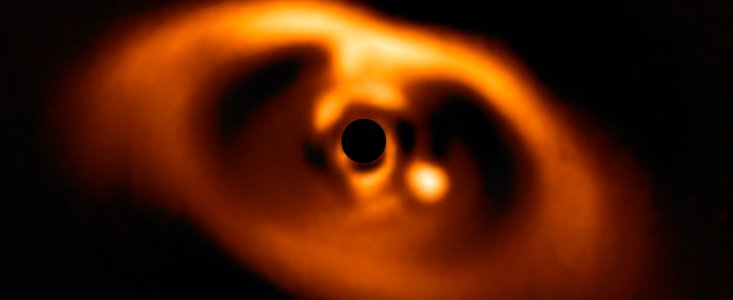
Astronomers say they now have the first confirmed image of the formation of a planet. The Guardian reports: The startling snapshot shows a bright blob -- the nascent planet -- traveling through the dust and gas surrounding a young star, known as PDS70, thought to be about 370 light years from Earth. The black circle in the centre of the image, to the left of the planet, is a filter to block the light from the star, enabling other features of the system to be seen.

"These discs around young stars are the birthplaces of planets, but so far only a handful of observations have detected hints of baby planets in them," said Miriam Keppler of the Max Planck Institute for Astronomy in Germany, a lead author of the research published in the journal Astronomy and Astrophysics. However, other ground-based observations have not yielded conclusive evidence. "The problem is that until now, most of these planet candidates could just have been features in the disc," she said. "The advantage of our detection is that we have detected [the new planet] with several different observing instruments, different filter bands and different years," she added.
This research was presented in two papers, entitled "Discovery of a planetary-mass companion within the gap of the transition disk around PDS 70" and "Orbital and atmospheric characterization of the planet within the gap of the PDS 70 transition disk," both to be published in Astronomy & Astrophysics.
Science

Coffee Drinkers Are More Likely To Live Longer. Decaf May Do The Trick, Too (npr.org) 230

Coffee is far from a vice. There's now lots of evidence pointing to its health benefits, including a possible longevity boost for those of us with a daily coffee habit. From a report: The latest findings come from a study published Monday in JAMA Internal Medicine that included about a half-million people in England, Scotland and Wales. "We found that people who drank two to three cups per day had about a 12 percent lower risk of death compared to non-coffee drinkers" during the decade-long study, says Erikka Loftfield, a research fellow at the National Cancer Institute. Participants ranged in age from 38 to 73. The association held up among drinkers of decaffeinated coffee, too. In the U.S., there are similar findings linking higher consumption of coffee to a lower risk of early death in African-Americans, Japanese-Americans, Latinos and white adults, both men and women. A daily coffee habit is also linked to a decreased risk of stroke and Type 2 diabetes.
Java

Scientists Use Caffeine To Control Genes (arstechnica.com) 38

An anonymous reader quotes a report from Ars Technica: A team led by Martin Fussenegger of ETH Zurich in Basel has shown that caffeine can be used as a trigger for synthetic genetic circuitry, which can then in turn do useful things for us -- even correct or treat medical conditions. For a buzz-worthy proof of concept, the team engineered a system to treat type 2 diabetes in mice with sips of coffee, specifically Nespresso Volluto coffee. Essentially, when the animals drink the coffee (or any other caffeinated beverage), a synthetic genetic system in cells implanted in their abdomens switches on. This leads to the production of a hormone that increases insulin production and lowers blood sugar levels -- thus successfully treating their diabetes after a simple morning brew.

The system, published Tuesday in Nature Communications, is just the start, Fussenegger and his colleagues suggest enthusiastically. "We think caffeine is a promising candidate in the quest for the most suitable inducer of gene expression," they write. They note that synthetic biologists like themselves have long been in pursuit of such inducers that can jolt artificial genetics. But earlier options had problems. These included antibiotics that can spur drug-resistance in bacteria and food additives that can have side effects. Caffeine, on the other hand, is non-toxic, cheap to produce, and only present in specific beverages, such as coffee and tea, they write. It's also wildly popular, with more than two billion cups of coffee poured each day worldwide.

Medicine

US Government Study Concludes: You're Probably Washing Your Hands Wrong (cnn.com) 179

97% of us don't wash our hands properly, a new government study concludes. An anonymous reader quotes CNN: The study from the U.S. Department of Agriculture shows most consumers failed to wash their hands and rub with soap for 20 seconds. That's the amount of time recommended by the Centers for Disease Control and Prevention, which says that washing for shorter periods means fewer germs are removed. "Numerous" study participants also didn't dry their hands with a clean towel.

The study involved 383 people in six test kitchen facilities in the metro Raleigh-Durham area of North Carolina and in rural Smithfield, North Carolina, the USDA said... About half the time, participants spread bacteria to spice containers while preparing burgers, and 11% of the time, they spread bacteria to refrigerator handles... The results from the USDA's study indicate our hand-washing habits may be getting worse. A study done in 2013 by Michigan State University found only 5% of people washed their hands correctly....

A separate study released this month found 49 of 100 towels tested showed growth of bacteria normally found in or on the human body.

CNN helpfully provides the proper method for handwashing. (Wet hands, lather them with soap -- between fingers and under fingernails -- and then scrub for at least 20 seconds.) They recommend singing the alphabet song once or "Happy Birthday" twice.

Just in America, foodborne illnesses sicken 48 million people each year, sending 128,000 to hospitals and resulting in 3,000 deaths.
Moon

The Quest To Find Nuclear Fuel On the Moon (businessweekme.com) 109

Bloomberg Businessweek Middle East reports: India's space program wants to go where no nation has gone before -- to the south side of the moon. And once it gets there, it will study the potential for mining a source of waste-free nuclear energy that could be worth trillions of dollars. The nation's equivalent of NASA will launch a rover in October to explore virgin territory on the lunar surface and analyze crust samples for signs of water and helium-3. That isotope is limited on Earth yet so abundant on the moon that it theoretically could meet global energy demands for 250 years if harnessed....

[A]ccomplishing feats on the cheap has been a hallmark of the agency since the 1960s. The upcoming mission will cost about $125 million -- or less than a quarter of Snap Inc. co-founder Evan Spiegel's compensation last year, the highest for an executive of a publicly traded company, according to the Bloomberg Pay Index... The upcoming launch of Chandrayaan-2 includes an orbiter, lander and a rectangular rover. The six-wheeled vehicle, powered by solar energy, will collect information for at least 14 days and cover an area with a 400-meter radius. The rover will send images to the lander, and the lander will transmit those back to ISRO for analysis. A primary objective, though, is to search for deposits of helium-3. Solar winds have bombarded the moon with immense quantities of helium-3 because it's not protected by a magnetic field like Earth is.

The European Space Agency points out that helium-3 isotope isn't radioactive and "would not produce dangerous waste products." And one former member of the NASA Advisory Council estimates that the moon-derived fuel could generate enough power to meet the world's energy demands for between two at least two centuries.
Medicine

Study Suggests There's No Limit On Longevity (smithsonianmag.com) 151

An anonymous reader quotes a report from Smithsonian: The science of longevity is surprisingly controversial, mainly because there are so few people of extreme old age -- defined at 110 years or older -- around to study. So researchers look to statistics to try and figure out how long people can live. [Ben Guarino reports via The Washington Post] that in 1825, actuary Benjamin Gompertz put forth the idea that the odds of dying grow exponentially as we age. Further research bears that out. Between the age of 30 and 80, the odds of dying double every 8 years. What happens after that, however, is not completely figured out. According to a controversial study released in 2016, which analyzed data from 40 different countries, the average person could make it to 115 with the right genes and interventions, and a few genetic superstars would be able to make it to 125. But that was it, they argued. There was a wall of mortality that medicine and positive thinking simply cannot overcome.

But not everyone is convinced by that data. That's why for the new paper in the journal Science, researchers looked at the lifespans of 3,836 people in Italy who reached the age of 105 or older between 2009 and 2015, with their ages verified by birth certificates. What they found is that the Gompertz law goes a little haywire around the century mark. According to a press release, a 90 year old woman has a 15 percent chance of dying in the next year, and an estimated six years left to live. At age 95, the chance of dying per year jumps to 24 percent. At the age of 105, the chance of dying makes another leap to 50 percent. But then, surprisingly, it levels off, even past 110. In other words, at least statistically, each year some lucky person could flip the coin of life, and if it comes up heads every time, they could live beyond 115 or 125.

Power

Engineers Develop Electric Car Battery That Can Heat Itself During Winter (popularmechanics.com) 118

Engineers at Penn State have created a battery that can self-heat, allowing for rapid charging regardless of the outside cold. The battery can reportedly provide a 15-minute rapid charge at all temperatures, even when the cold is as low as minus 45 degrees Fahrenheit. Popular Mechanics reports: Batteries have both positive and negative terminals. The scientists placed thin nickel foil with one end attached to the negative terminal and the other end creating a third terminal. When a temperature sensor attached to a battery detects that the battery is below room temperature, it then sends electrons flowing through the nickel foil. This heats the battery up until it's above room temperature again. When the sensor detects that the battery is above room temperature, that's the sign that charging that can begin again. Electric current flows into the battery, rapidly charging in a more efficient state. After 4,500 cycles of testing, the new battery only showed a 20 percent capacity loss, which could provide approximately 280,000 miles of driving and a lifetime of 12.5 years. This is compared to a conventional battery that "showed a 20 percent capacity loss after only 50 charges," reports Popular Mechanics. Penn State released a press statement with more details.

Slashdot Top Deals