Chromium

Tech Giants Form Chromium Browser Coalition (betanews.com) 67

BrianFagioli writes: The Linux Foundation has announced the launch of 'Supporters of Chromium-Based Browsers,' an initiative aimed at funding and supporting open development within the Chromium ecosystem. The purpose of this effort is to provide resources and foster collaboration among developers, academia, and tech companies to drive the sustainability and innovation of Chromium projects. Major industry players, including Google, Meta, Microsoft, and Opera, have pledged their support.
Communications

Italy Plans $1.6 Billion SpaceX Telecom Security Deal (yahoo.com) 27

An anonymous reader quotes a report from Bloomberg: Italy is in advanced talks with Elon Musk's SpaceX for a deal to provide secure telecommunications for the nation's government -- the largest such project in Europe, people with knowledge of the matter said Sunday. Discussions are ongoing, and a final agreement on the five-year contract hasn't been reached, said the people, who asked not to be identified citing confidential discussions. The project has already been approved by Italy's Intelligence Services as well as Italy's Defense Ministry, they said. Italy on Monday confirmed discussions are ongoing, saying no deal had yet been reached. "The talks with SpaceX are part of normal government business," the government said.

The negotiations, which had stalled until recently, appeared to move forward after Italian Prime Minister Giorgia Meloni visited President-elect Donald Trump in Florida on Saturday. The Italian government said the two didn't discuss the issue during their meeting. Italian officials have been negotiating on a $1.6 billion deal aimed at supplying Italy with a full range of top-level encryption for telephone and Internet services used by the government, the people said. The plan also includes communications services for the Italian military in the Mediterranean area as well as the rollout of so-called direct-to-cell satellite services in Italy for use in emergencies like terror attacks or natural disasters, they said. The possible deal has been under review since mid-2023. It's been opposed by some Italian officials concerned about how the services may detract from local carriers.

Social Networks

TikTok Pushes Users To Lemon8 As Ban Looms (axios.com) 71

TikTok has been pushing the platform's sister app, Lemon8, encouraging users to migrate via sponsored posts amid a looming ban. Axios reports: In the last few weeks, Lemon8 has been promoting its app to TikTok users through sponsored TikTok videos. In one sponsored post, TikTok user @miller.dailylife shares a video with a creator saying, "TikTok actually has another backup app. It's called Lemon8 ... and it automatically signs you in with your TikTok so you can still keep the same TikTok name and things like that. And it's supposed to transfer your followers over. ... Once you add Lemon8, it automatically pops up on your TikTok bio, so that people can just click on it. So, just so you guys know, now that they're trying to do this ban, if you want to have somewhere else to go where the government is not 100% controlling what we see, what we consume ... Just go ahead and go on to Lemon8."

In November, TikTok began informing users of its sister app, Lemon8, that beginning late that month Lemon8 would be powered by TikTok, and their TikTok usernames would also be used on Lemon8. "Some of your data on TikTok will be used to power services on lemon8," the notice says. "Your Lemon8 profile link will be shown to your TikTok profile publicly by default," it continues. "You can choose not to show it by editing your TikTok profile."
Last March, Lemon8 jumped into the U.S. App Store's Top 10 list shortly after it launched in the U.S. It currently ranks as one of the top-ranking free apps on Apple's app store.

The report notes that the TikTok ban law also applies to other apps owned by TikTok's Chinese parent ByteDance, like Lemon8. "ByteDance could be betting that regulators and app store companies are so focused on TikTok that they won't pay attention to its other apps," says Axios.
Government

White House Launches 'Cyber Trust' Safety Label For Smart Devices 32

BleepingComputer's Sergiu Gatlan reports: "Today, the White House announced the launch of the U.S. Cyber Trust Mark, a new cybersecurity safety label for internet-connected consumer devices. The Cyber Trust Mark label, which will appear on smart products sold in the United States later this year, will help American consumers determine whether the devices they want to buy are safe to install in their homes. It's designed for consumer smart devices, such as home security cameras, TVs, internet-connected appliances, fitness trackers, climate control systems, and baby monitors, and it signals that the internet-connected device comes with a set of security features approved by NIST.

Vendors will label their products with the Cyber Trust Mark logo if they meet the National Institute of Standards and Technology (NIST) cybersecurity criteria. These criteria include using unique and strong default passwords, software updates, data protection, and incident detection capabilities. Consumers can scan the QR code included next to the Cyber Trust Mark labels for additional security information, such as instructions on changing the default password, steps for securely configuring the device, details on automatic updates (including how to access them if they are not automatic), the product's minimum support period, and a notification if the manufacturer does not offer updates for the device.
"Americans are worried about the rise of criminals remotely hacking into home security systems to unlock doors, or malicious attackers tapping into insecure home cameras to illicitly record conversations," the Biden administration said on Tuesday.

"The White House launched this bipartisan effort to educate American consumers and give them an easy way to assess the cybersecurity of such products, as well as incentivize companies to produce more cybersecure devise [sic], much as EnergyStar labels did for energy efficiency.
Facebook

Meta Is Ushering In a 'World Without Facts,' Says Nobel Peace Prize Winner (theguardian.com) 258

An anonymous reader quotes a report from The Guardian: The Nobel peace prize winner Maria Ressa has said Meta's decision to end factchecking on its platforms and remove restrictions on certain topics means "extremely dangerous times" lie ahead for journalism, democracy and social media users. The American-Filipino journalist said Mark Zuckerberg's move to relax content moderation on the Facebook and Instagram platforms would lead to a "world without facts" and that was "a world that's right for a dictator."

"Mark Zuckerberg says it's a free speech issue -- that's completely wrong," Ressa told the AFP news service. "Only if you're profit-driven can you claim that; only if you want power and money can you claim that. This is about safety." Ressa, a co-founder of the Rappler news site, won the Nobel peace prize in 2021 in recognition of her "courageous fight for freedom of expression." She faced multiple criminal charges and investigations after publishing stories critical of the former Philippine president Rodrigo Duterte. Ressa rejected Zuckerberg's claim that factcheckers had been "too politically biased" and had "destroyed more trust than they've created."

"Journalists have a set of standards and ethics," Ressa said. "What Facebook is going to do is get rid of that and then allow lies, anger, fear and hate to infect every single person on the platform." The decision meant "extremely dangerous times ahead" for journalism, democracy and social media users, she said. [...] Ressa said she would do everything she could to "ensure information integrity." "This is a pivotal year for journalism survival," she said. "We'll do all we can to make sure that happens."

Businesses

Samsung is Rolling Out a Smartphone Subscription Next Month (theverge.com) 30

An anonymous reader shares a report: It looks like Samsung is finally ready to roll out a paid subscription for its AI-powered smartphones, but it might not look like what we were expecting.

According to ETNews, Samsung Electronics vice chair Han Jong-hee has confirmed that the company's AI Subscription Club, which launched last December for some of Samsung's home appliances in South Korea, will soon roll out to both Galaxy phones and the upcoming Ballie AI robot.

"We will apply the subscription service to Galaxy smartphones starting next month," he says. "Ballie will be introduced first in Korea and the US, and we plan to supply it as a subscription in Korea."

Technology

Nvidia's Huang Says His AI Chips Are Improving Faster Than Moore's Law (techcrunch.com) 54

Nvidia's AI chips are advancing faster than Moore's Law, the semiconductor industry's historical performance benchmark, according to chief executive Jensen Huang. "Our systems are progressing way faster than Moore's Law," Huang told TechCrunch. Nvidia's chips have improved thousand-fold over the past decade, outpacing Moore's Law's prediction of doubled transistor density every year, Huang said. He adds: We can build the architecture, the chip, the system, the libraries, and the algorithms all at the same time. If you do that, then you can move faster than Moore's Law, because you can innovate across the entire stack.

[...] Moore's Law was so important in the history of computing because it drove down computing costs. The same thing is going to happen with inference where we drive up the performance, and as a result, the cost of inference is going to be less.

Technology

Nvidia's Huang Says 'Very Useful' Quantum Computers Likely Decades Away (yahoo.com) 17

Nvidia founder and chief executive Jensen Huang believes "very useful" quantum computers are likely decades away, tempering expectations for the emerging technology. "If you kind of said 15 years for very useful quantum computers, that would probably be on the early side. If you said 30, it's probably on the late side," Huang said during Nvidia's analyst day. "If you picked 20, I think a whole bunch of us would believe it."
China

Akamai To Quit Its CDN in China (theregister.com) 23

An anonymous reader shares a report: Akamai has decided to end its content delivery network services in China, but not because it's finding it hard to do business in the Middle Kingdom. News of Akamai's decision to end CDN services in China emerged in a letter it recently published and sent to customers and partners that opens by reminding them the company has a "commitment to providing world-class delivery and security solutions" -- and must therefore inform them that "Effective June 30, 2026, all China CDN services will reach their decommission date."

Customers are offered a choice: do nothing and then be moved to an Akamai CDN located outside China, or use similar services from Chinese companies Tencent Cloud and Wangsu Science & Technology.

China

Chinese RISC-V Project Teases 2025 Debut of Freely Licensed Advanced Chip Design (theregister.com) 110

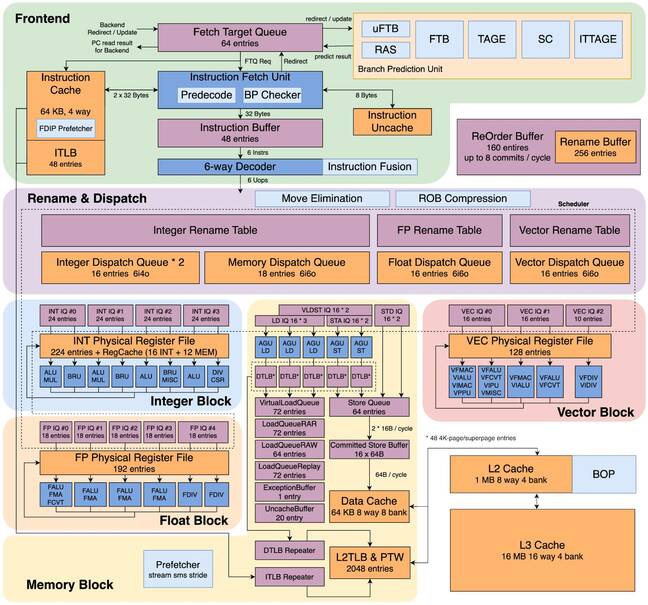
China's Xiangshan project aims to deliver a high-performance RISC-V processor by 2025. If it succeeds, it could be "enormously significant" for three reasons, writes The Register's Simon Sharwood. It would elevate RISC-V from low-end silicon to datacenter-level capabilities, leverage the open-source Mulan PSL-2.0 license to disrupt proprietary chip models like Arm and Intel, and reduce China's dependence on foreign technology, mitigating the impact of international sanctions on advanced processors. From the report: The prospect of a 2025 debut appeared on Sunday in a post to Chinese social media service Weibo, penned by Yungang Bao of the Institute of Computing Technology at the Chinese Academy of Sciences. The academy has created a project called Xiangshan that aims to use the permissively licensed RISC-V ISA to create a high-performance chip, with the Scala source code to the designs openly available.

Bao is a leader of the project, and has described the team's ambition to create a company that does for RISC-V what Red Hat did for Linux -- although he said that before Red Hat changed the way it made the source code of RHEL available to the public. The Xiangshan project has previously aspired to six-monthly releases, though it appears its latest design to be taped out was a second-gen chip named Nanhu that emerged in late 2023. That silicon ran at 2GHz and was built on a 14nm process node. The project has since worked on a third-gen design, named Kunminghu, and published the image [here] depicting an overview of its non-trivial micro-architecture.

Displays

Lenovo's Latest Laptop Has a Rollable OLED Screen (wired.com) 23

An anonymous reader quotes a report from Wired: Laptop screens can feel cramped. But what if you could magically get more real estate without having to carry around a portable monitor? That's precisely the purpose of Lenovo's ThinkBook Plus Gen 6 Rollable AI PC -- yes, rollable. It has an OLED display that, with the push of a button, extends the 14-inch screen upward to make for an awkward aspect ratio, but roughly doubles the screen space to 16.7 inches. Two screens are better than one for productivity, but what if one screen could be two but still one? Yes.

It plays a fun animation and some music when it does its rolling thing. You can also activate the rolling action with a palm gesture; once it scans your palm, shift it up or down to raise or lower the screen. (Pressing the button on the keyboard is way faster.) You can take advantage of Windows 11 window snapping features to put apps one on top of the other. I stacked two browser windows, but you can put other apps below too. Considering I'm already that guy who brings a spare portable monitor everywhere, this just seems like a more elegant solution that takes up less space in my bag. And of course, anyone can take advantage of the long aspect ratio to get a better look at documents, PDFs, and web pages.

Lenovo says it has tested the rolling function 30,000 times, and it has performed without flaws, so you can rest a little easier about reliability, though repairing this machine sounds like it will be a task. The whole laptop doesn't feel significantly different from a normal machine, weighing just 3.7 pounds -- that's 1 pound less than the 16-inch MacBook Pro. However, walking with your laptop open in your hand might be weird, as it feels a little top heavy. When closed, it's 19.9 mm thin -- the 16-inch MacBook Pro is 15.4 mm, so Lenovo's machine is thicker, but not as thick as a gaming laptop.
Lenovo published a concept video on YouTube.
AI

Nvidia Launches RTX 50 Blackwell GPUs: From the $2,000 RTX 5090 To the $549 RTX (techspot.com) 45

"Nvidia has officially introduced its highly anticipated GeForce 50 Series graphics cards, accompanied by the debut of DLSS 4 technology," writes Slashdot reader jjslash. "The lineup includes four premium GPUs: the RTX 5080 and RTX 5090 are slated for release on January 30, with the RTX 5070 and RTX 5070 Ti following in February. TechSpot recount of the Jensen Huang keynote tries to differentiate between dubious performance claims and actual expected raw output": The new RTX 5090 flagship comes packing significantly more hardware over its predecessor. Not only does this GPU use Nvidia's new Blackwell architecture, but it also packs significantly more CUDA cores, greater memory bandwidth, and a higher VRAM capacity. The SM count has increased from 128 with the RTX 4090 to a whopping 170 with the RTX 5090 -- a 33% increase in the core size. The memory subsystem is overhauled, now featuring GDDR7 technology on a massive 512-bit bus. With this GDDR7 memory clocked at 28 Gbps, memory bandwidth reaches 1,792 GB/s -- a near 80% increase over the RTX 4090's bandwidth. It also includes 32GB of VRAM, the most Nvidia has ever provided on a consumer GPU. [...]

As for the performance claims... Nvidia has - as usual - used its marketing to obscure actual gaming performance. RTX 50 GPUs support DLSS 4 multi-frame generation, which previous-generation GPUs lack. This means RTX 50 series GPUs can generate double the frames of previous-gen models in DLSS-supported games, making them appear up to twice as "fast" as RTX 40 series GPUs. But in reality, while FPS numbers will increase with DLSS 4, latency and gameplay feel may not improve as dramatically. [...] The claim that the RTX 5070 matches the RTX 4090 in performance seems dubious. Perhaps it could match in frame rate with DLSS 4, but certainly not in raw, non-DLSS performance. Based on Nvidia's charts, the RTX 5070 seems 20-30% faster than the RTX 4070 at 1440p. This would place the RTX 5070 slightly ahead of the RTX 4070 Super for about $50 less, or alternatively, 20-30% faster than the RTX 4070 for the same price.
These GeForce 50 series wasn't the only announcement Nvidia made at CES 2025. The chipmaker unveiled a $3,000 personal AI supercomputer, capable of running sophisticated AI models with up to 200 billion parameters. It also announced plans to introduce AI-powered autonomous characters in video games this year, starting with a virtual teammate in the battle royale game PUBG.
Facebook

Meta Ends Fact-Checking on Facebook, Instagram in Free-Speech Pitch (msn.com) 225

An anonymous reader shares a report: Mark Zuckerberg built up Facebook's content-policing efforts in the wake of Donald Trump's first presidential election. Now the Meta Platforms CEO is reversing course as he embraces a second Trump presidency. Meta is ending fact-checking and removing restrictions on speech across Facebook and Instagram, Zuckerberg said in a video Tuesday, a move he described as an attempt to restore free expression on its platforms.

"We're going to get back to our roots and focus on reducing mistakes, simplifying our policies and restoring free expression on our platforms," Zuckerberg said in the video. He said Meta is getting rid of fact-checkers and, starting in the U.S., replacing them with a so-called Community Notes system similar to that on Elon Musk's X platform in which users flag posts they think need more context.

While Meta will continue to target illegal behavior, Zuckerberg wrote in a separate post on Threads, it will stop enforcing content rules about immigration and gender that are "out of touch with mainstream discourse." Zuckerberg's plan is likely to reshape the experience of billions of people who use Meta's platforms. It steers sharply away from efforts started years ago in response to complaints from users, advertisers and politicians that abusive and deceptive content had run amok on Meta's suite of apps. The effort to rein in such speech sparked its own backlash from people -- especially on the political right -- who said it often strayed into censorship.
Further reading: Meta Is Ushering In a 'World Without Facts,' Says Nobel Peace Prize Winner
AI

Nvidia Unveils $3,000 Personal AI Supercomputer (nvidia.com) 80

Nvidia will begin selling a personal AI supercomputer in May that can run sophisticated AI models with up to 200 billion parameters, the chipmaker has announced. The $3,000 Project Digits system is powered by the new GB10 Grace Blackwell Superchip and can operate from a standard power outlet.

The device delivers 1 petaflop of AI performance and includes 128GB of memory and up to 4TB of storage. Two units can be linked to handle models with 405 billion parameters. "AI will be mainstream in every application for every industry," Nvidia CEO Jensen Huang said. The system runs on Linux-based Nvidia DGX OS and supports PyTorch, Python, and Jupyter notebooks.
AI

Nvidia To Deploy AI Teammates in Video Games this Year (theverge.com) 26

Nvidia has unveiled plans to introduce AI-powered autonomous characters in video games this year, starting with a virtual teammate in the battle royale game PUBG, the chip maker said at CES 2025 in Las Vegas.

The technology, called ACE, enables in-game characters to communicate, make decisions and interact with players using small language models. The AI companions will also feature in Naraka: Bladepoint Mobile PC Version in March 2025 and other upcoming titles including inZOI and MIR5, Nvidia said.
Social Networks

Instagram Begins Randomly Showing Users AI-Generated Images of Themselves (technologyreview.com) 39

An anonymous reader quotes a report from 404 Media: Instagram has begun testing a feature in which Meta's AI will automatically generate images of users in various situations and put them into that user's feed. One Redditor posted over the weekend that they were scrolling through Instagram and were presented an AI-generated slideshow of themselves standing in front of "an endless maze of mirrors," for example. "Used Meta AI to edit a selfie, now Instagram is using my face on ads targeted at me," the person posted. The user was shown a slideshow of AI-generated images in which an AI version of himself is standing in front of an endless "mirror maze." "Imagined for you: Mirror maze," the "location of the post reads."

"Imagine yourself reflecting on life in an endless maze of mirrors where you're the main focus," the caption of the AI images say. The Reddit user told 404 Media that at one point he had uploaded selfies of himself into Instagram's "Imagine" feature, which is Meta's AI image generation feature. People on Reddit initially did not even believe that these were real, with people posting things like "it's a fake story," and "I doubt that this is true," "this is a straight up lie lol," and "why would they do this?" The Redditor has repeatedly had to explain that, yes, this did happen. "I don't really have a reason to fake this, I posted screenshots on another thread," he said. 404 Media sent the link to the Reddit post directly to Meta who confirmed that it is real, but not an "ad."

"Once you access that feature and upload a selfie to edit, you'll start seeing these ads pop up with auto-generated images with your likeness," the Redditor told 404 Media. A Meta spokesperson told 404 Media that the images are not "ads," but are a new feature that Meta announced in September and has begun testing live. Meta AI has an "Imagine Yourself" feature in which you upload several selfies and take photos of yourself from different angles. You can then ask the AI to do things like "imagine me as an astronaut." Once this feature is enabled, Meta's AI will in some cases begin to automatically generate images of you in random scenarios that it thinks are aligned with your interests.

Transportation

John Deere Thinks Driverless Tractors Are the Answer To Labor Shortages (qz.com) 120

An anonymous reader quotes a report from Quartz: John Deere is going all in on autonomous tractors. The company, which first introduced a driverless vehicle in 2022, said self-driving machines will revolutionize the field and address labor shortages. It will soon be selling self-driving dump trucks, more driverless tractors, and a robot lawn mower. "When we talk about autonomy, we mean full autonomy," Jahmy Hindman, chief technology officer at John Deere, said at CES on Monday, according to The Verge. "No one's in the machine."

Hindman said the company wants "more of our machines to safely run autonomously in these unique and complex environments that our customers work in every day." John Deere says many farmers in the states currently utilize the first model of its driverless tractor, The Verge reported. "Those tractors are already being used by farmers to prepare the soil for planting in the next year," Hindman said. By 2030, the company is hoping to sell a fully self-driving corn and soybean farming system.

Between now and then, John Deere says its articulated dump truck will hit the market. That vehicle can carry more than 92,000 pounds at a time, The Verge reported, and the company says it will improve safety and productivity in sites like quarries. "It's unsupervised, it's capable of making decisions and operating safely on its own," Maya Sripadam, senior product manager of John Deere's subsidiary Blue River Technology, said. John Deere also plans to release driverless tractors that can spray nut orchards with pesticides, growth regulators, and nutrients for the trees. It thinks those vehicles will have a particular benefit to the California nut farming industry, which has faced labor shortages. [...] John Deere hasn't said how much the vehicles will cost.
Further reading: Software Fees To Make Up 10% of John Deere's Revenues By 2030
AI

Google Is Forming a New Team To Build AI That Can Simulate the Physical World 40

Google DeepMind is forming a new team to develop AI models capable of simulating the physical world. It's being led by former OpenAI Sora co-lead Tim Brooks and builds on Google's Gemini, Veo, and Genie projects. "DeepMind has ambitious plans to make massive generative models that simulate the world," Brooks wrote on X. "I'm hiring for a new team with this mission." TechCrunch reports: According to job listings Brooks linked to in his post, the new modeling team will collaborate with and build on work from Google's Gemini, Veo, and Genie teams to tackle "critical new problems" and scale models "to the highest levels of compute." Gemini is Google's flagship series of AI models for tasks like analyzing images and generating text, while Veo is Google's own video generation model. As for Genie, it's Google's take on a world model -- AI that can simulate games and 3D environments in real time. Google's latest Genie model, previewed in December, can generate a massive variety of playable 3D worlds.

"We believe scaling [AI training] on video and multimodal data is on the critical path to artificial general intelligence," reads one of the job descriptions. Artificial general intelligence, or AGI, generally refers to AI that can accomplish any task a human can. "World models will power numerous domains, such as visual reasoning and simulation, planning for embodied agents, and real-time interactive entertainment." Per the description, Brooks' new team will look to develop "real-time interactive generation" tools on top of the models they build, and study how to integrate their models with existing multimodal models such as Gemini.
AMD

AMD Reveals Next-Gen Handheld Gaming PC Chips (ign.com) 18

At CES 2025, AMD unveiled the Z2, Z2 Go, and Z2 Extreme chipsets -- all powered by Zen 5 CPU cores and designed for handheld gaming PCs. IGN reports: The AMD Zen 2 Extreme, along with lower-specced cousins the Z2 and Z2 Go, are powered by Zen 5 CPU cores. While the Zen 2 Extreme is using a RDNA 3.5-based GPU, the Z2 and Z2 Go are still using RDNA 3 and RDNA 2, respectively. This creates an entire family of APUs (Advanced Processing Units) for handheld gaming PCs that should hopefully cause the price of handhelds to go down a bit.

With the Z2 Extreme, AMD is hoping to dramatically improve battery life, while also delivering console-like gaming performance to devices like the Lenovo Legion Go. By and large, the biggest limiting factor of these handhelds, especially at the high end, is how quickly their batteries drain when playing demanding games away from a wall outlet.
The company also introduced the "Fire Range" HX3D processors for gaming laptops, leveraging 3D V-cache technology for enhanced gaming performance and efficiency. "All of these mobile chipsets, from 'Fire Range' HX3D to the AMD Z2 Extreme, will end up in gaming laptops and handhelds over the next few months," adds IGN.

AMD published a press release with additional details and specifications.
China

US Adds Tencent, CATL To List of Chinese Firms Aiding Beijing's Military (reuters.com) 29

An anonymous reader quotes a report from Reuters: The U.S. Defense Department said on Monday it has added Chinese tech giants including gaming and social media leader Tencent Holdings and battery maker CATL to a list of firms it says work with China's military. The list also included chip maker Changxin Memory Technologies, Quectel Wireless and drone maker Autel Robotics, according to a document published on Monday. The annually updated list (PDF) of Chinese military companies, formally mandated under U.S. law as the "Section 1260H list," designated 134 companies, according to a notice posted to the Federal Register.

U.S.-traded shares of Tencent, which is also the parent of Chinese instant messaging app WeChat, fell 8% in over-the-counter trading. Tencent said in a statement that its inclusion on the list was "clearly a mistake." It added: "We are not a military company or supplier. Unlike sanctions or export controls, this listing has no impact on our business." CATL called the designation a mistake, saying it "is not engaged in any military related activities." A Quectel spokesperson said the company "does not work with the military in any country and will ask the Pentagon to reconsider its designation, which clearly has been made in error."

While the designation does not involve immediate bans, it can be a blow to the reputations of affected companies and represents a stark warning to U.S. entities and firms about the risks of conducting business with them. It could also add pressure on the Treasury Department to sanction the companies. Two previously listed companies, drone maker DJI and Lidar-maker Hesai Technologies, both sued the Pentagon last year over their previous designations, but remain on the updated list. The Pentagon also removed six companies it said no longer met the requirements for the designation, including AI firm Beijing Megvii Technology, China Railway Construction Corporation Limited, China State Construction Group Co and China Telecommunications Corporation.

Slashdot Top Deals