Communications

FCC Maintains Ban on Mobile Phone Voice Calls During Flights (bloomberg.com) 126

The U.S. Federal Communications Commission killed a proposal to allow in-flight voice calls via mobile phones, ending its examination of an idea that evoked fears of air rage from passengers trapped beside jabbering seat mates. From a report: The idea drew "strong opposition" from pilots and flight attendants, the agency said Friday in a four-paragraph order. The FCC in 2013 proposed allowing mobile telephone conversations above 10,000 feet, adopting practices followed in Europe and elsewhere, where in-flight voice calling is more common. But the proposal led to strong and immediate pushback, with travelers, flight attendants, members of Congress and others saying they were troubled by the idea of passengers talking on phones in flight. One group raised "the potential for air rage if passengers are using their cell phone."
Businesses

Pushed by Pandemic, Amazon Goes on a Hiring Spree Without Equal (nytimes.com) 42

Amazon has embarked on an extraordinary hiring binge this year, vacuuming up an average of 1,400 new workers a day and solidifying its power as online shopping becomes more entrenched in the coronavirus pandemic. From a report: The hiring has taken place at Amazon's headquarters in Seattle, at its hundreds of warehouses in rural communities and suburbs, and in countries such as India and Italy. Amazon added 427,300 employees between January and October, pushing its work force to more than 1.2 million people globally, up more than 50 percent from a year ago. Its number of workers now approaches the entire population of Dallas. The spree has accelerated since the onset of the pandemic, which has turbocharged Amazon's business and made it a winner of the crisis. Starting in July, the company brought on about 350,000 employees, or 2,800 a day. Most have been warehouse workers, but Amazon has also hired software engineers and hardware specialists to power enterprises such as cloud computing, streaming entertainment and devices, which have boomed in the pandemic.

The scale of hiring is even larger than it may seem because the numbers do not account for employee churn, nor do they include the 100,000 temporary workers who have been recruited for the holiday shopping season. They also do not include what internal documents show as roughly 500,000 delivery drivers, who are contractors and not direct Amazon employees. Such rapid growth is unrivaled in the history of corporate America. It far outstrips the 230,000 employees that Walmart, the largest private employer with more than 2.2 million workers, added in a single year two decades ago. The closest comparisons are the hiring that entire industries carried out in wartime, such as shipbuilding during the early years of World War II or home building after soldiers returned, economists and corporate historians said.

Windows

Microsoft's 'Project Latte' Aims To Bring Android Apps To Windows 10 (windowscentral.com) 65

Windows Central reports: Microsoft is working on a software solution that would allow app developers to bring their Android apps to Windows 10 with little to no code changes by packaging them as an MSIX and allowing developers to submit them to the Microsoft Store. According to sources familiar with the matter, the project is codenamed 'Latte' and I'm told it could show up as soon as next year. The company has toyed with the idea of bringing Android apps to Windows 10 before via a project codenamed Astoria that never saw the light of day. Project Latte aims to deliver a similar product, and is likely powered by the Windows Subsystem for Linux (WSL.) Microsoft will need to provide its own Android subsystem for Android apps to actually run, however.

Microsoft has announced that WSL will soon get support for GUI Linux applications, as well as GPU acceleration which should aid the performance of apps running through WSL. It's unlikely that Project Latte will include support for Play Services, as Google doesn't allow Play Services to be installed on anything other than native Android devices and Chrome OS. This means that apps which require Play Services APIs will need to be updated to remove those dependencies before they can be submitted on Windows 10.

Businesses

'Tokenized': Inside Black Workers' Struggles at the King of Crypto Start-Ups (nytimes.com) 197

Nathaniel Popper, reporting for The New York Times: One by one, they left. Some quit. Others were fired. All were Black. The 15 people worked at Coinbase, the most valuable U.S. cryptocurrency start-up, where they represented roughly three-quarters of the Black employees at the 600-person company. Before leaving in late 2018 and early 2019, at least 11 of them informed the human resources department or their managers about what they said was racist or discriminatory treatment, five people with knowledge of the situation said. One of the employees was Alysa Butler, 25, who worked in recruiting. During her time at Coinbase, she said, she told her manager several times about how he and others excluded her from meetings and conversations, making her feel invisible. "Most people of color working in tech know that there's a diversity problem," said Ms. Butler, who resigned in April 2019. "But I've never experienced anything like Coinbase."

In Silicon Valley, where entrepreneurs and investors often preach high-minded missions and style themselves as management gurus, Coinbase has held itself up as a model. Since the start-up was founded in 2012, Brian Armstrong, the chief executive, has assembled memos and blog posts about how he built the $8 billion company's culture with distinct hiring and training practices. That has won him acclaim among influential venture capitalists and executives. But according to 23 current and former Coinbase employees, five of whom spoke on the record, as well as internal documents and recordings of conversations, the start-up has long struggled with its management of Black employees. One Black employee said her manager suggested in front of colleagues that she was dealing drugs and carrying a gun, trading on racist stereotypes. Another said a co-worker at a recruiting meeting broadly described Black employees as less capable. Still another said managers spoke down to her and her Black colleagues, adding that they were passed over for promotions in favor of less experienced white employees. The accumulation of incidents, they said, led to the wave of departures.
On Wednesday, before publication of this article, Emilie Choi, Coinbase's chief operating officer, wrote an email to employees to preemptively question the article's accuracy and said, "We know the story will recount episodes that will be difficult for employees to read." The company posted the email to its public blog. "As Brian shared with the ColorBlock ERG this morning, we don't care what The New York Times thinks. "
AI

Dyson Pledges New Investment Into AI, Robotics and Batteries (ft.com) 35

Dyson will invest an additional 2.75bn pound ($3.67 billion) on developing technologies and products over the next five years [Editor's note: the link may be paywalled; alternative source], as the appliances brand pushes deeper into areas such as artificial intelligence, robotics and energy storage. From a report: The company founded by billionaire James Dyson and famous for its vacuum cleaners said it intended to double its portfolio of products by 2025 and enter new fields, taking it "beyond the home" for the first time. Although it did not provide any breakdown of the investments, they will be focused in Singapore, where the group controversially decided to move its headquarters last year, as well as the UK and the Philippines. The announcement comes more than a year after Dyson abandoned its ambitious plans to manufacture an electric vehicle from scratch in the Asian city-state. Sir James had hoped that the EV project would redefine his business but, after spending hundreds of millions of pounds, concluded that it was too expensive to compete against established carmakers.
United Kingdom

UK To Set Up 'Pro-Competition' Regulator To Put Limits on Big Tech (techcrunch.com) 42

The UK is moving ahead with a plan to regulate big tech, responding to competition concerns over a 'winner takes all' dynamic in digital markets. From a report: It will set up a new Digital Market Unit (DMU) to oversee a "pro-competition" regime for Internet platforms -- including those funded by online advertising, such as Facebook and Google -- the Department of Digital, Culture, Media and Sport (DCMS) announced today. It's moving at a clip -- with the new Unit slated to begin work in April. Although the necessary law to empower the new regulator to make interventions will take longer. The government said it will consult on the Unit's form and function in early 2021 -- and legislate "as soon as parliamentary time allows." A core part of the plan is a new statutory Code of Conduct aimed at giving platform users more choice and third party businesses more power over the intermediaries that host and monetize them. The government suggests the code could require tech giants to allow users to opt out of behavioral advertising entirely -- something Facebook's platform, for example, does not currently allow. It also wants the code to support the sustainability of the news industry by "rebalancing" the relationship between publishers and platform giants, as it puts it.
Security

Patients of a Vermont Hospital Are Left 'in the Dark' After a Cyberattack (nytimes.com) 112

A wave of damaging attacks on hospitals upended the lives of patients with cancer and other ailments. From a report: At lunchtime on Oct. 28, Colleen Cargill was in the cancer center at the University of Vermont Medical Center, preparing patients for their chemotherapy infusions. A new patient will sometimes be teary and frightened, but the nurses try to make it welcoming, offering trail mix and a warm blanket, a seat with a view of a garden. Then they work with extreme precision: checking platelet and white blood cell counts, measuring each dosage to a milligram per square foot of body area, before settling the person into a port and hooking them up to an IV. That day, though, Ms. Cargill did a double-take: When she tried to log in to her work station, it booted her out. Then it happened again. She turned to the system of pneumatic tubes used to transport lab work. What she saw there was a red caution symbol, a circle with a cross. She walked to the backup computer. It was down, too.

"I wasn't panicky," she said, "and then I noticed my cordless phone didn't work." That was, she said, the beginning of the worst 10 days of her career. Cyberattacks on America's health systems have become their own kind of pandemic over the past year as Russian cybercriminals have shut down clinical trials and treatment studies for the coronavirus vaccine and cut off hospitals' access to patient records, demanding multimillion-dollar ransoms for their return. Complicating the response, President Trump last week fired Christopher Krebs, the director of CISA, the cybersecurity agency responsible for defending critical systems, including hospitals and elections, against cyberattacks, after Mr. Krebs disputed Mr. Trump's baseless claims of voter fraud. The attacks have largely unfolded in private, as hospitals scramble to restore their systems -- or to quietly pay the ransom -- without releasing information that could compromise an F.B.I. investigation. [...] The latest wave of attacks, which hit about a dozen hospitals in the United States, was believed to have been conducted by a particularly powerful group of Russian-speaking hackers that deployed ransomware via TrickBot, a vast network of infected computers used for cyberattacks, according to security researchers who are tracking the attacks.

China

Britain Commits $333 Million To Help Carriers Replace Huawei 5G (scmp.com) 56

Britain will spend $333 million to diversify its sources of 5G wireless equipment after banning China's Huawei from supplying the next-generation technology. From a report: Huawei is set to be excluded from British 5G networks by 2027 due to security concerns, leaving phone carriers reliant on a supply duopoly of Finland's Nokia and Sweden's Ericsson. Around $67 million of the total will be spent next year to help build "a secure and resilient 5G network" according to documents published on Wednesday as part of Chancellor of the Exchequer Rishi Sunak's spending review. The resulting reduction in competition could hurt security and push up prices, so Digital Secretary Oliver Dowden has started a task force to increase the number of suppliers. He is set to publish more details before the end of the year.

Britain's crackdown on Huawei came in July after UK officials said US sanctions made it impossible to verify the security of Huawei's supply chain. The White House accuses Huawei of being a security risk, which the company has always denied. Since then, Nokia and Ericsson have already won major contracts from British carriers like BT Group and CK Hutchison Holdings' Three UK. The phone industry is banking that longer-term initiatives such as OpenRAN -- a project to make mobile network equipment more interoperable and encourage new suppliers -- will eventually introduce more competition.

Businesses

Amazon Workers To Stage Coordinated Black Friday Protests in 15 Countries (vice.com) 130

On Friday, Amazon warehouse workers and social and environmental justice activists around the world will stage a series of coordinated protests, strikes, and actions to demand the online retailer respect workers' rights to participate in union activity, stop circumventing tax laws, and commit to higher environmental standards, according to the event's organizers. From a report: The day of action, which is being called #MakeAmazonPay, coincides with Black Friday, one of Amazon's biggest sales events of the year and the start of its peak season, when warehouse worker injuries are highest and workloads for warehouse workers and delivery drivers skyrocket. On Friday, protest actions will take place across Amazon's supply chain in Brazil, Mexico, the United States, the United Kingdom, Spain, France, Belgium, Germany, Luxembourg, Italy, Poland, India, Bangladesh, the Philippines, and Australia. As many as 3,000 workers will strike at six Amazon facilities in Germany. Garment workers in Bangladesh who manufacture clothes sold by Amazon will also protest. Trade union members and environmental groups, including the climate-focused Extinction Rebellion, will demonstrate outside Amazon's European headquarters in Luxembourg. In the Philippines, contracted Amazon Ring call center workers, who face 'subhuman' conditions according to a recent Financial Times article, will hold a virtual action. At Amazon's Seattle and Northern Virginia headquarters, community activists from social justice organizations, including Justice for Muslims Collective and La ColectiVA, will hold their own protests.
Security

Sophos Notifies Customers of Data Exposure After Database Misconfiguration (zdnet.com) 5

UK-based cyber-security vendor Sophos is currently notifying customers via email about a security breach the company suffered earlier this week. From a report: "On November 24, 2020, Sophos was advised of an access permission issue in a tool used to store information on customers who have contacted Sophos Support," the company said in an email sent to customers and obtained by ZDNet. Exposed information included details such as customer first and last names, email addresses, and phone numbers (if provided).
Security

hCaptcha Runs On 15% Of the Internet (hcaptcha.com) 66

In a blog post, hCaptcha announced that its bot detector is running on about 15% of the internet, adding they they "took most of this market share directly from Google reCAPTCHA." From the post: Competing with Google and other Big Tech companies seems like a tall order: their monopolistic market power, platform effects and army of highly paid developers are generally considered too powerful to tackle for anyone but other tech giants such as Facebook or Amazon. Our story shows that it doesn't have to be that way -- you can beat Big Tech by focussing on privacy. Consider Google reCAPTCHA, which consumes enormous amounts of behavioral data to determine whether web users are legitimate humans or bots. At hCaptcha, we have deliberately taken a very different approach, using privacy-preserving machine learning techniques to identify typical bot behaviors at high accuracy, all while consuming and storing as little data as possible.

Google is an ad company, and their security products look very much like their ad products: they track user behavior on every page of a website and across the web. We designed hCaptcha to be as privacy-friendly as possible from day one. This led to a completely different approach to the problem. As it turns out, tracking users across the web and tying their web history to their identity is completely unnecessary for achieving good security. The many companies that have switched over to hCaptcha often report equal or better performance in bot detection and mitigation despite our privacy focus.

A growing number of critics have pointed out that Google's disregard for user privacy should concern customers looking to protect their websites and apps. At the same time, stopping bots from accessing publisher sites can reveal ad fraud, pitting Google's reCAPTCHA product directly against their ad business, which produces over 80% of their revenue. Every bot Google detects should be earning zero ad dollars. Google's company incentives are thus poorly aligned with the users of their security services, and this may be one explanation for the poor performance of their reCAPTCHA security offering.

Transportation

Illegal Tampering By Diesel Pickup Owners Is Worsening Pollution, EPA Says 336

An anonymous reader quotes a report from The New York Times: The owners and operators of more than half a million diesel pickup trucks have been illegally disabling their vehicles' emissions control technology over the past decade, allowing excess emissions equivalent to 9 million extra trucks on the road, a new federal report has concluded. The practice, described in a report by the Environmental Protection Agency's Office of Civil Enforcement, has echoes of the Volkswagen scandal of 2015, when the automaker was found to have illegally installed devices in millions of diesel passenger cars worldwide -- including about half a million in the United States -- designed to trick emissions control monitors. But in this case no single corporation is behind the subterfuge; it is the truck owners themselves who are installing illegal devices, which are typically manufactured by small companies. That makes it much more difficult to measure the full scale of the problem, which is believed to affect many more vehicles than the 500,000 or so estimated in the report.

The E.P.A. focused just on devices installed in heavy pickup trucks, such as the Chevrolet Silverado and the Dodge Ram 2500, about 15 percent of which appear to have defeat devices installed. But such devices -- commercially available and marketed as a way to improve vehicle performance -- almost certainly have been installed in millions of other vehicles. The report found "significant amounts of excess air pollution caused by tampering" with diesel pickup truck emissions controls. The technology is essentially an at-home version of the factory-installed "defeat devices" embedded into hundreds of thousands of vehicles in the United States byVolkswagen, which was forced to pay $14.7 billion in the U.S. to settle claims stemming from the scandal. The report said "diesel tuners" will allow the trucks to release more than 570,000 tons of nitrogen dioxide, a pollutant linked to heart and lung disease and premature death, over the lifetime of the vehicles. That is more than ten times the excess nitrogen oxide emissions attributed to the factory-altered Volkswagens sold domestically. The report also found that the altered pickup trucks will emit about 5,000 excess tons of industrial soot, also known as particulate matter, which is linked to respiratory diseases and higher death rates for Covid-19 patients.
Transportation

GM To Leverage Customer Data In New Insurance Business (reinsurancene.ws) 45

General Motors has launched a new insurance service that will leverage the data captured through its OnStar connected car service, ultimately helping drivers cash in on lower insurance rates based on safe driving habits. From a report: OnStar Insurance Services has been created to achieve a better understanding of the vehicles GM produces, in order to offer a personalized digital insurance experience for drivers. The service is currently working with its insurance carrier partners to remove biased insurance plans by focusing on factors within the customer's control, which includes individual vehicle usage and rewarding smart driving habits that benefit road safety.

OnStar Insurance Services plans to provide customers with personalized vehicle care and promote safer driving habits, along with a data-backed analysis of driving behavior. The service plans to build on the learnings of the OnStar Smart Driver feature to provide each policyholder with recommendations for smarter driving habits so customers can drive more safely and potentially earn discounts. The service will start in Arizona and initially offer OnStar Insurance to GM employees in Q4 2020, slowly expanding to additional customers, including the general public, in early 2021.

EU

European Regulators Prepare For MAX To Return To Service In 2021 (theregister.com) 40

thegreatbob writes: Looks like the main additions over the FAA's requirements are some additional pilot training requirements. The actual EASA statement can be found here. Confirms what the available information had been pointing to: the plane flies tolerably without its Maneuvering Characteristics Augmentation System (MCAS), but does not meet certification criteria. [The MCAS was a software system installed on the Max by Boeing to compensate for the Max having larger engines than its predecessors in the 737 family of airliners. Those larger engines changed the way the aeroplane responded to its controls, requiring a software system to keep it within certifiable limits.] The EU Aviation Safety Agency made the announcement after confirming the airliner will return to European skies in January 2021.

Patrick Ky, chief of EASA, said in a statement: "EASA's review of the 737 MAX began with the MCAS but went far beyond. We took a decision early on to review the entire flight control system and gradually broadened our assessment to include all aspects of design which could influence how the flight controls operated. This led, for example, to a deeper study of the wiring installation, which resulted in a change that is now also mandated in the Proposed Airworthiness Directive."

Ky added: "We also pushed the aircraft to its limits during flight tests, assessed the behavior of the aircraft in failure scenarios, and could confirm that the aircraft is stable and has no tendency to pitch-up even without the MCAS." A spokesperson for EASA clarified that the Max's MCAS "is necessary to meet the safety regulation and obtain the necessary safety margins. However, when it is lost (failed and inoperative), an averagely skilled and trained crew is still able to safely fly and land the airplane."
Google

Google Ordered To Hand Over Emails in $600 Million Divorce Battle (ft.com) 33

A US court has ordered Google to hand over the personal emails of the son of a Russian oligarch as part of a bitter $601 million divorce case. From a report [Editor's note: the link may be paywalled; alternative source]: Judge Virginia DeMarchi in California told the US tech group to surrender Temur Akhmedov's emails for use as evidence in a lawsuit brought by his mother, Tatiana Akhmedova, the wife of an ally of President Vladimir Putin. Ms Akhmedova has gone to court in the US and the UK in an attempt to force her ex-husband, Farkhad Akhmedov, to pay the world's largest-ever divorce settlement. Google said the order was a breach of its customer's privacy. The divorce case, which is being funded by litigation financier Burford Capital, has led to a legal battle over assets including a helicopter, a private jet and a superyacht called the Luna that used to belong to Chelsea Football Club owner Roman Abramovich. Google sought to block the order to give up the emails this week on the basis that to do so would infringe Mr Akhmedov's right to privacy because he had not given consent to share them. Ms DeMarchi said Google's concern for the "privacy and security of its account holders' communications" was "commendable" but ruled the request did not breach the US Stored Communications Act, which governs voluntary and compelled disclosure of emails. The information from the emails will be used to learn whether Temur assisted his father in the fraudulent transfer of assets, and if so, to win a judgment against him, Tatiana Akhmedova said in a filing.
The Internet

AWS Outage Has Taken Down a Big Chunk of the Internet (theverge.com) 90

Amazon Web Services (AWS), Amazon's internet infrastructure service that is the backbone of many websites and apps, is experiencing a major outage affecting a large portion of the internet. From a report: "Kinesis has been experiencing increased error rates this morning in our US-East-1 Region that's impacted some other AWS services," Amazon said in a statement to The Verge. "We are working toward resolution." And, ironically, in a notice on the AWS Service Health Dashboard, Amazon said the issue has apparently "affected our ability to post updates" to that dashboard. "We continue to work towards recovery of the issue affecting the Kinesis Data Streams API in the US-EAST-1 Region," Amazon said in a 1:47PM ET update posted to the dashboard. "For Kinesis Data Streams, the issue is affecting the subsystem that is responsible for handling incoming requests. The team has identified the root cause and is working on resolving the issue affecting this subsystem."
Google

Google Plans Fiber-Optic Network To Connect Via Saudi Arabia and Israel for First Time (wsj.com) 29

Google is laying the groundwork for a fiber-optic network that for the first time will connect through historical enemies Saudi Arabia and Israel while opening a new corridor for global internet traffic, according to people familiar with the plans. From a report: The project linking India to Europe is Google's latest globe-crossing internet construction effort. The Alphabet subsidiary is vying with Facebook to build more network capacity to support its surging user demand for videos, search results and other products. Expanded connectivity between Europe and India would also help Google roll out data centers globally and catch up to rivals Microsoft and Amazon.com in the business of on-demand cloud-computing. Google, which names most of its internet cables after scientists, has dubbed the new route Blue Raman after Indian physicist Chandrasekhara Venkata Raman. A submarine cable project the length of Blue Raman -- at more than 5,000 miles -- would cost typically up to $400 million, according to Dubai-based telecommunications firm Salience Consulting.

Google is expected to turn to telecom-company partners to help fund the project, including Oman Telecommunications and Telecom Italia, which are helping finance the route, according to those with knowledge of the project. Those partners and others will help fund the cable's construction while sharing its fiber-optic infrastructure. Those familiar with Google's Blue Raman project cautioned that it still might not materialize. Because it crosses multiple borders, the project will require agreements with several regulators, and one setback could force Google to redesign the route. For example, Google's consortium still lacks the go-ahead it needs from Saudi government authorities to connect the Blue Raman project, some of these people said.

China

ZTE's Designation as Security Threat Affirmed by US FCC (bloomberg.com) 27

The U.S. Federal Communications Commission affirmed its decision to designate ZTE as a national security threat over concerns telecommunications gear made by the Chinese company could be used for spying. From a report: The action shows that the FCC remains determined to drive ZTE and fellow Shenzhen-based manufacturer Huawei Technologies Co. from the U.S. market, where small rural carriers rely on their cheap network equipment. The agency at its Dec. 10 meeting is to consider rules for listing prohibited gear, FCC Chairman Ajit Pai said in a Nov. 18 blog post that identified Huawei as a threat. The FCC has said ZTE and Huawei pose a risk of espionage, an allegation each company denies. The agency has increasingly scrutinized Chinese companies amid tensions between Beijing and Washington over trade, the coronavirus and security issues. The FCC is considering banning three Chinese telephone companies, and last year barred China Mobile from entering the American market. The FCC on June 30 designated both companies national security threats, and ZTE asked the agency to reconsider its listing. The company said it supplies safe and secure equipment and is "clearly and fully dedicated to complying with all applicable laws in the United States."
Cellphones

Study Finds Users, Not Notifications, Initiate 89% of Smartphone Interactions (psychnewsdaily.com) 33

According to a new study published in the journal Computers In Human Behavior, smartphone users initiate 89% of the interactions, with only 11% initiated by a notification. "This is at odds with previous academic literature and news reports which commonly claim that smartphone notifications are ruining your life, ruining productivity, and so on," reports PsychNewsDaily. From the report: "The perceived disruptiveness of smartphones is not mainly driven by external notifications," the study's authors write, "but by an urge of the user to interact with their phone that seems to occur in an almost automatic manner, just as a smoker would light a cigarette." [...] The researchers explain that many users felt compelled to check their phones even when they had switched off notifications. "Seeing this has made me realize that I don't even remember picking it up," one of the subjects said in a subsequent interview with the study's authors. The study also found that the average duration of a smartphone interaction was 64 seconds. About 50% of the interactions were 23 seconds or less.

The most common activity users engaged in when using their phones was checking WhatsApp, which accounted for 22% of interactions. [...] The second most common interaction, at 17% of the total, was a "lock screen check," which means briefly unlocking the phone to check for new notifications. In third place was interacting with Instagram (16%). Facebook and Facebook messenger together accounted for 13% of the interactions, e-mail for 6%, web browsing 4%, music 3%, Snapchat 2%, and photos 2%. Phone calls -- these devices are phones, after all -- only comprised about 1% of the interactions.

The participants generally considered e-mail notifications the most important. Likewise, they largely considered group chats a "source of distress," and found most group-chat messages unimportant. Smartphone interactions were longer when users were alone versus with others, and were also longer at home versus at work. Likewise, these interactions were shorter when participants received notifications, compared to when they "self-disrupt." This indicates that smartphone use is more purposeful when users receive notifications, and more "distraction-seeking" when they check their phones themselves. The researchers also found that the scrolling features on apps like Instagram and Facebook led to the longest interactions.

OS X

Is Apple Silicon Ready? (thenextweb.com) 132

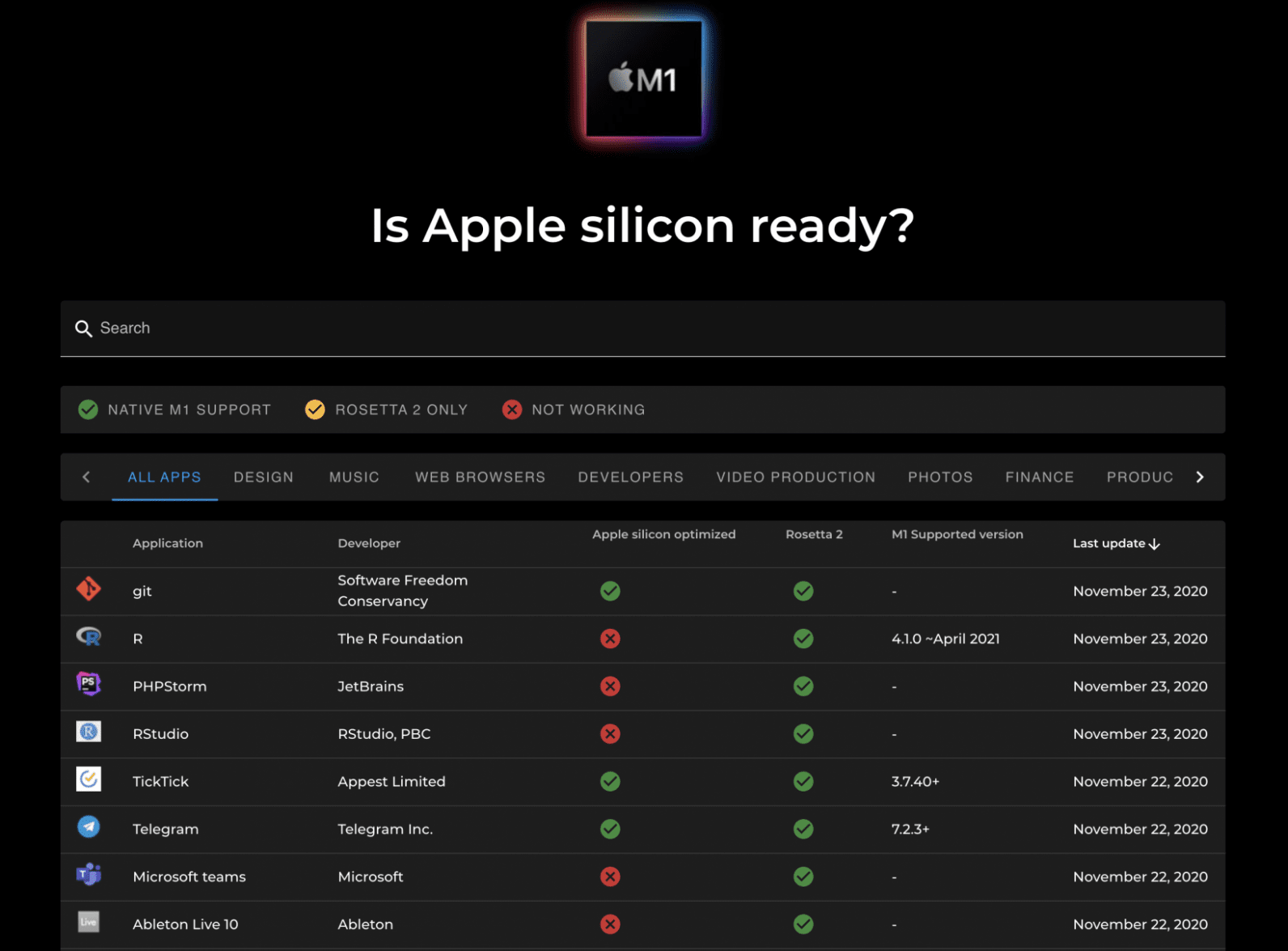
Programmer Abdullah Diaa has put together a website to help determine if your favorite apps work on Apple Silicon yet. An anonymous reader shares a report from The Next Web: ... [P]lease say hello to Is Apple silicon ready? The idea behind the site is simple: it shows you if specific apps will work on laptops and desktops with Apple's in-house chip. Easy to get your head around, right? It shows you a list of software and, if they have native M1 support, they're given a green tick.

Here's an image that shows you what's going on far clearer than lots of words could. As you can see, the site also shows you if the app you're after has Rosetta 2 support. Effectively, Rosetta 2 is an emulator, allowing a large number of apps designed for Intel machines to run on Apple Silicon. If this is supported, you will still be able to use that software on an M1-toting machine.
Further reading: Linus Torvalds Would Like To Use An M1 Mac For Linux, But...

Slashdot Top Deals