Firefox

'Have I Been Pwned' Is Being Integrated Into Firefox, 1Password (troyhunt.com) 111

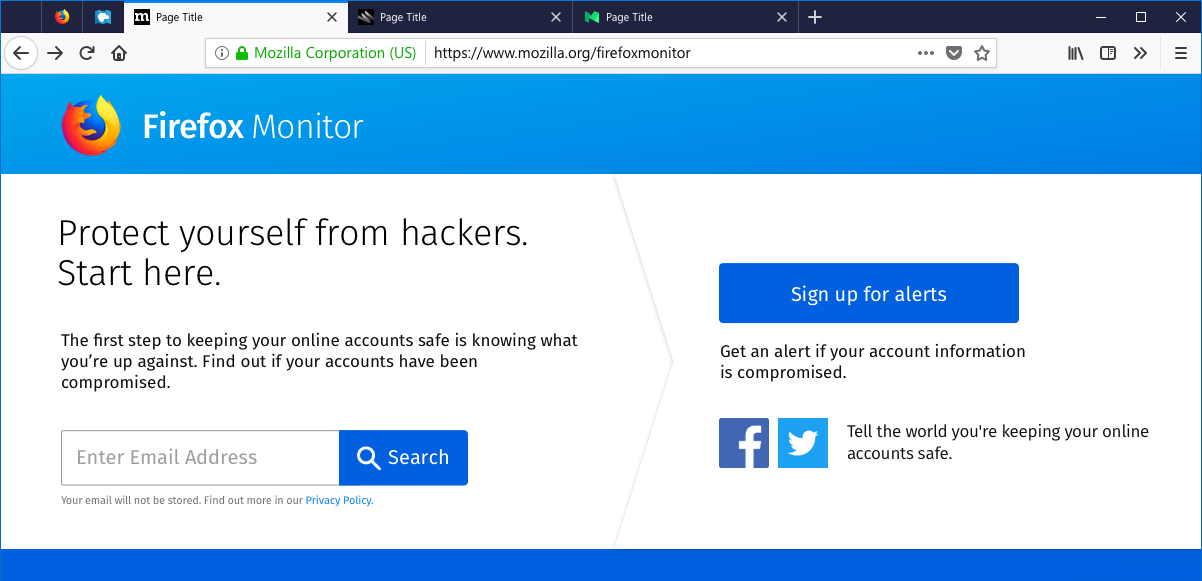
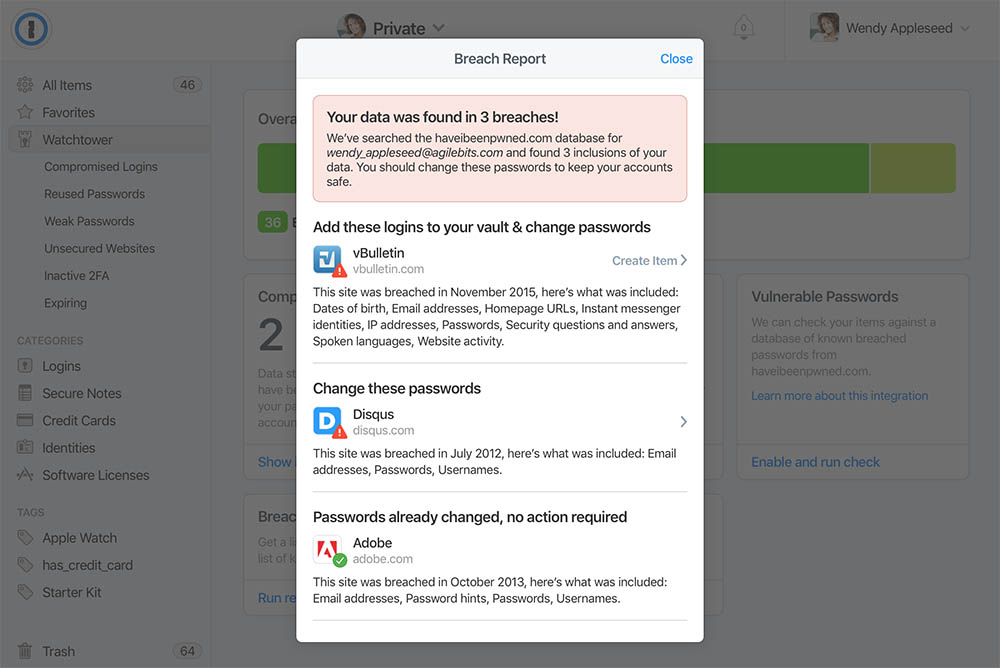
Troy Hunt, web security expert and creator of the website Have I Been Pwned (HIBP), wrote a blog post announcing his partnerships with Firefox and 1Password. For those unfamiliar with the site, Have I Been Pwned allows you to search across multiple data breaches to see if your email address has been compromised. The service is especially handy now that data breaches are becoming a daily occurrence. Hunt writes: Last November, there was much press about Mozilla integrating HIBP into Firefox. I was a bit surprised at the time as it was nothing more than their Breach Alerts feature which simply highlighted if the site being visited had previously been in a data breach (it draws this from the freely accessible breach API on HIBP). But the press picked up on some signals which indicated that in the long term, we had bigger plans than that and the whole thing got a heap of very positive attention. I ended up fielding a heap of media calls just on that one little feature - people loved the idea of HIBP in Firefox, even in a very simple form. As it turns out, we had much bigger plans and that's what I'm sharing here today. Over the coming weeks, Mozilla will begin trialling integration between HIBP and Firefox to make breach data searchable via a new tool called "Firefox Monitor." Here's what Hunt has to say about 1Password: As of now, you can search HIBP from directly within 1Password via the Watchtower feature in the web version of the product. This helps Watchtower become "mission control" for accounts and introduces the "Breach Report" feature. If you're a 1Password user you can use this feature right now, just head on over to the 1Password login page.
Businesses

LinkedIn's Forthcoming Analytics Tool May Boost Job Poaching (techtarget.com) 85

dcblogs writes: LinkedIn has developed a new analytics platform that should make it easier to poach job candidates. It will use its vast database of nearly 600 million profiles to help recruiters find pockets of talent, know the attrition rate and glean competitive data. The platform, due in September, was discussed at a recent HR conference. One attendee asked a LinkedIn official: "Does that set up an environment for poaching talent?" And then she immediately answered her own question. "I think the answer is yes. And so why would I sign off on that?" In response to the attendees' question, Eric Owski, the head of product for Talent Insights at LinkedIn, said there was nothing wrong with making this data available. The LinkedIn team concluded that "the world is becoming more transparent," and "very sophisticated teams at large companies were able to figure out a lot of the calculations that we're making available in this product," he said. "We think by packaging it up nicely, it levels the playing field," Owski said. "We feel like we're on safe ground."
Security

OpenBSD Chief De Raadt Says No Easy Fix For New Intel CPU Bug 'TLBleed' (itwire.com) 123

Recompiling is unlikely to be a catch-all solution for a recently unveiled Intel CPU vulnerability known as TLBleed, the details of which were leaked on Friday, the head of the OpenBSD project Theo de Raadt says. iTWire reports: The details of TLBleed, which gets its name from the fact that the flaw targets the translation lookaside buffer, a CPU cache, were leaked to the British tech site, The Register; the side-channel vulnerability can be theoretically exploited to extract encryption keys and private information from programs. Former NSA hacker Jake Williams said on Twitter that a fix would probably need changes to the core operating system and were likely to involve "a ton of work to mitigate (mostly app recompile)." But de Raadt was not so sanguine. "There are people saying you can change the kernel's process scheduler," he told iTWire on Monday. "(It's) not so easy."

He said that Williams was lacking all the details and not thinking it through. "They actually have sufficient detail to think it through: the article says the TLB is shared between hyperthreading CPUs, and it is unsafe to share between two different contexts. Basically you can measure evictions against your own mappings, which indicates the other process is touching memory (you can determine the aliasing factors)."
De Raadt said he was still not prepared to say more, saying: "Please wait for the paper [which is due in August]."
Businesses

Amazon Workers Facing Firing Can Appeal To a Jury of Their Co-Workers (bloomberg.com) 108

An anonymous reader quotes a report from Bloomberg: Jane was working in Amazon's Seattle headquarters when she was asked to a meeting with her manager and a human resources representative. They gave her a document outlining concerns about her work performance and spelled out three choices. She could quit and receive severance pay, spend the next several weeks trying to keep her job by meeting certain performance goals, or square off with her manager in a videoconference version of the Thunderdome, pleading her case with a panel of co-workers while her boss argued against her. Jane, who asked that her real name not be used to discuss a personal matter, chose the last one.

Amazon is borrowing a page from union grievance processes that don't apply to most corporate employees. But only about 30 percent of those who appeal their manager's criticisms prevail, meaning they can keep their jobs or seek new ones within the company with different bosses, according to people familiar with the matter. Eighteen months after its debut, the hearing process has created resentment and raised questions about fairness, according to current and former workers as well as attorneys familiar with their situations. "It's a kangaroo court," says George Tamblyn, a Seattle employment lawyer who helped one former Amazon worker plan her appeal earlier this year. "My impression of the process is it's totally unfair."
According to a person familiar with the process, the workers who fail to make their case and get their job back can still choose between severance pay or a performance-improvement plan. The program, called "Pivot," was started last year.

Here's what Amazon has to say on the matter: "Pivot is a uniquely Amazonian program that was thoughtfully designed to provide a fair and transparent process for employees who need support. When employees are placed in Pivot, they have the option of working with their manager and HR to improve with a clear plan forward, of leaving Amazon with severance, or of appealing if they feel they shouldn't be in the program. Just over a year into program, we're pleased with the support it offers our employees and we're continuing to iterate based on employee feedback and their needs."
Electronic Frontier Foundation

EFF Announces STARTTLS Everywhere To Help Make Email Delivery More Secure (betanews.com) 58

Mark Wilson writes: When it comes to messaging tools, people have started to show greater interest in whether encryption is used for security, and the same for websites -- but not so much with email. Thanks to the work of the Electronic Frontier Foundation, however, email security is being placed at the top of the agenda. The privacy group today announces STARTTLS Everywhere, its new initiative to improve the security of the email ecosystem. STARTTLS is an addition to SMTP, and while it does not add end-to-end encryption, it does provide hop-to-hop encryption, which is very much a step in the right direction. In a blog post, EFF elaborates SMARTTLS for the uninitiated, and outlines how it worked around some of the tech's underlying challenges: There are two primary security models for email transmission: end-to-end, and hop-to-hop. Solutions like PGP and S/MIME were developed as end-to-end solutions for encrypted email, which ensure that only the intended recipient can decrypt and read a particular message. Unlike PGP and S/MIME, STARTTLS provides hop-to-hop encryption (TLS for email), not end-to-end. Without requiring configuration on the end-user's part, a mailserver with STARTTLS support can protect email from passive network eavesdroppers. For instance, network observers gobbling up worldwide information from Internet backbone access points (like the NSA or other governments) won't be able to see the contents of messages, and will need more targeted, low-volume methods. In addition, if you are using PGP or S/MIME to encrypt your emails, STARTTLS prevents metadata leakage (like the "Subject" line, which is often not encrypted by either standard) and can negotiate forward secrecy for your emails.
Privacy

Smart Lights, Speakers, Thermostats, Cameras and Other IoT Devices Are Being Increasingly Used as a Means For Harassment, Monitoring, and Revenge (nytimes.com) 174

Smart home devices are supposed to bring convenience to people's lives, but increasingly, their unintended consequences are surfacing, and are being exploited to harass others, an investigation by The New York Times has found. [Editor's note: the link maybe paywalled; syndicated source.] From the report: In more than 30 interviews with The New York Times, domestic abuse victims, their lawyers, shelter workers and emergency responders described how the technology was becoming an alarming new tool. Abusers -- using apps on their smartphones, which are connected to the internet-enabled devices -- would remotely control everyday objects in the home, sometimes to watch and listen, other times to scare or show power. Even after a partner had left the home, the devices often stayed and continued to be used to intimidate and confuse.

For victims and emergency responders, the experiences were often aggravated by a lack of knowledge about how smart technology works, how much power the other person had over the devices, how to legally deal with the behavior and how to make it stop. "People have started to raise their hands in trainings and ask what to do about this," Erica Olsen, director of the Safety Net Project at the National Network to End Domestic Violence, said of sessions she holds about technology and abuse. She said she was wary of discussing the misuse of emerging technologies because "we don't want to introduce the idea to the world, but now that it's become so prevalent, the cat's out of the bag."

IOS

Apple Refutes Hacker's Claim He Could Break iPhone Passcode Limit (cnet.com) 96

A security researcher claimed he had figured out a way to bypass the passcode lock limit on an iPhone or iPad, ZDNet reported. But it turned out the passcodes he tested weren't always counted. From a report: "The recent report about a passcode bypass on iPhone was in error, and a result of incorrect testing," Apple said Saturday in an emailed statement. Since the 2014 release of iOS 8, all iPhones and iPads have come with device encryption protected by a four- or six-digit passcode. If the wrong passcode is entered too many times, the device gets wiped, explained ZDNet's Zack Whittaker. But Hacker House co-founder Matthew Hickey figured out a way "to bypass the 10-time limit and enter as many codes as he wants -- even on iOS 11.3," Whittaker wrote.
Security

Changes in WebAssembly Could Render Meltdown and Spectre Browser Patches Useless (bleepingcomputer.com) 181

Catalin Cimpanu, reporting for BleepingComputer: Upcoming additions to the WebAssembly standard may render useless some of the mitigations put up at the browser level against Meltdown and Spectre attacks, according to John Bergbom, a security researcher at Forcepoint. WebAssembly (WA or Wasm) is a new technology that shipped last year and is currently supported within all major browsers, such as Chrome, Edge, Firefox, and Safari.

The technology is a compact binary language that a browser will convert into machine code and run it directly on the CPU. Browser makers created WebAssembly to improve the speed of delivery and performance of JavaScript code, but as a side effect, they also created a way for developers to port code from other high-level languages (such as C, C++, and others) into Wasm, and then run it inside a browser. All in all, the WebAssembly standard is viewed as a success in the web dev community, and there've been praises for it all around.

Google

Google is Adding Anti-Tampering DRM To Android Apps in the Play Store (androidcentral.com) 177

Google has introduced a small change to Play Store apps that could significantly protect several Android users. From a report: Earlier this week, Google quietly rolled out a feature that adds a string of metadata to all APK files (that's the file type for Android apps) when they are signed by the developer. You can't install an application that hasn't been signed during its final build, so that means that all apps built using the latest APK Signature Scheme will have a nice little chunk of DRM built into them. And eventually, your phone will run a version of Android that won't be able to install apps without it.
The Military

America's 'CyberWar' With Foreign Governments Could Get More Aggressive (wral.com) 116

America's Department of Defense "has quietly empowered the United States Cyber Command to take a far more aggressive approach to defending the nation against cyberattacks, a shift in strategy that could increase the risk of conflict with the foreign states that sponsor malicious hacking groups," reports the New York Times. Long-time Slashdot reader TheSauce shares their report: In the spring, as the Pentagon elevated the command's status, it opened the door to nearly daily raids on foreign networks, seeking to disable cyberweapons before they can be unleashed, according to strategy documents and military and intelligence officials... The new strategy envisions constant, disruptive "short of war" activities in foreign computer networks... "Continuous engagement imposes tactical friction and strategic costs on our adversaries, compelling them to shift resources to defense and reduce attacks"...

The risks of escalation -- of U.S. action in foreign networks leading to retaliatory strikes against U.S. banks, dams, financial markets or communications networks -- are considerable, according to current and former officials... The chief risk is that the internet becomes a battleground of all-against-all, as nations not only place "implants" in the networks of their adversaries -- something the United States, China, Russia, Iran and North Korea have done with varying levels of sophistication -- but also begin to engage in daily attack and counterattack.

An article shared by schwit1 notes that officials in the Obama administration "were also worried that a vigorous cyber response...could escalate into a full scale cyber war."

Yet the Times reports that this new policy reflects "a widespread view that the United States has mounted an inadequate defense against the rising number of attacks aimed at America."
Security

An Up-to-Date Browser Should Keep Users Safe From Most Exploit Kits (bleepingcomputer.com) 53

Exploit kits, once a preferred choice of attackers to invade a victim's browser and find way to their computer, are increasingly diminishing in their effectiveness. If you have an updated browser, chances are it packs adequate resources to fight such attacks. Catalin Cimpanu, writing for BleepingComputer: Exploit kits (EK) have been around on the criminal underground for more than a decade and were once pretty advanced, often being a place where researchers found zero-days on a regular basis. But as browsers got more secure in recent years, exploit kits started to die out in 2016-2017. Most operators were arrested, moved to other things, and nobody developed new exploits to add to the arsenal of EK left on the market, which slowly began falling behind when it came to their effectiveness to infect new victims.

A Palo Alto Networks report published yesterday details statistics about the vulnerabilities used by current exploit kits in the first three months of the year (Q1 2018). According to the gathered data, researchers found 1,583 malicious URLs across 496 different domains, leading to landing pages (URLs) where an EK attempted to run exploits only for only a meager eight vulnerabilities. All eight were old and known bugs, with the newest dating back to 2016. Seven of the eight vulnerabilities targeted Internet Explorer, meaning that using a more modern browser like Chrome and Firefox is a simple, yet effective way of avoiding falling victim to exploit kits.

The Military

Google Engineers Refused To Build Security Tool To Win Military Contracts (bloomberg.com) 243

Mark Bergen reports via Bloomberg: Earlier this year, a group of influential software engineers in Google's cloud division surprised their superiors by refusing to work on a cutting-edge security feature. Known as "air gap," the technology would have helped Google win sensitive military contracts. The coders weren't persuaded their employer should be using its technological might to help the government wage war, according to four current and former employees. After hearing the engineers' objections, Urs Holzle, Google's top technical executive, said the air gap feature would be postponed, one of the people said. Another person familiar with the situation said the group was able to reduce the scope of the feature.

The act of rebellion ricocheted around the company, fueling a growing resistance among employees with a dim view of Google's yen for multi-million-dollar government contracts. The engineers became known as the "Group of Nine" and were lionized by like-minded staff. The current and former employees say the engineers' work boycott was a catalyst for larger protests that convulsed the company's Mountain View, California, campus and ultimately forced executives to let a lucrative Pentagon contract called Project Maven expire without renewal.

Transportation

'Digital Key' Standard Uses Your Phone To Unlock Your Car (engadget.com) 158

The Car Connectivity Consortium, a mix of major smartphone and automotive brands, has posted a Digital Key 1.0 standard that will let you download a virtual key that can unlock your vehicle, start the engine and even share access with other drivers. Engadget reports: Unsurprisingly, the technology focuses on security more than anything else. Your car manufacturer uses an existing trusted system to send the digital key to your phone, which uses close-range NFC to grant access to your ride. You can't just unlock your car from inside your home, then, but this would also force would-be thieves to be physically present with your phone when trying to unlock your car. Apple, LG and Samsung are among the phone brands in the group, while car brands including BMW, Hyundai and the Volkswagen group are also onboard. There's also talk of a version 2.0 spec that will promise more interoperability between cars and mobile devices in the first quarter of 2019.
Android

Fake Fortnite Android Apps Spread Across Internet (bbc.com) 30

Fake Fortnite Android apps are spreading around the internet, even though the game has not been officially released for the platform. From a report: Videos on YouTube with links to scam versions of the popular game have been viewed millions of times, according to security experts. None of the fake apps has made it on to the Google Play Store, but they are easy to find on search engines. According to one security firm, the apps look legitimate. Talking about one particular fake app, Nathan Collier, an analyst from security firm Malwarebytes, said: "It's so realistic that some may recognise it from the Apple iOS version. By stealing the icon directly from Apple, how could it not look real? In fact the app redirects users to a browser asking them to download a number of other apps in order to play the game. The scammers are paid each time someone downloads an app from the website.
Technology

The Man Who Was Fired By a Machine (bbc.com) 213

"It wasn't the first time my key card failed, I assumed it was time to replace it." So began a sequence of events that saw Ibrahim Diallo fired from his job, not by his manager but by a machine. From a report: He has detailed his story in a blogpost which he hopes will serve as a warning to firms about relying too much on automation. "Automation can be an asset to a company, but there needs to be a way for humans to take over if the machine makes a mistake," he writes. The story of Mr Diallo's sacking by machine began when his entry pass to the Los Angeles skyscraper where his office was based failed to work, forcing him to rely on the security guard to allow him entry. "As soon as I got to my floor, I went to see my manager to let her know. She promised to order me a new one right away." And that was just the beginning. Mr Diallo soon realized that he was logged out of his work system and "inactive" status was appearing next to his name, his colleagues told him. He was then informed by his recruiter, who was just as puzzled, that his contract has been terminated. Next day, says Mr Diallo, he was locked out of every system, except his Linux machine. Things continued to go south, as two people approached Mr Diallo to escort him out of the building. The story continues: It took Mr Diallo's bosses three weeks to find out why he had been sacked. His firm was going through changes, both in terms of the systems it used and the people it employed. His original manager had been recently laid off and sent to work from home for the rest of his time at the firm and in that period he had not renewed Mr Diallo's contract in the new system. After that, machines took over -- flagging him as an ex-employee. "All the necessary orders are sent automatically and each order completion triggers another order. For example, when the order for disabling my key card is sent, there is no way of it to be re-enabled. "Once it is disabled, an email is sent to security about recently dismissed employees. Scanning the key card is a red flag. The order to disable my Windows account is also sent. There is also one for my Jira account. And on and on."
China

US Lawmakers Want Google To Reconsider Links To China's Huawei (reuters.com) 89

Some U.S. lawmakers on both sides of the aisle have asked Google on Wednesday to reconsider its work with Chinese telecommunications firm Huawei, citing security concerns. Reuters reports: In a letter to Google Chief Executive Sundar Pichai, the lawmakers said Google recently decided not to renew "Project Maven," an artificial intelligence research partnership with the U.S. Department of Defense. "While we regret that Google did not want to continue a long and fruitful tradition of collaboration between the military and technology companies, we are even more disappointed that Google apparently is more willing to support the Chinese Communist Party than the U.S. military," they wrote. The letter was signed by Republican Senators Tom Cotton and Marco Rubio, Republican Representatives Michael Conaway and Liz Cheney, and Democratic Representative Dutch Ruppersberger.

"Like many U.S. companies, we have agreements with dozens of OEMs (manufacturers) around the world, including Huawei. We do not provide special access to Google user data as part of these agreement, and our agreements include privacy and security protections for use data," she said in an emailed statement.

Security

Google, Roku, Sonos To Fix DNS Rebinding Attack Vector (bleepingcomputer.com) 56

The developer teams from Google Home, Roku TV, and Sonos, are preparing security patches to prevent DNS rebinding attacks on their devices. From a report: Roku has already started deploying updates, while Google and Sonos are expected to deploy patches next month. DNS rebinding is not a new attack vector by any stretch of the imagination. Researchers have known about it since 2007 when it was first detailed in a Stanford research paper. The purpose of a DNS rebinding attack is to make a device bind to a malicious DNS server and then make the device access unintended domains.
Intel

OpenBSD Disables Intel CPU Hyper-Threading Due To Security Concerns (bleepingcomputer.com) 234

The OpenBSD project announced today plans to disable support for Intel CPU hyper-threading due to security concerns regarding the theoretical threat of more "Spectre-class bugs." Bleeping Computer reports: Hyper-threading (HT) is Intel's proprietary implementation of Simultaneous Multithreading (SMT), a technology that allows processors to run parallel operations on different cores of the same multi-core CPU. The feature has been added to all Intel CPUs released since 2002 and has come enabled by default, with Intel citing its performance boost as the main reason for its inclusion.

But today, Mark Kettenis of the OpenBSD project, said the OpenBSD team was removing support for Intel HT because, by design, this technology just opens the door for more timing attacks. Timing attacks are a class of cryptographic attacks through which a third-party observer can deduce the content of encrypted data by recording and analyzing the time taken to execute cryptographic algorithms. The OpenBSD team is now stepping in to provide a new setting to disable HT support because "many modern machines no longer provide the ability to disable hyper-threading in the BIOS setup."

Crime

Bumbling Hacker 'Bitcoin Baron' Sentenced To 20 Months In Prison (bleepingcomputer.com) 39

An anonymous reader writes: "A hacker once considered 'the Internet's most inept criminal' received on Monday a prison sentence of 20 months in prison for launching DDoS attacks against the city of Madison, Wisconsin -- attacks which caused delays and outages to various municipality services, including its 911 emergency call center," reports Bleeping Computer. He was sentenced for this attack in particular, part of a plea deal, but his attacks span over two years.

The hacker, Randall Charles Tucker, 23, known as Bitcoin Baron, never bothered hiding his attacks, advertised them on Twitter, and used public chats and Skype to brag about his deeds. According to a timeline of events, Tucker carried out all of these hacks -- most of which were downright silly -- as a way to boost his reputation before going to jail for stabbing his father with a prison knife. The plan backfired when authorities linked him to the hacks and received another 20 months in prison on top of the original 18 months.

China

China-based Campaign Breached Satellite Operators, Defense Contractors and Telecommunications Companies in US: Symantec (reuters.com) 60

A sophisticated hacking campaign launched from computers in China burrowed deeply into satellite operators, defense contractors and telecommunications companies in the United States and southeast Asia, security researchers at Symantec Corp said on Tuesday. Reuters: Symantec said the effort appeared to be driven by national espionage goals, such as the interception of military and civilian communications. Such interception capabilities are rare but not unheard of, and the researchers could not say what communications, if any, were taken. More disturbingly in this case, the hackers infected computers that controlled the satellites, so that they could have changed the positions of the orbiting devices and disrupted data traffic, Symantec said. "Disruption to satellites could leave civilian as well as military installations subject to huge [real world] disruptions," said Vikram Thakur, technical director at Symantec. "We are extremely dependent on their functionality." Satellites are critical to phone and some internet links as well as mapping and positioning data. Symantec, based in Mountain View, California, described its findings to Reuters exclusively ahead of a planned public release. It said the hackers had been removed from infected systems.

Slashdot Top Deals