Communications

SpaceX Starlink Public Beta Begins: It's $99 a Month Plus $500 Up Front (arstechnica.com) 236

Rei writes: According to an email sent out to the Starlink mailing list, Starlink is now moving from a private, free, invite-only beta to a much larger, subscription-based public beta. Bandwidth estimates have risen to 50-150Mbps, while latency remains similar, at 20-40ms. This is expected to decrease to 16-19ms by summer of 2021. As it is a beta, the email cautions that "There will also be brief periods of no connectivity at all" as they enhance the system. Pricing involves an antenna purchase ($500) and a $99/mo subscription rate. There is no data cap. The beta currently only appears to be for the northern U.S. and Canada, but SpaceX expects to quickly move further south; "near global coverage" is targeted at summer of 2021.
Medicine

Folding@Home Exascale Supercomputer Finds Potential Targets For COVID-19 Cure (networkworld.com) 38

An anonymous reader quotes a report from Network World: The Folding@home project has shared new results of its efforts to simulate proteins from the SARS-CoV-2 virus to better understand how they function and how to stop them. Folding@home is a distributed computing effort that uses small clients to run simulations for biomedical research when users' PCs are idle. The clients operate independently of each other to perform their own unique simulation and send in the results to the F@h servers. In its SARS-CoV-2 simulations, F@h first targeted the spike, the cone-shaped appendages on the surface of the virus consisting of three proteins. The spike must open to attach itself to a human cell to infiltrate and replicate. F@h's mission was to simulate this opening process to gain unique insight into what the open state looks like and find a way to inhibit the connection between the spike and human cells.

And it did so. In a newly published paper, the Folding@home team said it was able to simulate an "unprecedented" 0.1 seconds of the viral proteome. They captured dramatic opening of the spike complex, as well as shape-shifting in other proteins that revealed more than 50 "cryptic" pockets that expand targeting options for the design of antivirals. [...] The model derived from the F@h simulations shows that the spike opens up and exposes buried surfaces. These surfaces are necessary for infecting a human cell and can also be targeted with antibodies or antivirals that bind to the surface to neutralize the virus and prevent it from infecting someone.
"And the tech sector played a big role in helping the find," adds the anonymous Slashdot reader. "Microsoft, Nvidia, AMD, Intel, AWS, Oracle, and Cisco all helped with hardware and cloud services. Pure Storage donated a one petabyte all-flash storage array. Linus Tech Tips, a hobbyist YouTube channel for home system builders with 12 million followers, set up a 100TB server to take the load off."
Privacy

Trump's Campaign Website Hacked By Cryptocurrency Scammers (techcrunch.com) 108

President Trump's campaign website was briefly and partially hacked Tuesday afternoon as unknown adversaries took over the "About" page and replaced it with what appeared to be a scam to collect cryptocurrency. TechCrunch reports: There is no indication, despite the hackers' claims, that "full access to trump and relatives" was achieved or "most internal and secret conversations strictly classified information" were exposed. The hack seemingly took place shortly after 4 PM Pacific time. The culprits likely gained access to the donaldjtrump.com web server backend and replaced the "About" page with a long stretch of obfuscated javascript producing a parody of the FBI "this site has been seized" message.

"the world has had enough of the fake-news spreaded daily by president donald j trump," the new site read. "it is time to allow the world to know truth." Claiming to have inside information on the "origin of the corona virus" and other information discrediting Trump, the hackers provided two Monero addresses. Monero is a cryptocurrency that's easy to send but quite difficult to track. For this reason it has become associated with unsavory operations such as this hack. One address was for people that wanted the "strictly classified information" released, the other for those who would prefer to keep it secret. After an unspecified deadline the totals of cryptocurrency would be compared and the higher total would determine what was done with the data.
"The website was reverted to its original content within a few minutes of the hack taking place," the report adds. "There is no evidence to suggest that any sensitive data, such as donator information, was accessed, but until the site administrators investigate the event thoroughly it is a remote possibility."
Facebook

Facebook Tells Academics To Stop Monitoring Its Political Ads (theregister.com) 63

couchslug shares a report from The Register: Facebook has ordered the end to an academic monitoring project that has repeatedly exposed failures by the internet giant to clearly label political advertising on its platform. The social media goliath informed New York University (NYU) that research by its Tandon School of Engineering's Online Transparency Project's Ad Observatory violates Facebook's terms of service on bulk data collection and demanded it end the program immediately. The project recruited 6,500 volunteers to install its AdObserver browser extension that collects data on the ads that Facebook shows them personally. It sends the information to the American university, allowing it to perform a real-time check that Facebook is living up its promise to clearly disclose not only who paid for political ads shown on the platform but also how much and when the adverts would be shown.

The Facebook Ad Library is a public collection of all adverts running on Facebook, and any not suitably labeled are flagged up by the university project using data obtained via the AdObserver extension. Facebook didn't like this one bit, and responded with a warning letter on October 16, the Wall Street Journal first reported. The Silicon Valley titan wants the academic project shut down and all data deleted by November 30. It seems the researchers aren't backing down. On October 22, they published the latest research showing 12 political ads that had slipped under the radar as non-political on Facebook, some of which are still running.

The Internet

German Regulators Look To Block Teens From Porn Sites (gizmodo.com) 103

German authorities are trying to force internet service providers to block major porn sites that don't implement age verification systems. Gizmodo reports: Currently, German law requires porn sites to restrict access to individuals 18 or older. What's changed is that German authorities, like the British before them, have now dubbed it a good use of their time to actually pursue porn sites they think aren't doing enough to prevent under-18 browsing, and are trying to compel them to introduce more stringent age verification systems. That in turn comes with all the complications and privacy issues that thwarted a similar effort in the UK, such as the technical difficulty enforcing the rules, censorship, and -- depending on how sites choose to comply -- the possibility third-party age verification services would build databases of who's watching what and when.

Per Motherboard, German regulators -- in an effort spearheaded by the director of the State Media Authority (LMA) of the German state of North Rhine-Westphalia, Tobias Schmid -- are in the process of forcing telecoms like Vodafone and Deutsche Telekom to impose Domain Name System (DNS) blocks against sites like Pornhub and YouPorn. The DNS system is essentially the phonebook of the internet, translating domain names into IP addresses so users can navigate the web. DNS blocking Pornhub would prevent German internet users from typing "pornhub.com" into a stock web browser and immediately arriving at the page. The logic, apparently, is that faced with the threat of a losing the majority of their web traffic from Germany, major porn sites will cave to regulators and enforce the rules.

But it's not exactly foolproof (or teenproof). It would be trivial for German youth to evade these blocks by using an alternate DNS provider or simply downloading a browser plugin. They could also use a virtual private network, which creates an encrypted bridge from a user's device to a server somewhere else, to visit a porn site from another country. Or, they could simply drop the IP address into their browser and arrive at any site without needing to go through DNS. (Pornhub's happens to be 66.254.114.41. You're welcome, Germans of the future.) According to Motherboard, German regulators are also only targeting a handful of the largest sites on the web, meaning anyone could simply navigate to a lesser-known porn site and watch uninhibited.

Facebook

Deleting Your Facebook Account Forfeits Oculus VR Games You Already Paid For (polygon.com) 111

An anonymous reader quotes a report from Polygon: In August, Facebook announced that consumers who use its Oculus virtual reality headsets would be required to log in with their Facebook accounts in order to play games. The transition went into effect earlier this month, and it comes with a catch. If at any point you decide to delete your Facebook account, you immediately forfeit your access to any games or VR experiences you purchased through the Oculus store. The gotcha was spotted last week, and began to surface first on Twitter, only to be confirmed Friday by the team at UploadVR.

According to Facebook, those who create a new Oculus account will be required to use their Facebook credentials. Those who previously used a separate username and password to access the Oculus store have two years before the transition will be forced upon them. Once users flip the switch, they're bound by a new end-user license agreement that formally entangles their VR purchases and their Facebook account. "Deleting your Facebook account will also delete your Oculus information," warns Facebook in the Deactivation and Deletion section of its iOS app. "This includes your app purchases and your achievements. You will no longer be able to return any apps and will lose any existing store credits."

Programming

The No-Code Generation is Arriving (techcrunch.com) 154

An anonymous reader shares a column: In the distant past, there was a proverbial "digital divide" that bifurcated workers into those who knew how to use computers and those who didn't. Young Gen Xers and their later millennial companions grew up with Power Macs and Wintel boxes, and that experience made them native users on how to make these technologies do productive work. Older generations were going to be wiped out by younger workers who were more adaptable to the needs of the modern digital economy, upending our routine notion that professional experience equals value. Of course, that was just a narrative. Facility with using computers was determined by the ability to turn it on and log in, a bar so low that it can be shocking to the modern reader to think that a "divide" existed at all. Software engineering, computer science and statistics remained quite unpopular compared to other academic programs, even in universities, let alone in primary through secondary schools. Most Gen Xers and millennials never learned to code, or frankly, even to make a pivot table or calculate basic statistical averages.

There's a sociological change underway though, and it's going to make the first divide look quaint in hindsight. Over the past two or so years, we have seen the rise of a whole class of software that has been broadly (and quite inaccurately) dubbed "no-code platforms." These tools are designed to make it much easier for users to harness the power of computing in their daily work. That could be everything from calculating the most successful digital ad campaigns given some sort of objective function, or perhaps integrating a computer vision library into a workflow that calculates the number of people entering or exiting a building. The success and notoriety of these tools comes from the feeling that they grant superpowers to their users. Projects that once took a team of engineers some hours to build can now be stitched together in a couple of clicks through a user interface. That's why young startups like Retool can raise at nearly a $1 billion valuation and Airtable at $2.6 billion, while others like Bildr, Shogun, Bubble, Stacker and dozens more are getting traction among users.

United Kingdom

UK Mobile Networks Banned From Selling Locked Phones (bbc.com) 33

The UK's mobile networks are to be forbidden from selling phones locked to their services from December 2021. From a report: Regulator Ofcom said unlocking handsets could often be a complicated process, and this was discouraging owners from switching providers at the end of their contracts. The networks have previously suggested that locking devices helps deter theft and fraud. But the watchdog noted some companies had already abandoned the practice. Among those companies affected are: BT and its EE mobile division, Vodafone, Tesco Mobile, O2, Sky, Three and Virgin already only sell unlocked handsets. "[It] will save people time, money and effort -- and help them unlock better deals," said Ofcom's connectivity director Selina Chadha. Vodafone has already responded: "We stand ready to implement these changes when they come into force." EE added: "We'll work with Ofcom to comply with its guidelines."
The Internet

FCC Votes To Maintain 2017 Repeal of Net Neutrality Rules (reuters.com) 84

The U.S. Federal Communications Commission voted 3-2 on Tuesday to maintain its 2017 repeal of Obama-era net neutrality rules, even after a federal court directed a review of some provisions of the repeal. From a report: The 2015 net neutrality rules barred internet service providers (ISPs) from blocking or slowing internet content or offering paid "fast lanes." Under President Donald Trump, the 2017 FCC order granted ISPs sweeping powers to recast how Americans use the internet, as long as they disclose changes. A federal appeals court in October 2019 largely upheld the FCC's repeal of the rules, but ordered the agency to reconsider the repeal's impact on public safety; regulations on attachments to utility poles; and the FCC's ability to provide subsidies for broadband service. The FCC majority opted to leave the order unchanged.
Facebook

Study Shows Which Messengers Leak Your Data, Drain Your Battery, and More (arstechnica.com) 25

AmiMoJo writes: Link previews are a ubiquitous feature found in just about every chat and messaging app, and with good reason. They make online conversations easier by providing images and text associated with the file that's being linked. Unfortunately, they can also leak our sensitive data, consume our limited bandwidth, drain our batteries, and, in one case, expose links in chats that are supposed to be end-to-end encrypted. Among the worst offenders, according to research published on Monday, were messengers from Facebook, Instagram, LinkedIn, and Line. [...] Facebook Messenger and Instagram both downloaded a 2.6GB test file, as well as executing arbitrary Javascript code on their servers. When informed of this Facebook (which owns Instagram) said that was the intended behaviour, even though it could be used to e.g. hijack their servers for cryptocurrency mining. The three best messaging platforms were Signal, WhatsApp, Threema and iMessage, at least in terms of properly protecting your personal data.
EU

Google Search Rivals Urge EU To Revisit Android Antitrust Case (venturebeat.com) 15

A group of search engines from around the world are banding together to demand European Union regulators address Google's dominance in the online search market. They are also urging the EU to take a closer look at Google's controversial auction process. From a report: The news comes hot on the heels of the U.S. Department of Justice's (DOJ) antitrust case, which formally launched last week. The suit alleges that Google violates anti-competition laws by crowding out rivals in the internet search and advertising markets. DuckDuckGo (U.S.), Ecosia (Germany), Lilo and Qwant (France), and Seznam (Czech Republic) have penned an open letter to European Commission executive VP Margrethe Vestager asking her to take a "renewed look" at the policing of Google's search market dominance. As an initial step, the companies are calling for a trilateral meeting between themselves, the European Commission (EC), and Google to look at the issue of search engine competition in Europe and elsewhere. More specifically, Google's smaller rivals want to establish a more "effective preference menu," giving Android users an easier way to choose a default search engine when setting up their device for the first time.
Youtube

YouTube Will Warn Users That Election Day Results 'May Not Be Final' (engadget.com) 351

An anonymous reader shares a report: Google knows that many people will be using YouTube to keep up with the US election on November 3rd. Many politicians use the platform to communicate with voters, and some news organizations will likely livestream round-the-clock coverage. Keeping up with Election Day can be difficult, though, so YouTube is preparing a small but useful information panel that will appear at the top of search results and election-centric videos. It will remind users that "results may not be final" and, using a massive 'SHOW ME' button, point them toward a Google-run election hub. It's not the first time that YouTube has used this feature. Back in March 2019, the Google-owned operation added an alert that appeared alongside controversial search queries. If someone had typed 'virus in paracetamol,' for instance, YouTube would throw up a small card that details the hoax and, more importantly, a trustworthy assessment from a fact-checking partner such as The Quint. It was launched in India but has since expanded to other countries including the US. Last month, YouTube also introduced some panels that appear alongside election-related queries -- such as how to vote, and how to register to vote in your state -- and link to information by authoritative sources such as the Bipartisan Policy Center think tank.
Google

Verily's COVID Testing Program Halted in San Francisco and Oakland (californiahealthline.org) 43

Amid fanfare in March, California officials celebrated the launch of a multimillion-dollar contract with Verily -- Google's health-focused sister company -- that they said would vastly expand COVID testing among the state's impoverished and underserved communities. But seven months later, San Francisco and Alameda counties -- two of the state's most populous -- have severed ties with the company's testing sites amid concerns about patients' data privacy and complaints that funding intended to boost testing in low-income Black and Latino neighborhoods instead was benefiting higher-income residents in other communities. From a report: San Francisco and Alameda are among at least 28 counties, including Los Angeles, where California has paid Verily to boost testing capacity through contracts collectively worth $55 million, according to a spokesperson for the California Governor's Office of Emergency Services. About half of them have received COVID tests through six mobile units that travel among rural areas. Gov. Gavin Newsom has heralded the investment as a game changer in addressing persistent inequities in access to COVID testing across the state that tend to fall along lines of ethnicity and income. The goal, he said in April, touting six new Verily testing sites, was to "make sure we're truly testing California broadly defined, not just parts of California and those that somehow have the privilege of getting ahead of the line." Yet the roadblocks for getting underrepresented populations to use the program soon became apparent to Alameda County officials. In a June letter to California Secretary of Health Mark Ghaly, Oakland Mayor Libby Schaaf and other members of the county's COVID-19 Racial Disparities Task Force raised numerous concerns about the Verily protocols.
The Internet

Study Shows Which Messengers Leak Your Data, Drain Your Battery, and More (arstechnica.com) 28

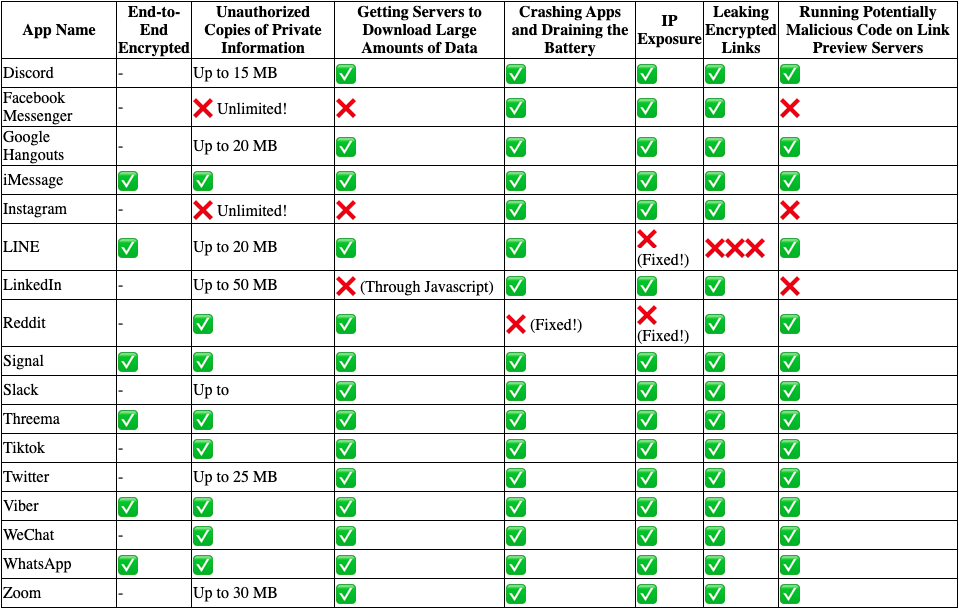
An anonymous reader quotes a report from Ars Technica: Link previews are a ubiquitous feature found in just about every chat and messaging app, and with good reason. They make online conversations easier by providing images and text associated with the file that's being linked. Unfortunately, they can also leak our sensitive data, consume our limited bandwidth, drain our batteries, and, in one case, expose links in chats that are supposed to be end-to-end encrypted. Among the worst offenders, according to research published on Monday, were messengers from Facebook, Instagram, LinkedIn, and Line. More about that shortly.

The researchers behind Monday's report, Talal Haj Bakry and Tommy Mysk, found that Facebook Messenger and Instagram were the worst offenders. As the chart below shows, both apps download and copy a linked file in its entirety -- even if it's gigabytes in size. Again, this may be a concern if the file is something the users want to keep private. It's also problematic because the apps can consume vast amounts of bandwidth and battery reserves. Both apps also run any JavaScript contained in the link. That's a problem because users have no way of vetting the security of JavaScript and can't expect messengers to have the same exploit protections modern browsers have.

LinkedIn performed only slightly better. Its only difference was that, rather than copying files of any size, it copied only the first 50 megabytes. Haj Bakry and Mysk reported their findings to Facebook, and the company said that both apps work as intended. Meanwhile, when the Line app opens an encrypted message and finds a link, it appears to send the link to the Line server to generate a preview. "We believe that this defeats the purpose of end-to-end encryption, since LINE servers know all about the links that are being sent through the app, and who's sharing which links to whom," Haj Bakry and Mysk wrote. Discord, Google Hangouts, Slack, Twitter, and Zoom also copy files, but they cap the amount of data at anywhere from 15MB to 50MB. [This chart] provides a comparison of each app in the study.

Communications

About 3% of Starlink Satellites Have Failed So Far (phys.org) 165

According to Phys.Org, about 3% of SpaceX's Starlink satellites "have proven to be unresponsive and are no longer maneuvering in orbit, which could prove hazardous to other satellites and spacecraft in orbit." From the report: In order to prevent collisions in orbit, SpaceX equips its satellites with krypton Hall-effect thrusters (ion engines) to raise their orbit, maneuver in space and deorbit at the end of their lives. However, according to two recent notices SpaceX issued to the Federal Communications Commission (FCC) over the summer (mid-May and late June), several of their satellites have lost maneuvering capability since they were deployed. Unfortunately, the company did not provide enough information to indicate which of their satellites were affected. For this reason, astrophysicist Jonathan McDowell of the Harvard-Smithsonian Center for Astrophysics (CfA) and the Chandra X-ray Center presented his own analysis of the satellites' orbital behavior to suggest which satellites have failed.

The analysis was posted on McDowell's website (Jonathan's Space Report), where he combined SpaceX's own data with U.S. government sources. From this, he determined that about 3% of satellites in the constellation have failed because they are no longer responding to commands. Naturally, some level of attrition is inevitable, and 3% is relatively low as failure rates go. But every satellite that is incapable of maneuvering due to problems with its communications or its propulsion system creates a collision hazard for other satellites and spacecraft. As McDowell told Business Insider: "I would say their failure rate is not egregious. It's not worse than anybody else's failure rates. The concern is that even a normal failure rate in such a huge constellation is going to end up with a lot of bad space junk."

Power

The Explosive Problem of 'Zombie' Batteries (bbc.com) 120

AmiMoJo shares a report from the BBC: The Environmental Services Association (ESA), which represents waste firms like Biffa, Veolia and Suez, says too many batteries are going into either recycling bins or black rubbish bags, where they are easily damaged by sorting equipment and start to burn -- so-called "zombie" batteries. The ESA has launched a campaign called Take Charge which encourages people to dispose of batteries properly. "Unfortunately, the majority of batteries thrown away in the UK at the moment are not put in the proper recycling bins. Fires caused by carelessly discarded zombie batteries endanger lives, cause millions of pounds of damage and disrupt waste services," says Jacob Hayler, executive director of ESA.

Lithium-ion batteries, which power mobile phones, tablets and toothbrushes, can be extremely volatile if damaged. CCTV footage taken at several recycling centers shows explosions sending flames and debris shooting across sorting areas. And those sorts of batteries are a growing menace. Between April 2019 and March 2020, lithium-ion batteries were suspected to have caused around 250 fires at waste facilities. That is 38% of all fires, up from 25% compared to the previous year, according to the latest data from ESA. In many cases the precise cause of a fire is never established but ESA says it is likely that lithium-ion batteries account for an even bigger proportion of fires.

Displays

Samsung, Stanford Make a 10,000 PPI Display That Could Lead To 'Flawless' VR (engadget.com) 62

Samsung and Stanford University have developed OLED technology that supports resolutions up to 10,000 pixels per inch -- "well above what you see in virtually any existing display, let alone what you'd find in a modern VR headset like the Oculus Quest 2," reports Engadget. From the report: The newOLED tech uses films to emit white light between reflective layers, one silver and another made of reflective metal with nano-sized corrugations. This "optical metasurface" changes the reflective properties and allows specific colors to resonate through pixels. The design allows for much higher pixel densities than you see in the RGB OLEDs on phones, but doesn't hurt brightness to the degree you see with white OLEDs in some TVs. This would be ideal for VR and AR, creating a virtually 'flawless' image where you can't see the screen door effect or even individual pixels. This might take years to arrive when it would require much more computing power, but OLED tech would no longer be an obstacle.
Chrome

Chrome OS May Finally Be Getting a Dark Mode (theverge.com) 16

New submitter andreavenezia shares a report from The Verge: Chrome OS may finally be getting a dark mode, but so far it's only been spotted in its experimental Canary channel, Android Central reported. Before you go tinkering with Canary just be advised: Canary is Google's "bleeding edge" Chrome OS path, which receives daily updates of features before they've been widely tested. It can only be accessed from Chromebooks switched into a special developer mode (not to be confused with the Chrome OS Developer channel). Google warns that Canary can be "unstable."

But at the moment, to activate dark mode on your Chromebook, you need to have the Canary channel installed. Once you've done that, Android Central says you just open Chrome and type in chrome://flags/#enable-force-dark and chrome://flags/#enable-webui-dark-mode into the URL bar. I should note I tried this on my older Chromebook and wasn't able to get it to work. But here's the view Android Police captured. Android Central says the dark mode has some bugs, but notes it seems to apply across the UI, not just as darker backgrounds.

Facebook

Pakistan's PM Asks Facebook To Ban Islamophobic Content (reuters.com) 211

Pakistan Prime Minister Imran Khan called on Facebook to ban Islamophobic content on its platform, warning of a spike in radicalization amongst Muslims, hours after he hit out at the French president for "attacking Islam." Reuters reports: Pakistan summoned the French ambassador in Islamabad as anger spread on Monday over President Emmanuel Macron's reaction to the murder last week of a French teacher by an Islamist. Khan, in an open letter posted on Twitter on Sunday, said "growing Islamophobia" was encouraging extremism and violence worldwide, especially through social media platforms such as Facebook. "I would ask you to place a similar ban on Islamophobia and hate against Islam for Facebook that you have put in place for the Holocaust," Khan said.

"One cannot send a message that while hate messages against some are unacceptable, these are acceptable against others," Khan said, adding such a stance was "reflective of prejudice and bias that will encourage further radicalization." In response, a Facebook spokeswoman told Reuters the company opposed all forms of hate and did not allow attacks based on race, ethnicity, national origin or religion. "We'll remove this hate speech as soon as we become aware of it," the spokeswoman said in a statement, adding that Facebook had "more work to do."

Privacy

Surveillance Startup Used Own Cameras To Harass Coworkers (vice.com) 54

An anonymous reader shares a report: Verkada, a fast-growing Silicon Valley surveillance startup, equips its offices in downtown San Mateo, California, with its own state-of-the-art security cameras. Last year, a sales director on the company's sales team abused their access to these cameras to take and post photos of colleagues in a Slack channel called #RawVerkadawgz where they made sexually explicit jokes about women who worked at the company, according to a report in IPVM, which Motherboard independently verified and obtained more information about. "Face match... find me a squirt," the sales director wrote in the company Slack channel in August 2019, according to one screenshot obtained by Motherboard. The comment was posted along with a series of photos of employees' faces captured with the office's surveillance system which were patched together using a Verkada facial recognition feature. "Face search," as it's called, can pinpoint an individual in a sea of faces. The pinpointed face, in this instance, belonged to a Verkada employee, her mouth wide open. In addition to verifying the incident with three sources who worked at Verkada at the time, Motherboard compared the format of the images posted to those included in Verkada's publicly available demo videos to verify that they were indeed captured by the company's surveillance cameras.

Slashdot Top Deals