The Almighty Buck

Crashed Boeing Planes Lacked Safety Features That Company Sold Only As Extras (apnews.com) 486

The recent Boeing 737 MAX crashes involving an Ethiopian Airlines flight and a Lion Air flight may have been a result of two missing safety features that Boeing charged airlines extra for (Warning: source may be paywalled; alternative source). The New York Times reports that many low-cost carriers like Indonesia's Lion Air opted not to buy them so they could save money, even though some of these systems are fundamental to the plane's operations. "Now, in the wake of the two deadly crashes involving the same jet model, Boeing will make one of those safety features standard as part of a fix to get the planes in the air again," the report says. From the report: It is not yet known what caused the crashes of Ethiopian Airlines Flight 302 on March 10 and Lion Air Flight 610 five months earlier, both after erratic takeoffs. But investigators are looking at whether a new software system added to avoid stalls in Boeing's 737 Max series may have been partly to blame. Faulty data from sensors on the Lion Air plane may have caused the system, known as MCAS, to malfunction, authorities investigating that crash suspect.

The jet's software system takes readings from one of two vanelike devices called angle of attack sensors that determine how much the plane's nose is pointing up or down relative to oncoming air. When MCAS detects that the plane is pointing up at a dangerous angle, it can automatically push down the nose of the plane in an effort to prevent the plane from stalling. Boeing's optional safety features, in part, could have helped the pilots detect any erroneous readings. One of the optional upgrades, the angle of attack indicator, displays the readings of the two sensors. The other, called a disagree light, is activated if those sensors are at odds with one another. The angle of attack indicator will remain an option that airlines can buy. Neither feature was mandated by the Federal Aviation Administration. All 737 Max jets have been grounded.
"Boeing will soon update the MCAS software, and will also make the disagree light standard on all new 737 Max planes," the report adds, citing a person familiar with the changes. "Boeing started moving on the software fix and the equipment change before the crash in Ethiopia."

Slashdot reader Futurepower(R) adds to the story: The FBI has joined the criminal investigation into the certification of the Boeing 737 MAX, lending its considerable resources to an inquiry already being conducted by U.S. Department of Transportation agents, according to people familiar with the matter. "The federal grand jury investigation, based in Washington, D.C., is looking into the certification process that approved the safety of the new Boeing plane, two of which have crashed since October.
Television

Vizio Wants Next-Generation Smart TVs To Target Ads To Households (reuters.com) 235

Smart TV manufacturer Vizio has formed a partnership with nine media and advertising companies to develop an industry standard that will allow smart TVs to target advertisements to specific households, the companies said this week. From a report: The consortium includes major TV networks like Comcast Corp's NBCUniversal and CBS, as well as advertising technology companies like AT&T's Xandr. Addressable advertising, or targeting viewers on the household level based on their interests, has long been the goal of TV marketers. But TVs lack cookies that internet browsers use to allow ads to follow people around the web. [...] The consortium of companies, dubbed Project OAR, or Open Addressable Ready, hopes to define the technical standards for TV programmers and platforms to deliver addressable advertising on smart TVs, which are WiFi-enabled TVs with apps for services like Netflix Inc and Hulu, by the end of this year, McAfee said. Further reading: In January this year, Bill Baxter, chief technology officer of Vizio, spoke about business of data collection in an interview. He said: It's about post-purchase monetization of the TV. This is a cutthroat industry. It's a 6-percent margin industry, right? I mean, you know it's pretty ruthless. You could say it's self-inflicted, or you could say there's a greater strategy going on here, and there is. The greater strategy is I really don't need to make money off of the TV. I need to cover my cost. And then I need to make money off those TVs. They live in households for 6.9 years -- the average lifetime of a Vizio TV is 6.9 years. You would probably be amazed at the number of people come up to me saying, "I love Vizio TVs, I have one" and it's 11 years old. I'm like, "Dude, that's not even full HD, that's 720p." But they do last a long time and our strategy -- you've seen this with all of our software upgrades including AirPlay 2 and HomeKit -- is that we want to make things backward compatible to those TVs. So we're continuing to invest in those older TVs to bring them up to feature level comparison with the new TVs when there's no hardware limitation that would otherwise prevent that.
Businesses

Spotify Files Complaint Against Apple With the European Commission Over 30% Tax and Restrictive Rules (spotify.com) 257

Spotify today filed a complaint with EU antitrust regulators against Apple, saying the iPhone maker unfairly limits rivals to its own Apple Music streaming service. Spotify CEO Daniel Ek writes in a blog post: In recent years, Apple has introduced rules to the App Store that purposely limit choice and stifle innovation at the expense of the user experience -- essentially acting as both a player and referee to deliberately disadvantage other app developers. After trying unsuccessfully to resolve the issues directly with Apple, we're now requesting that the EC take action to ensure fair competition. Apple operates a platform that, for over a billion people around the world, is the gateway to the internet. Apple is both the owner of the iOS platform and the App Store -- and a competitor to services like Spotify. In theory, this is fine. But in Apple's case, they continue to give themselves an unfair advantage at every turn.

To illustrate what I mean, let me share a few examples. Apple requires that Spotify and other digital services pay a 30% tax on purchases made through Apple's payment system, including upgrading from our Free to our Premium service. If we pay this tax, it would force us to artificially inflate the price of our Premium membership well above the price of Apple Music. And to keep our price competitive for our customers, that isn't something we can do. As an alternative, if we choose not to use Apple's payment system, forgoing the charge, Apple then applies a series of technical and experience-limiting restrictions on Spotify.

For example, they limit our communication with our customers -- including our outreach beyond the app. In some cases, we aren't even allowed to send emails to our customers who use Apple. Apple also routinely blocks our experience-enhancing upgrades. Over time, this has included locking Spotify and other competitors out of Apple services such as Siri, HomePod, and Apple Watch. We aren't seeking special treatment. We simply want the same treatment as numerous other apps on the App Store, like Uber or Deliveroo, who aren't subject to the Apple tax and therefore don't have the same restrictions.

Transportation

Tesla Launches Base Model 3 For $35,000 With Shorter Range, New Interior (electrek.co) 265

In a call with reporters Thursday, Tesla CEO Elon Musk said the company is finally launching the long-promised standard Model 3 with a base price of $35,000. "The automaker is now making several new versions of the Model 3 available with a shorter range and new interior options," reports Electrek. From the report: Today, Tesla sent an email to its retail stores the details of the announcement of the new options being available to order in the U.S. today and available as soon as next month. All the details are expected to become available in the next hour, but here's what we know so far: Customers are now able to order the $35,000 Model 3 with a standard interior and standard battery pack enabling 130mph top speed and 5.6s 0-60s acceleration. Tesla is also making a new "Partial Premium Interior" with better seats than the standard interior available with a different "standard range plus" battery pack for a $2,000 premium. The Model 3 Standard Range Plus results in 240 miles of range, a top speed of 140mph, 0-60mph acceleration of just 5.3 seconds. Tesla says that deliveries are starting within the next 2 to 4 weeks depending on the configuration in the U.S. In Europe, Musk said it will be available to order within the "next 3 to 6 months." Slashdot reader Rei provides additional details: The new unveiling introduced a whole slew of variants, including (price, range, top speed, 0-60, premium):

SR: $35K, 220 miles, 130mph, 5.6 seconds, non-PUP
SR+: $37K, 240 miles, 140mph, 5.3 seconds, partial-PUP
MR: $40K, 264 miles, 140mph, 5.2 seconds, PUP
LR: $43K, 325 miles, 140mph, 5.0 seconds, PUP
AWD: $47K, 310 miles, 145mph, 4.5 seconds, PUP
P: $48K, 310 miles, 162mph, 3.2 seconds, PUP

Pricing, ranges, and features have by and large significantly surpassed initial promises. For example, the Long Range (LR) variant was supposed to be a $9K premium over SR, with the Premium Upgrades Package another $5k, but now PUP is included in LR and the price difference is only $8K. Range and performance specs have been upgraded not just on new vehicles, but will also be upgraded on existing vehicles, where applicable, via software update. The price for Autopilot has dropped from $5K to $3K, and some features once planned to be premium-only -- including the glass roof and auto dimming, power folding, heated side mirrors -- are now standard. The Model S and X product line has also been modified, with higher performance at the top end and lower prices at the bottom.

To achieve cost savings, in addition to production optimizations and the recent layoffs, Tesla announced an unexpected strategy: they're closing most of their stores. Sales will only be conducted online. Instead of test drives, cars can be returned within 7 days or 1,000 miles at no charge. "Quite literally, you could buy a Tesla, drive several hundred miles for a weekend road trip with friends and then return it for free," Tesla said in their blog post.

Android

The Volvo Polestar 2 Is the First Google-Powered, All-Electric Car (theverge.com) 92

The Polestar 2 is the first all-electric car from Volvo, and the first car to feature Google's new native version of Android Auto. Billed as a competitor to Tesla's Model 3, "the Polestar 2 should be able to travel up to 275 miles (about 443 kilometers) on a single charge thanks to a 78kWh battery that makes up the entire floor of the car," reports The Verge. "It will be quick, too; Polestar says there's 300kW (about 408 horsepower) to play with, spread across dual electric motors. That all-wheel drive power should help the car get from 0 to 60 miles per hour in under 5 seconds." From the report: All this will eventually cost about 39,900 euros, or about $45,000, at the cheapest. Polestar will sell versions of the car that cost as much as 59,900 euros, or about $68,000. But none of that will happen until the second year of production. The version available when the car launches later this year will cost $63,000, and Polestar will make only that "launch edition" car for the first 12 months. Pre-orders are open now, and production begins next year in China (where Volvo's Chinese parent company Geely is headquartered). Polestar's launching the car with in an ambitious slate of markets, too: China, the United States, Canada, the United Kingdom, Germany, the Netherlands, Norway, Sweden, and Belgium.
[...]
[T]he Polestar 2's interior looks more fully developed and coherent than the one in the Polestar 1, to my eyes at least. The centerpiece is an 11-inch portrait oriented touchscreen where the company's Android-based infotainment system lives. Car companies have built infotainment systems on Android in the past, but they essentially had to fork the open source operating system and build their own solution on top. What's more, Google wasn't involved in those efforts. This meant the cars would wind up with outdated versions of Google's operating system, which complicated upgrades and security. [...] A big benefit to this embedded approach is customers will have instant access to Android Auto-approved apps like Google Maps, or Play Music, or Google Assistant without needing to use their smartphones. Another is that it will have access to the car's functions, meaning it can control climate settings, or send you maintenance alerts. This native version of Android will also be updatable, meaning Polestar and Google can push over-the-air software updates to improve the car's functions long after it's sold.

Communications

FCC Says Gutting ISP Oversight Was Great For Broadband (vice.com) 141

Earlier this week, the FCC proclaimed that broadband connectivity saw unprecedented growth last year thanks to the agency's policies like killing net neutrality. But, as Motherboard points out, that's not entirely true. The lion's share of improvements highlighted by the agency "are courtesy of DOCSIS 3.1 cable upgrades, most of which began before Pai even took office and have nothing to do with FCC policy," the report says. "Others are likely courtesy of build-out conditions affixed to AT&T's merger with DirecTV, again the result of policies enacted before Pai was appointed head of the current FCC." Also, last year's FCC report, which showcased data up to late 2016, "showed equal and in some instances faster growth in rural broadband deployment -- despite Pai having not been appointed yet." From the report: The broadband industry's biggest issue remains a lack of competition. That lack of competition results in Americans paying some of the highest prices for broadband in the developed world, something the agency routinely fails to mention and does so again here. [...] Still, Pai was quick to take a victory lap in the agency release. "For the past two years, closing the digital divide has been the FCC's top priority," Pai said in a press release. "We've been tackling this problem by removing barriers to infrastructure investment, promoting competition, and providing efficient, effective support for rural broadband expansion through our Connect America Fund. This report shows that our approach is working." One of those supposed "barriers to broadband investment" were the former FCC's net neutrality rules designed to keep natural monopolies like Comcast from behaving anti-competitively.

"Overall, capital expenditures by broadband providers increased in 2017, reversing declines that occurred in both 2015 and 2016," the FCC claimed, again hinting that the repeal of net neutrality directly impacted CAPEX and broadband investment. A problem with that claim: the FCC's latest report only includes data up to June 2018, the same month net neutrality was formally repealed. As such the data couldn't possibly support the idea that the elimination of net neutrality was responsible for this otherwise modest growth. Another problem: that claim isn't supported by ISP earnings reports or the public statements of numerous telecom CEOs, who say net neutrality didn't meaningfully impact their investment decisions one way or another. Telecom experts tell Motherboard that's largely because such decisions are driven by a universe of other factors, including the level of competition (or lack thereof) in many markets.

Patents

Apple To Close Retail Stores In the Patent Troll-Favored Eastern District of Texas (techcrunch.com) 54

An anonymous reader quotes a report from TechCrunch: Apple has confirmed its plans to close retail stores in the Eastern District of Texas -- a move that will allow the company to better protect itself from patent infringement lawsuits, according to Apple news sites 9to5Mac and MacRumors which broke the news of the stores' closures. Apple says that the impacted retail employees will be offered new jobs with the company as a result of these changes. The company will shut down its Apple Willow Bend store in Plano, Texas as well as its Apple Stonebriar store in Frisco, Texas, MacRumors reported, and Apple confirmed. These stores will permanently close up shop on Friday, April 12. Customers in the region will instead be served by a new Apple store located at the Galleria Dallas Shopping Mall, which is expected to open April 13. "The Eastern District of Texas had become a popular place for patent trolls to file their lawsuits, though a more recent Supreme Court ruling has attempted to crack down on the practice," the report adds. "The court ruled that patent holders could no longer choose where to file." One of the most infamous patent holding firms is VirnetX, which has won several big patent cases against Apple in recent years.

A spokesperson for Apple confirmed the stores' closures, but wouldn't comment on the company's reasoning: "We're making a major investment in our stores in Texas, including significant upgrades to NorthPark Center, Southlake and Knox Street. With a new Dallas store coming to the Dallas Galleria this April, we've made the decision to consolidate stores and close Apple Stonebriar and Apple Willow Bend. All employees from those stores will be offered positions at the new Dallas store or other Apple locations."
Space

Gravitational Wave Detectors Upgraded To Hunt For 'Extreme Cosmic Events' (cnet.com) 53

The Laser Interferometer Gravitational-Wave Observatory (LIGO) facilities, residing in Washington and Louisiana, will be upgraded via grants from the U.S. National Science Foundation, UK Research and Innovation and the Australian Research Council -- providing stronger, more frequent detections and decreasing noise. CNET reports: Over $34 million will be provided for the upgrade which makes LIGO sound like the latest iPhone. When it is complete, LIGO will go from its crusty old 2015 "Advanced LIGO" phase to the "Advanced LIGO Plus" phase. LIGO's twin facilities both contain two 4-kilometer long arms that use lasers to detect minute disturbances caused by extremely energetic cosmic events -- like black holes merging. The incredibly high-powered events are responsible for gravitational waves, rippling out through spacetime the same way water does when you drop a rock in a pond. By the time they reach Earth, the ripples are so small that only incredibly tiny disturbances in LIGO's lasers can detect them.

The proposed upgrades will greatly increase the number of events that LIGO will detect. With only 11 under its belt so far, [David Reitze, executive director of LIGO] even expects we might see "black hole mergers on a daily basis" and describes neutron star mergers becoming "much more frequent." All that extra power adds up, hopefully revealing some of the cosmos' deepest, darkest secrets.
In September 2015, LIGO provided the first evidence for a black hole merger -- and in turn, the existence of gravitational waves -- just four days after a three-year long upgrade. Since then, LIGO has seen 10 black hole mergers and a single, huge collision between two incredibly dense stars, known as neutron stars.
Android

The Moto G7 Lineup Offers Bigger Screens and Smaller Bezels On a Budget (theverge.com) 66

Motorola is releasing three versions of the Moto G7 this year: the G7, the G7 Power, and the G7 Play (a fourth, more powerful G7 Plus model will also be released internationally). These new devices offer slimmer bezels, bigger displays, and larger batteries than their predecessors. The Verge reports: [T]he $299 G7 (not to be confused with LG's G7 ThinQ) is the top-of-the-line model, with a 6.2-inch Gorilla Glass display that features a 2270 x 1080 resolution and a more subtle teardrop notch. The G7 also has more RAM (4GB), and more internal storage (64GB) than its siblings, along with a dual-camera setup on the back that offers a 12-megapixel main lens along with a 5-megapixel depth sensor for a better portrait mode experience (the other G7 phones will have a software-based portrait mode instead). The G7 also supports Motorola's 15W TurboPower charging spec, which promises nine hours of battery life from a 15-minute charge.

The next phone in the lineup, the $249 G7 Power, may not offer the same level of premium upgrades as the G7, but it does offer an intriguing feature that its pricier counterpart doesn't: a massive 5,000mAh battery that Motorola promises should last for up to three days, besting the 3,000mAh battery in the G7 by a considerable amount (it also supports Motorola's TurboPower charging). The G7 Power also features a 6.2-inch display, but at a lower 1520 x 720 resolution and with a larger notch, and only a single 12-megapixel camera on the back. It also drops down to 3GB of RAM and a base storage of 32GB, and is a bit bulkier than the main G7 -- but if sheer battery life is your goal, it seems like the G7 Power will be tough to beat. Lastly, there's the $199 G7 Play, the smallest and cheapest model in the 2019 Moto G lineup. There are more cuts here: a smaller 5.7-inch 1512 x 720 display with an even larger notch than the G7 Power, a cheaper plastic case, and just 2GB of RAM.
All three devices will feature Qualcomm's mid-tier Snapdragon 632 processor, Android 9.0 Pie, 8-megapixel front-facing cameras, charge via USB-C, and offer rear-mounted fingerprint sensors. Lastly, the 3.5mm headphone jack is still included on all three models. Motorola is promising a release date sometime in the spring for both the U.S. and Canada.
Microsoft

Windows Setup Error Messages Will Soon Actually Help Fix Problems (arstechnica.com) 69

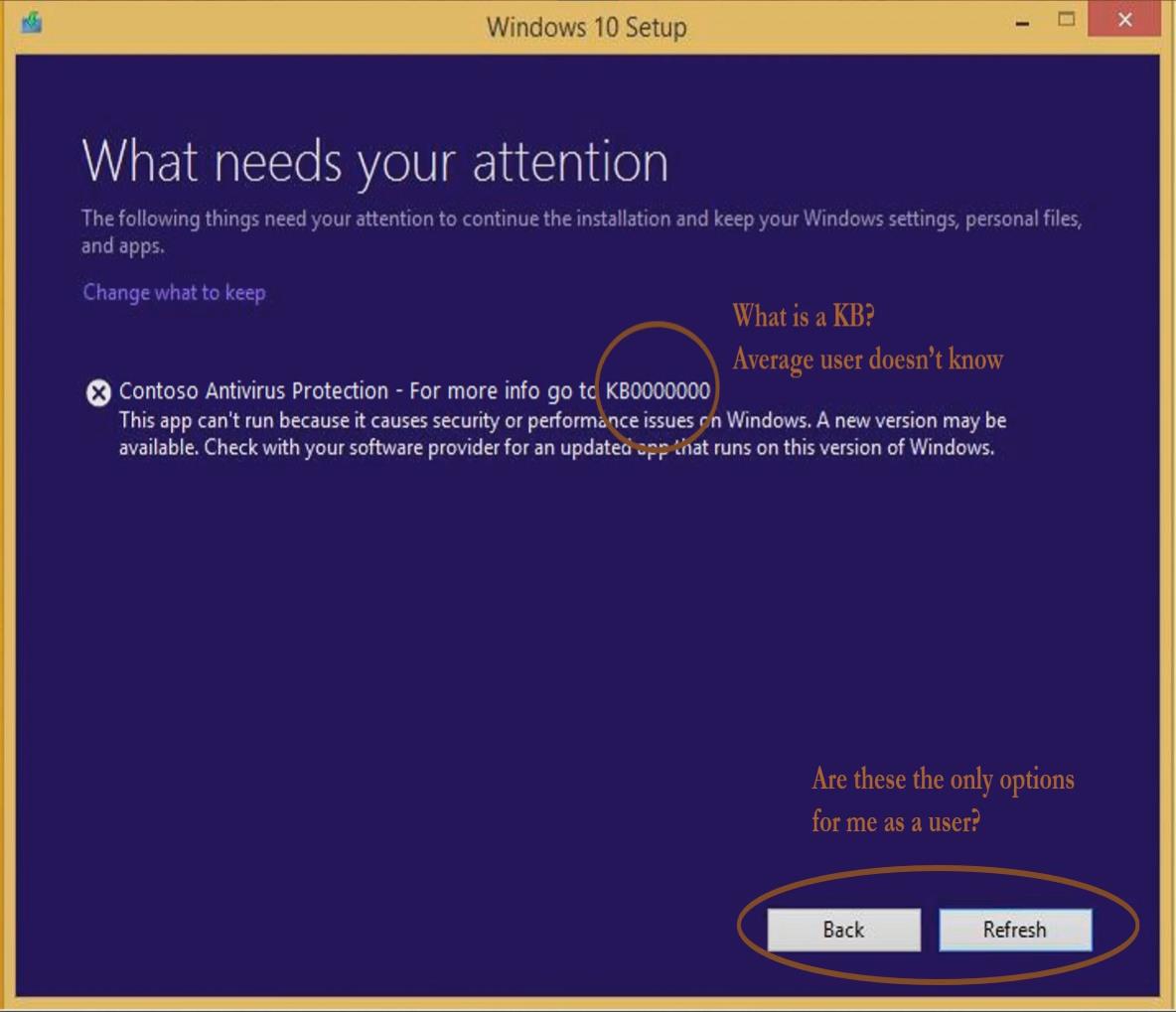
An anonymous reader quotes a report from Ars Technica: The next major Windows release, the Windows 10 April 2019 Update (codenamed 19H1), is going to offer some significant improvements [to error messages]. Microsoft described them on its Windows Insider webcast, and they were spotted initially by WinFuture. Currently, the best case during installation is something like this screen.

The message says that an incompatible application is detected, and a Knowledge Base article is referenced. It turns out that most Windows users don't know what "KBxxxxxxx" actually means, and the article isn't hyperlinked to make accessing it any easier. Issues detected through the other setup experience aren't much better. Windows will offer to uninstall problem applications, but often the better solution is to upgrade the application in question. The new setup process aims to be both more informative and more useful. The general approach is to allow decisions to be made within the setup program where possible and to put meaningful descriptions in the error messages, rather than leaving people with just a KB number to go on. Further, the "learn more" links will take you directly to the relevant Knowledge Base article, rather than hoping that end users know what "KBxxxxxxxx" means. Third-party developers will also be able to provide information about upgrades and updates when applicable to resolving compatibility issues.

Stats

Terabyte-Using Cable Customers Double, Increasing Risk of Data Cap Fees (arstechnica.com) 117

An anonymous reader quotes a report from Ars Technica: U.S. cable Internet customers are using an average of 268.7GB per month, and 4.1 percent of households use at least 1TB, according to new research by the vendor OpenVault. Households that use at least 1TB a month are at risk of paying overage fees because of the 1TB data caps imposed by Comcast and other ISPs. Terabyte users nearly doubled year over year, as just 2.1 percent of households hit the 1TB mark last year, according to OpenVault. OpenVault found that households that face data caps use 8.5-percent less data than un-capped users, suggesting that cable customers limit their Internet usage when they face the prospect of overage fees. According to OpenVault, the caps can help cable companies avoid major network upgrades.

Specifically, "OpenVault's 2018 data also shows that average usage for households with flat-rate pricing was 282.1GB/HH, more than 9 percent higher than the 258.2GB/HH average usage for households on usage-based billing (UBB) plans," OpenVault wrote. Stated another way, customers facing caps and overage fees use 8.5-percent less data than un-capped customers. Un-capped customers are, naturally, more likely to exceed a terabyte. "The percentage of flat-rate (non-UBB) households exceeding 1TB of usage was 4.82 percent, a full percentage point higher than the 3.81 percent of UBB households who exceeded the 1TB threshold," OpenVault said.
The 268.7GB average household data used in December 2018 was "up from 226.4GB/HH [household] at the end of June 2018 and a 33.3 percent increase over the YE 2017 average of 201.6GB/HH," OpenVault said. Median usage was 145.2GB in December 2018, "up from 116.4GB/HH in June 2018 and a 40 percent increase over the YE 2017 median of 103.6GB/HH," the company also said.
Businesses

The 'Fortnite' Economy Now Has Its Own Black Market (qz.com) 31

Fortnite's in-game currency, V-bucks, are now being used to launder money from stolen credit cards, according to a report by The Independent and cybersecurity firm Sixgill. From a report: Here's how it works: After a hacker obtains someone else's credit card information, they make a Fortnite account and use the card to buy V-bucks which are used in the game to purchase cosmetic upgrades and new ways your character can dance. Once the account is loaded up with V-bucks, it is then sold through a legitimate vendor like eBay, or on the dark web. V-bucks cost about $10 for 1,000 when you buy them in the game or from authorized online stores. But these accounts are sold at rates low enough that it ends up being much cheaper to buy V-bucks that way.
Television

Taking the Smarts Out of Smart TVs Would Make Them More Expensive (theverge.com) 329

In a wide-ranging interview, Nilay Patel of The Verge speaks with Bill Baxter, chief technology officer of Vizio, about what the company thinks of some TV vendors adding support for Apple's AirPlay 2, and other things. A remarkable exchange on the business of data collection and selling: Nilay Patel: I guess I have a philosophical question. You guys are committed to low price points and you often beat the industry at those price points. Can you hit those price points without the additional data collection that TV does if you don't have an ad business or a data business on top of the TV?
Bill Baxter: So that's a great question. Actually, we should have a beer and have a long, long chat about that. So look, it's not just about data collection. It's about post-purchase monetization of the TV. This is a cutthroat industry. It's a 6-percent margin industry, right? I mean, you know it's pretty ruthless. You could say it's self-inflicted, or you could say there's a greater strategy going on here, and there is. The greater strategy is I really don't need to make money off of the TV. I need to cover my cost.

And then I need to make money off those TVs. They live in households for 6.9 years -- the average lifetime of a Vizio TV is 6.9 years. You would probably be amazed at the number of people come up to me saying, "I love Vizio TVs, I have one" and it's 11 years old. I'm like, "Dude, that's not even full HD, that's 720p." But they do last a long time and our strategy -- you've seen this with all of our software upgrades including AirPlay 2 and HomeKit -- is that we want to make things backward compatible to those TVs. So we're continuing to invest in those older TVs to bring them up to feature level comparison with the new TVs when there's no hardware limitation that would otherwise prevent that.

And the reason why we do that is there are ways to monetize that TV and data is one, but not only the only one. It's sort of like a business of singles and doubles, it's not home runs, right? You make a little money here, a little money there. You sell some movies, you sell some TV shows, you sell some ads, you know. It's not really that different than The Verge website.

Patel: One sort of Verge-nerd meme that I hear in our comments or on Twitter is "I just want a dumb TV. I just want a panel with no smarts and I'll figure it out on my own." But it sounds like that lifetime monetization problem would prevent you from just making a dumb panel that you can sell to somebody.
Baxter: Well, it wouldn't prevent us, to be honest with you. What it would do is, we'd collect a little bit more margin at retail to offset it. Again, it may be an aspirational goal to not have high margins on our TV business because I can make it up downstream. On the other hand, I'm actually aggregating that monetization across a large number of users, some of which opt out. It's a blended revenue model where, in the end, Vizio succeeds, but you know, it's not wholly dependent on things like data collection.

Encryption

OSNews Suffered 'Likely' Data Breach, Contemplated Going Offline Permanently (osnews.com) 77

hmckee writes: OSNews was offline for a few days for upgrades. It is now back up with a message that indicates they encountered a data breach and considered going offline for good due to maintenance and financial difficulties. "Our best guess is that someone was able to exploit a vulnerability in old, unmaintained code in the site's content management system, and made off with at least some user data, which may be as little as a few user records or, at worst, our entire database," writes Publisher David Adams. "Your email addresses were in there, and the encryption on the passwords wasn't up to modern standards (unsalted SHA1). [...] Other than potential spam, though, we're not aware of any other nefarious use of your data, we don't store much beyond email addresses and passwords..."

David goes on to cite poor advertising revenues and a lack of time for reasons to throw in the towel and go offline permanently.
Iphone

Apple Says It Could Miss $9 Billion In iPhone Sales Due To Weak Demand (theverge.com) 332

An anonymous reader quotes a report from The Verge: Apple CEO Tim Cook published a letter to investors today warning of weaker than expected first-quarter earnings, citing "fewer iPhone upgrades than we had anticipated." The weakened demand came primarily from China, although Cook notes that "in some developed markets, iPhone upgrades also were not as strong as we thought they would be." In his letter, Cook offers several explanations for the lower earnings guidance: earlier launch timing of the iPhone XS and XS Max compared to the iPhone X, the strength of the US dollar, supply constraints due to the number of new products Apple released in the fall, and overall economic weakness in some markets. But the core issue remains simple: people just aren't buying as many new iPhones as Apple hoped. All in all, Apple's revised Q1 guidance forecast is dropping by up to $9 billion in revenue compared to its original estimate.
Operating Systems

Linux 4.20 Released in Time for Christmas (betanews.com) 47

Linus Torvalds has announced the general availability of v4.20 of the Linux kernel. In a post to the Linux Kernel Mailing List, Torvalds said that there was no point in delaying the release of the latest stable version of the kernel just because so many people are taking a break for the holiday season. From a report: He says that while there are no known issues with the release, the shortlog is a little longer than he would have liked. However "nothing screams 'oh, that's scary'", he insists. The most notable features and changes in the new version includes: New hardware support! New hardware support includes bringing up the graphics for AMD Picasso and Raven 2 APUs, continued work on bringing up Vega 20, Intel has continued putting together its Icelake Gen 11 graphics support, there is support for the Hygon Dhyana CPUs out of China based upon AMD Zen, C-SKY 32-bit CPU support, Qualcomm Snapdragon 835 SoC enablement, Intel 2.5G Ethernet controller support for "Foxville", Creative Sound Blaster ZxR and AE-5 sound card support, and a lot of smaller additions.

Besides new hardware support when it comes to graphics processors, in the DRM driver space there is also VCN JPEG acceleration for Raven Ridge, GPUVM performance work resulting in some nice Vulkan gaming boosts, Intel DRM now has full PPGTT support for Haswell/IvyBridge/ValleyView, and HDMI 2.0 support for the NVIDIA/Nouveau driver. On the CPU front there are some early signs of AMD Zen 2 bring-up, nested virtualization now enabled by default for AMD/Intel CPUs, faster context switching for IBM POWER9, and various x86_64 optimizations. Fortunately the STIBP work for cross-hyperthread Spectre V2 mitigation was smoothed out over the release candidates that the performance there is all good now.

Btrfs performance improvements, new F2FS features, faster FUSE performance, and MDRAID improvements for RAID10 round out the file-system/storage work. One of the technical highlights of Linux 4.20 that will be built up moving forward is the PCIe peer-to-peer memory support for device-to-device memory copies over PCIe for use-cases like data going directly from NICs to SSD storage or between multiple GPUs.

Programming

Rust 1.31 Released As 'Rust 2018' In Major Push For Backwards Compatibility (rust-lang.org) 81

"The Rust programming language team has announced the first major edition of Rust since 1.0 was released in 2015," reports SD Times -- specifically, Rust 1.31, the first edition of "Rust 2018," described by Rust's developers as "the culmination of feature stabilization."

An anonymous reader writes: The Rust team is working hard to maintain backwards compatibility, for example with the way they're handling the ongoing addition of an async/await feature. "Even though the feature hasn't landed yet, the keywords are now reserved," notes the Rust Team. "All of the breaking changes needed for the next three years of development (like adding new keywords) are being made in one go, in Rust 1.31." The keyword "try" has now also been reserved, but "Almost all of the new features are 100% compatible with Rust as it is. They don't require any breaking changes... New versions of the compiler will continue to support "Rust 2015 mode", which is what you get by default... [Y]ou could think of Rust 2018 as the specifier in Cargo.toml that you use to enable the handful of features that require breaking changes."

The Rust language's blog adds, "Your 2018 project can use 2015 dependencies, and a 2015 project can use 2018 dependencies. This ensures that we don't split the ecosystem, and all of these new things are opt-in, preserving compatibility for existing code. Furthermore, when you do choose to migrate Rust 2015 code to Rust 2018, the changes can be made automatically, via cargo fix." Tooling improvements include faster and smarter "incremental" compilation (along with better IDE support), plus the addition of function-like and attribute-like (procedural) macros. There's also a rustfmt tool which can automatically reformat your code's style "like clang format does for C++ and Prettier does for JavaScript," plus an optional diagnostics linter named clippy, and automated code fixes via rustfix. There's even upgrades to Rust's module system and other path clarity improvements.

But this is only the beginning, SD Times reports: With the release of Rust 2018, the team is now starting to look at Rust's future. The team is asking developers to reflect on what they liked, didn't like or hoped to see in Rust during the last year, and propose any goals or directions for the upcoming year.
Japan

Japan Has Restarted Five Nuclear Power Reactors In 2018 (oilvoice.com) 193

With Shikoku Electric Power Company's 890 megawatt (MW) Ikata-3 reactor, Japan has restarted a total of five nuclear reactors in 2018. "Japan had suspended its nuclear fleet in 2013 for mandatory safety checks and upgrades following the 2011 Fukushima accident, and before 2018 only four reactors had been restarted," reports OilVoice. From the report: Following the Fukushima accident, as each Japanese nuclear reactor entered its scheduled maintenance and refueling outage, it was not returned to operation. Between September 2013 and August 2015, Japan's entire reactor fleet was suspended from operation, leaving the country with no nuclear generation. Sendai Units 1 and 2, in Japan's Kagoshima Prefecture, were the first reactors to be restarted in August and October 2015, respectively.

The restart of Japan's nuclear power plants requires the approval of both Japan's Nuclear Regulation Authority (NRA) and the central government, as well as consent from the governments of local prefectures. In July 2013, the NRA issued more stringent safety regulations to address issues dealing with tsunamis and seismic events, complete loss of station power, and emergency preparedness. As part of Japan's long-term energy policy, issued in April 2014, the central government called for the nuclear share of total electricity generation to reach 20%-22% by 2030, which would require 25 to 30 reactors to be in operation by then. In 2017, four operating nuclear reactors provided 3% of Japan's total electricity generation.

Microsoft

Microsoft's Surface Roadmap Reportedly Includes Ambient Computing and a Modular All-in-One PC (venturebeat.com) 41

Journalist Brad Sams is releasing a book chronicling the company's Surface brand: Beneath a Surface. VentureBeat writes: While you'll want to read all 26 chapters to get the juicy details, the last one includes Microsoft's hardware roadmap for 2019, and even a part of 2020 -- spanning various Surface products and even a little Xbox. Here's a quick rundown of Microsoft's current Surface lineup plans:

Spring 2019: A new type of Surface-branded ambient computing device designed to address "some of the common frustrations of using a smartphone," but that isn't itself a smartphone.
Q4 2019: Surface Pro refresh with USB-C (finally), smaller bezels, rounded corners, and new color options.
Q4 2019: AMD-based Surface Laptop -- Microsoft is exploring using the Picasso architecture.
Late 2019: Microsoft's foldable tablet Andromeda could be larger than earlier small form factor prototypes for a pocketable device with dual screens and LTE connectivity.
Q1 2020: Surface Book update that might include new hinge designs (high-end performance parts may delay availability).
2020: A Surface monitor, and the modular design debuted for Surface Hub 2 could make its way to Surface Studio. The idea is to bring simple upgrades to all-in-one PCs, rather than having to replace the whole computer.
GeekWire adds: A pair of new lower-cost devices Xbox One S devices could come next year. Sams reports that one of the models may be all digital, without a disc drive.
Windows

'Windows Isn't a Service, It's an Operating System' (howtogeek.com) 445

A reader shares an article by former PC World columnist Chris Hoffman.

"No PC users asked Microsoft for Windows as a service," Hoffman complains. "It was all Microsoft's idea." "Software as a service" is trendy. But these types of services are generally hosted on a remote platform, like Amazon Web Services or even Microsoft Azure. Web applications like Gmail and Facebook are services. That all makes sense -- the company maintains the software, and you access it remotely. An operating system that runs on millions of different hardware configurations is not a service. It can't be updated as easily, and you'll run into issues with hardware, drivers, and software when you change things. The upgrade process isn't instant and transparent -- it's a big download and can take a while to install... [M]illions of applications (or computers!) could break if Microsoft makes a mistake with Windows.

What has Windows as a service even gotten us? How much has Windows 10 improved since its release? Sure, Microsoft keeps adding new features like the Timeline and Paint 3D, but how many Windows users care about those? Many of these new features, like Paint 3D and updates to Microsoft Edge, could be delivered without major operating system upgrades. Just take a look at the many features in Windows 10's October 2018 Update and ask whether they were worth all the deleted files and drama. Texting from your PC is great, but Microsoft could release an app that does that -- in fact, this was once supposed to be a Skype feature. Clipboard history is cool, and a dark theme for File Explorer is cute. But couldn't we have waited another six months for Microsoft to properly polish and test this stuff?

"Windows as a Service" does get us a few things. It gets us applications like Candy Crush installed on our PCs. It gets us an ever-increasing number of built-in advertisements. And it gets us activation problems when Windows phones home once a day and discovers that Microsoft has a server problem.

"Please Microsoft, slow down," the article concludes. "How about releasing a new version of Windows once per year instead? That's what Apple does, and Apple doesn't need 'macOS as a Service' to do it. Just create a new version of Windows every year, give it a new name, and spend a lot of time polishing it and fixing bugs.

"Wait until it's stable to release it, even if you have to delay it."

Slashdot Top Deals