Transportation

New Airbus Facility To Research Cryogenic Fuel Systems For Next-Gen Hydrogen Planes (cnbc.com) 68

An anonymous reader quotes a report from CNBC: Airbus is launching a U.K.-based facility focused on hydrogen technologies, a move which represents the firm's latest attempt to support the design of its next generation of aircraft. In a statement Wednesday, Airbus said the Zero Emission Development Centre in Filton, Bristol, had already begun working on the development of the tech. One of the site's main goals will center around work on what Airbus called a "cost-competitive cryogenic fuel system" that its ZEROe aircraft will need.

Details of three zero-emission, "hybrid-hydrogen" concept planes under the ZEROe moniker were released back in Sept. 2020. Airbus has said it wants to develop "zero-emission commercial aircraft" by the year 2035. The ZEDC in the U.K. will join other similar sites in Spain, Germany and France. "All Airbus ZEDCs are expected to be fully operational and ready for ground testing with the first fully functional cryogenic hydrogen tank during 2023, and with flight testing starting in 2026," the company said.

Businesses

Broadcom To 'Focus On Rapid Transition To Subscription' For VMware (theregister.com) 68

Broadcom has signaled its $61 billion acquisition of VMware will involve a "rapid transition from perpetual licenses to subscriptions." The Register reports: That's according to Tom Krause, president of the Broadcom Software Group, on Thursday's Broadcom earnings call. He was asked how the semiconductor giant plans to deliver on its guidance that VMware will add approximately $8.5 billion of pro forma EBITDA to Broadcom within three years of the deal closing -- significant growth given VMware currently produces about $4.7 billion. And subscriptions was the answer. Krause also repeatedly said Broadcom intends to invest in VMware's key product portfolio and is pleased to be acquiring a sales organization and channel relationships that give it reach Broadcom does not currently enjoy. [...]

Krause and Broadcom CEO Hock Tan both said Broadcom plans to nurture VMware's 300,000-plus customer base. The move to subscription-based licensing will apparently happen over the course of the next few years. [...] VMware may also experience slower growth in the short term due to the licensing shift. Krause said Broadcom is willing to live with lower margins for VMware than it expects from CA and Symantec, with R&D to benefit as a result. The software boss pledged ongoing investment and innovation for VMware's core infrastructure products, naming vSphere, VSAN, vRealize and NSX as the subjects of ongoing love and attention

Transportation

IndyCar Is Moving To 100% Renewable Ethanol In 2023 (arstechnica.com) 43

An anonymous reader quotes a report from Ars Technica: The IndyCar racing series is switching to an entirely renewable fuel next year. On Friday, ahead of Sunday's Indianapolis 500 race, IndyCar announced that starting next year, the race cars will be powered by a new, second-generation renewable ethanol race fuel developed by Shell. The manufacturing process for IndyCar's ethanol will be slightly less exotic than that seen in the low-carbon fuel that Formula 1 is considering for 2026. Rather than carbon capture and electrolysis, Shell will use sugarcane waste and other renewable feedstocks, which are hydrolyzed and fermented at a plant in Brazil operated by Raizen (Shell is a co-owner).

Shell says that the switch "enables at least" 60 percent less carbon dioxide emissions than fossil fuel gasoline, although IndyCar currently runs on an E85 blend of gasoline rather than 100 percent fossil fuel or the 100 percent methanol that powered the sport for so many years. [...] Among other changes to help green the sport is the installation of a 150 kW DC fast charger at the Indianapolis Motor Speedway. And the roughly 5,000 tires that Firestone will transport to the track by Sunday will be hauled there from the tire maker's central Indiana warehouse by one of Penske's electric Freightliner eCascadia trucks.

Communications

Starlink Has Been Approved in Nigeria and Mozambique (techcrunch.com) 13

Elon Musk has announced that Starlink, the satellite internet service launched by SpaceX, has been approved in Nigeria and Mozambique. From a report: This news is coming three days after Musk answered a tweet about the service launch in Africa. "Yes, first countries in Africa to be announced coming soon," he tweeted. "Starlink will serve everywhere on Earth that we're legally allowed to serve."
Google

Russia Opens Cases Against Google, other Foreign Tech Over Data Storage (reuters.com) 51

Russia's communications regulator Roskomnadzor said on Friday it had opened administrative cases against Alphabet's Google and six other foreign technology companies for alleged violations of personal data legislation. From a report: Moscow has clashed with Big Tech over content, censorship, data and local representation in a simmering dispute that has erupted into a full-on information battle since Russia sent tens of thousands of troops into Ukraine on Feb. 24. Russia fined Google 3 million roubles ($46,540) last year for not storing the personal data of Russian users in databases on Russian territory, and on Friday said it had opened a new case over what it called Google's repeated failure to comply with Russian legislation.
Television

Are We on the Verge of an 8K Resolution Breakthrough in Gaming? (arstechnica.com) 104

An anonymous reader shares a report: With the 2020 release of the Xbox Series X and PlayStation 5, we've started to see the era of console games that finally make full use of TVs capable of 4K resolutions (i.e., "Ultra HD" 3840x2160 pixels) that have become increasingly popular in the marketplace. Now, though, at least one TV manufacturer is already planning to support 8K-capable consoles (i.e., 7680x4320 resolution) that it thinks could launch in the next year or two.

Polish gaming site PPL reports on a recent public presentation by Chinese TV and electronics maker TCL. Tucked away in a slide during that presentation is a road map for what TCL sees as "Gen 9.5" consoles coming in 2023 or '24. Those supposed consoles -- which the slide dubs the PS5 Pro and "New Xbox Series S/X" -- will be capable of pushing output at 8K resolution and up to 120 frames per second, according to TCL's slide.

Facebook

Meta Copied VR Technology Key To Metaverse Gaming, Immersion Claims (bloomberg.com) 13

Meta Platforms built its industry-leading virtual reality headset by infringing Immersion's patents, the smaller company alleged in a lawsuit. From a report: The Meta Quest 2, which dominates the market, infringes six patents covering haptic technology, Immersion said in a complaint filed Thursday in federal court in Waco, Texas. In video game systems and controllers, haptics allow users to experience vibrations that mimic real-life forces -- such as blocking a punch in a virtual boxing game. Meta Chief Executive Officer Mark Zuckerberg has committed to spending $10 billion a year to bring to life his vision of a virtual reality-enabled metaverse. Sales of Meta Quest 2 hit 8.7 million units in 2021, twice as much as in the prior year, and the company owns 80% of the market.
Communications

Starlink Gets Nod To Provide Internet in Philippines (bloomberg.com) 9

Starlink has been authorized to provide satellite internet services in the Philippines, paving the way for the SpaceX unit's expansion to Southeast Asia. From a report: The Philippine National Telecommunications Commission said it approved Starlink's registration as a value-added service provider, according to a statement Friday. This would allow Starlink to directly access satellite systems, and to build and operate broadband facilities. The Philippines will be the first country in Southeast Asia to offer Starlink's high speed, low latency satellite internet service, the NTC said.
Businesses

Tech Industry Groups Are Watering Down Attempts at Privacy Regulation, One State at a Time (themarkup.org) 38

Coordinated industry lobbying is overwhelming the scattered efforts of consumer groups and privacy-minded lawmakers. From a report: In late 2019, Utah state senator Kirk Cullimore got a phone call from one of his constituents, a lawyer who represented technology companies in California. "He said, 'I think the businesses I represent would like to have some bright lines about what they can do in Utah,'" Cullimore told The Markup. At the time, tech companies in California were struggling with how they could comply with a new state law that gave individual Californians control over the data that corporations routinely gather and sell about their online activities. The lawyer, whom Cullimore and his office wouldn't identify, recounted how burdensome his corporate clients found the rules, Cullimore remembered, and suggested that Utah proactively pass its own, business-friendly consumer privacy law.

"He said, 'I want to make this easy so consumers can make use of their rights and the compliance is also easy for companies.' He actually sent me some suggested language [for a bill] that was not very complex," Cullimore told The Markup. "I introduced the bill as that." What followed over the next two years was a multipronged influence campaign straight out of a playbook Big Tech is deploying around the country in response to consumer privacy legislation. It's common for industries to lobby lawmakers on issues affecting their business. But there is a massive disparity in the state-by-state battle over privacy legislation between well-funded, well-organized tech lobbyists and their opposition of relatively scattered consumer advocates and privacy-minded politicians, The Markup has found. During the 2021 and 2022 Utah legislative sessions -- when Cullimore's bill made its way through the legislature -- Amazon, Apple, Facebook, Google, and Microsoft collectively registered 23 active lobbyists in the state, according to their lobbying disclosures. Thirteen of those lobbyists had never previously registered to work in the state, and some of them were influential in shaping Cullimore's legislation.

Canada

Internet Drama in Canada (nytimes.com) 88

We all need great internet service, but it doesn't happen by accident. From a report: Let's talk about internet policy! In Canada! Wheee! I'm serious that there are useful lessons from a saga over home internet service in Canada. What has been a promising, albeit imperfect, system that increased choices and improved internet service for Canadians is poised to fall apart. Barring a last-minute government intervention today or Friday, many smaller internet providers in Canada are likely to significantly increase their prices and lose customers or shut down. The dream of more competition leading to better internet service for Canadians is on life support. What's happening in Canada reveals why we need smart internet policy to be paired with strong government oversight to have better and more affordable internet for all -- and it shows what happens when we lose that.

The U.S. has botched it for years, and that's one reason America's internet service stinks. Canada may be a real-world experiment in what happens when muddled government regulation undermines internet policy that has mostly been effective. Bear with me for a lesson in Canada's home internet service. The bottom line is that Canadians have something that is relatively novel to Americans: Many people have options to pick a home internet provider that they don't hate. That's because in Canada -- similar to many countries including Britain, Australia and Japan -- the companies that own internet pipelines are required to rent access to businesses that then sell internet service to homes. Regulators keep a close watch to make sure those rental costs and terms are fair.

Amiga

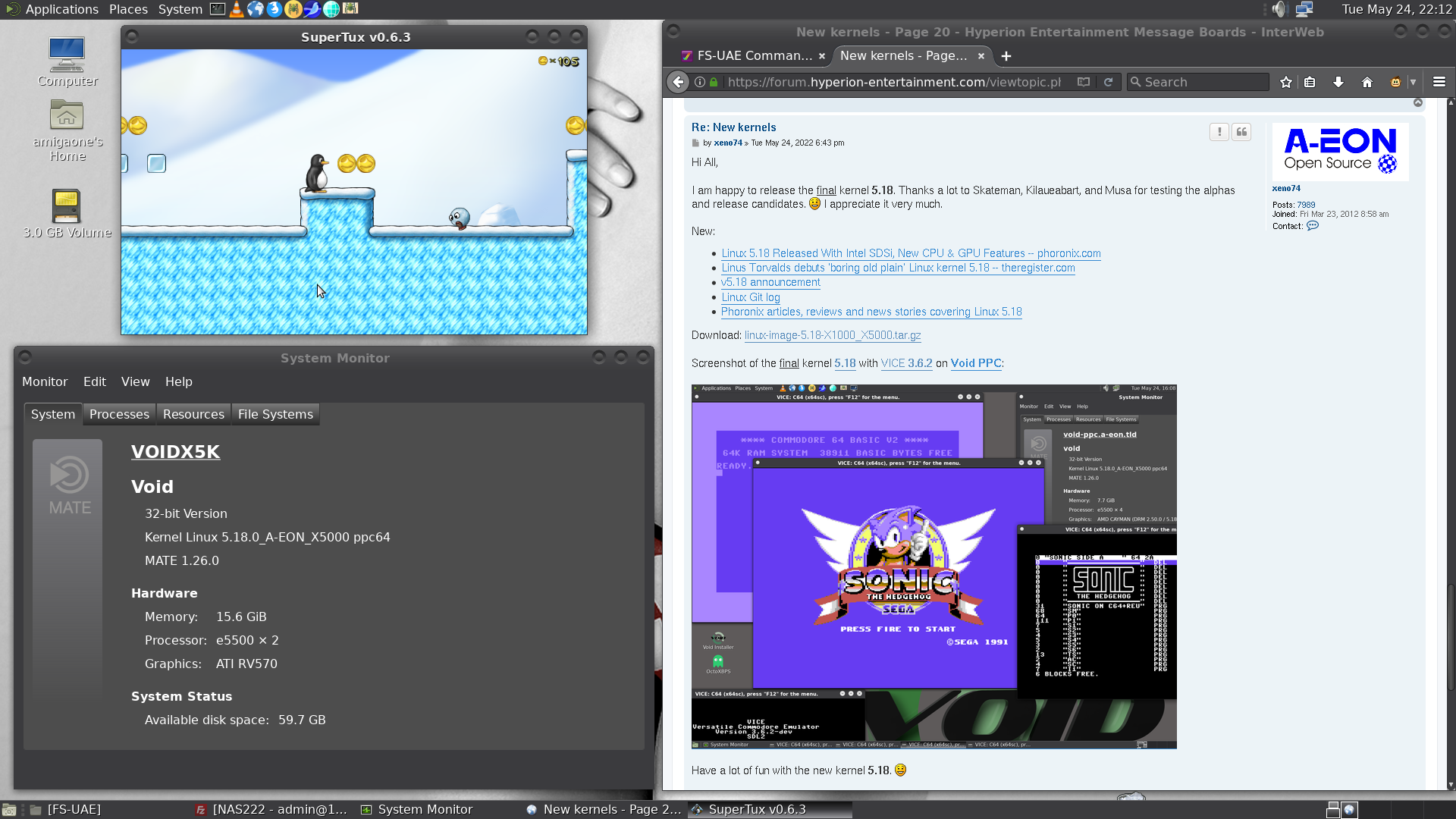
AmigaOne X1000/X5000 Remains Well Supported With PowerPC Linux 117

Mike Bouma writes: Despite being expensive and having been sold out for quite some time at the main Amiga Dealers, two days after Linus Torvalds' release of Linux 5.18, Christian "xeno74" Zigotzky made the latest PPC kernel available for the AmigaOne X1000/X5000. Here and here are some screenshots. Linux PPC performs well on AmigaOne computers. For example, here is a 5-year-old YouTube AmigaOne X5000 demonstration video.
Television

NCTC Could Drop 'Cable' As Industry Group Eyes Name Change (fiercevideo.com) 16

Industry trade group the National Cable Television Cooperative (NCTC) could be dropping the "cable" moniker as it eyes a potential name change. Fierce Video reports: A trademark application filed by NCTC on May 17 shows one proposal for a new name: National Content & Technology Cooperative. An NCTC spokesperson confirmed to Fierce that the organization will be changing its name, but said it is considering a large number of options and hasn't yet settled on a final decision. The spokesperson noted it's taking time to register potential names, but some of the other choices on the table include simply "NCTC," "NCTC Online" or even sticking with its current brand of the National Cable Television Cooperative. [...] According to the application, it appears NCTC is also considering losing the image of a coaxial cable that's currently featured in its logo.

So why the potential shift away from cable? One factor could be that the industry has clearly changed since NCTC formed in 1984, with cable operators in recent years deemphasizing traditional video offerings. The "Cable Television" part of the group's name is becoming less accurate over time, said Brett Sappington, VP of Interpret. "Broadband, not television, is the cash cow for the cable industry," he told Fierce Video. "Many of the organization's members are actually moving away from offering their own video service and are, instead, focusing on broadband bundled with streaming services." [...] Along with industry changes come some shifts in perception as well. "Cable TV doesn't necessarily have a positive connotation today," Sappington noted. "In fact, many online TV services such as Sling TV or FuboTV emphasize why consumers should 'drop cable' and go with their services instead," he continued.

The Internet

Corey B. Marion, Co-Founder of The Iconfactory, Dies Age 54 (appleinsider.com) 8

Designer and co-founder of The Iconfactory, Corey B. Marion, has died following a long battle with cancer. He was 54. AppleInsider reports: Marion founded The Iconfactory in 1996 with Talos Tsui, and Gedeon Maheux, when he was 29. For a quarter of a century, he led the firm while also designing icons -- including the company's own factory logo one -- and created a typeface based on his own handwriting. [...] The Iconfactory produces sets of icons, such as free ones commissioned by Paramount to promote a "Star Trek" film, and over 100 for Microsoft Windows XP. Corey designed logos, emojis, and wallpapers too. Plus from 1997 to 2004, he was a judge on The Iconfactory's annual Pixelpalooza icon design contest, created specifically for the Mac community. "We hope you'll join us in celebrating his life via the digital gifts he gave of himself as well as send warm and comforting wishes to his entire family," says a statement on the front page of the company's site. "Our sadness is tempered by the fact that his art and legacy live on in all of us here at the factory as well as for all those, like yourselves, who have enjoyed his creations over the years."
Graphics

Linux 5.19 Adds 500K Lines of New Graphics Driver Code (phoronix.com) 79

UnknowingFool writes: The current Linux kernel in development, 5.19, added 495,793 new lines of code for graphic driver updates. David Airlie sent in the new lines as part of Direct Rendering Manager (DRM) subsystem of Linux. The majority of additions were for AMD's RDNA and CDNA platforms but Intel also submitted changes for their DG2 graphics as well. Updates also came from Qualcomm and MediaTek for their GPU offerings.
Microsoft

Microsoft Continues To Iterate on an Xbox Cloud Streaming Device Codenamed 'Keystone' (windowscentral.com) 29

Windows Central: For a few years, rumors have persisted that Microsoft was exploring building some form of streaming stick to offer Xbox Cloud Gaming via a more affordable dongle, similarly to Chromecast and Google Stadia. The first hint was Project Hobart. More recently, a code name "Keystone" appeared in an Xbox OS list, lending fire to rumors that Microsoft was continuing to explore additional hardware for the Xbox lineup. We can now confirm that that is indeed true, and it pertains to a modernized HDMI streaming device that runs Xbox Game Pass and its cloud gaming service. Microsoft is, however, taking exploring additional iterations of the product before taking it to market. In a statement provided to Windows Central, a Microsoft spokesperson described its commitment to lowering boundaries to Xbox content via low cost-hardware, while acknowledging that the existing version of Keystone needs a little more time to bake before going live.
Google

US Bill Would Bar Google, Apple From Hosting Apps That Accept China's Digital Yuan (reuters.com) 52

Republican Senators want to bar U.S. app stores including Apple and Google from hosting apps that allow payments to be made with China's digital currency, according to a copy of proposed legislation seen by Reuters, amid fears the payment system could allow Beijing to spy on Americans. From a report: The bill to be unveiled on Thursday by Senators Tom Cotton, Marco Rubio and Mike Braun states that companies that own or control app stores "shall not carry or support any app in [their] app store(s) within the United States that supports or enables transactions in e-CNY." According to Cotton's office, digital yuan could provide the Chinese government with "real-time visibility into all transactions on the network, posing privacy and security concerns for American persons who join this network."
Google

Google Opens Up Chrome and Chrome OS To Enterprise Security, Control Integrations (theverge.com) 10

Google is highlighting how Chromebooks can work in "zero trust" corporate environments with its new Chrome Enterprise Connectors Framework. From a report: The new integration system is designed to make the Chrome browser and Chrome OS devices easier for IT departments to implement with existing security, endpoint, and authentication solutions as well as bother management solutions. Google Chrome OS exec John Solomon describes the new tools as a "plug and play" solution that lets other companies helm Chrome OS management functions like remote-wiping a Chromebook using BlackBerry Unified Endpoint Management or flagging malware downloads with Splunk. These types of management functions previously worked through the Google Admin console. Managing and enrolling Chrome OS devices in the enterprise will still rely on Google tools like Google Admin and Chrome Browser Cloud Management. But new tools like Chrome OS Data Controls give enterprises more options to allow or lock down actions like printing, screen capture, copy / paste, and other potential data loss situations. It might even give IT a better handle on buggy Chrome OS updates and is currently available through the Trusted Tester program.
Technology

Tim Sweeney Casts Doubt on Metaverse's Use for Work, Saying Stripping Entertainment Aspect Leaves You With 'Super Creepy Version of AOL Chat Rooms' (ft.com) 81

In an interview with the FT, Epic chief executive Tim Sweeney spoke about the metaverse and expressed his concerns that tech giants Apple and Google could "unfairly" extend their "stranglehold" on smartphone platforms to "dominate all physical commerce taking place in virtual and augmented reality." An excerpt from the report: FT: How convinced are you that the metaverse -- this immersive virtual world -- really is the next digital platform beyond the smartphone?

Tim Sweeney: It's happening already. If you look at Fortnite, Roblox, Minecraft and other real-time 3D social entertainment experiences, you can readily identify at least 600mn monthly active users in a medium that's growing at a significant rate every year. So, there's no question that this phenomenon is happening. The only question is: when does it reach billions?

FT: When I think of the metaverse, it's much broader than gaming. It's doing work in the metaverse, and meeting your colleagues in there. What are the challenges of bringing that vision into existence?

Tim Sweeney: I'm not sure if that vision actually works, because it's not very fun to sit around in 3D and just talk to people. It gets really awkward really fast. A bunch of guys can't get together and just sit in a room for hours and have a conversation, right? You have to be shooting darts or playing billiards or shooting hoops or doing something together to break up the dull moments and keep you entertained for a long period of time. And that's what this medium does. I think if you strip the entertainment aspect from it, you end up with a super creepy version of America Online chat rooms!

The Courts

California Parents Could Soon Sue For Social Media Addiction (apnews.com) 155

California could soon hold social media companies responsible for harming children who have become addicted to their products, permitting parents to sue platforms like Instagram and TikTok for up to $25,000 per violation under a bill that passed the state Assembly on Monday. The Associated Press reports: The bill defines "addiction" as kids under 18 who are both harmed -- either physically, mentally, emotionally, developmentally or materially -- and who want to stop or reduce how much time they spend on social media but they can't because they are preoccupied or obsessed with it. Business groups have warned that if the bill passes, social media companies would most likely cease operations for children in California rather than face the legal risk.

The proposal would only apply to social media companies that had at least $100 million in gross revenue in the past year, appearing to take aim at social media giants like Facebook and others that dominate the marketplace. It would not apply to streaming services like Netflix and Hulu or to companies that only offer email and text messaging services. [...] The bill gives social media companies two paths to escape liability in the courts. If the bill becomes law, it would take effect on Jan. 1. Companies that remove features deemed addictive to children by April 1 would not be responsible for damages. Also, companies that conduct regular audits of their practices to identify and remove features that could be addictive to children would be immune from lawsuits.
"Monday's vote is a key -- but not final -- step for the legislation," adds the report. "The bill now heads to the state Senate, where it will undergo weeks of hearings and negotiations among lawmakers and advocates. But Monday's vote keeps the bill alive this year."
Twitter

Jack Dorsey Steps Down From Twitter's Board (techcrunch.com) 19

Former Twitter CEO Jack Dorsey stepped down from Twitter's board of directors Wednesday. TechCrunch reports: Dorsey had already begun to distance himself from the social media platform he co-founded, leaving Twitter's chief executive role late last year to focus on Block, formerly known as Square. The plan for Dorsey to leave the board has been in place since he stepped down as CEO. At the time, the company noted that Dorsey would stay on the board "until his term expires at the 2022 meeting of stockholders."

Dorsey's exit from the board marks the end of an era, as Dorsey has been involved with the company in an official capacity since its founding. With SpaceX and Tesla billionaire Elon Musk still poised to buy Twitter, cold feet notwithstanding, the world's most prominent real-time social network is on the cusp of a lot of change.

Slashdot Top Deals